CHANCE OF STORMS, CONTINUED: Already energized by the action of a high-speed solar wind stream, Earth's magnetic field could receive an additional jolt on April 22nd from an incoming CME. NOAA forecasters estimate a 65% chance of a G1-class geomagnetic storm when the cloud arrives. Aurora alerts: text, voice.
LYRID METEOR SHOWER--TONIGHT: Earth is passing through a stream of debris from Comet Thatcher, source of the annual Lyrid meteor shower. If forecasters are correct, the shower will peak tonight (April 22-23) with 10 to 20 meteors per hour. Get the full story from Science@NASA.
While Earth was still in the outskirts of the debris stream on April 20-21, NASA's network of all-sky meteor cameras observed six Lyrid fireballs over the USA. "The brightest was magnitude -4.5, similar to the planet Venus," says Bill Cooke of NASA's Meteoroid Environment Office. "The average mass was 4.5 grams, giving a diameter of about 2 cm for the meteoroids. These fireballs were inch-size pieces of Comet Thatcher!" Cooke prepared this orbit diagram of the six fireballs:

"In this diagram of the inner solar system, the green elliptical curves trace the path of the meteoroids," he explains. "The purple line is the orbit of Comet Thatcher--a good match to the debris orbits."
In terms of hourly counts, the Lyrids are mild. Ten meteors per hour is not a strong shower. As these NASA observations show, however, the shower is spiced with occasional fireballs that make the late-night meteor watch worthwhile.
Observing tips: The best time to look is between about 11 pm on April 22nd and sunrise on April 23rd. Dress warmly. Bring a reclining chair, or spread a thick blanket over a flat spot of ground. Lie down and look up. Meteors can appear in any part of the sky, although their trails will tend to point back toward the constellation Lyra, from which the meteors get their name. The hours before dawn are best, because that is when Lyra is highest in the sky. [sky map]

TINY ASTRONOMERS CATCH BIG SOLAR ACTIVITY: After days of low solar activity, departing sunspot AR2322 erupted with a flurry of activity on April 21st. The suddenly active region produced five M-class solar flares in less than 14 hours. A group of 2nd graders in Columbus, Georgia, caught one of the M-flares in action:

"Ms. Getz's 2nd grade class at Forrest Road Elementary captured this incredible solar eruption during a session with the Real-time Interactive Solar Observatory," explains Mary Johnson, Assistant Director of the Coca-Cola Space Science Center at Columbus State University. Johnson and colleagues have been developing this online telescope for three years. "To give you an idea of what happens during these sessions, one of our staff members joins the school teacher in the classroom. The students and teacher then use a control system to move the telescope and take images of the features they choose to view."
"Teachers from anywhere in the world can request online telescope sessions for their classes," she continues. "To learn more about this FREE resource, please visit http://observatory.ccssc.org/ or contact Michael Johnson at michaelj@ccssc.org."
Good news for tiny astronomers: More flares are in the offing. NOAA forecasters have boosted the odds of M-class eruptions to 30% on April 22nd. There is a chance of X-flares, too--about 5%. Solar flare alerts: text, voice.
Realtime Space Weather Photo Gallery
SPACE YEAST MAKES SPACE BREAD: Thought experiment: Suppose you flew a packet of baker's yeast high above Earth's surface, to the edge of space itself, and exposed the microbes to a blast of cosmic rays. Then you made some bread. How would it taste? "Delicious," reports Eileen Weingram of Highland Lakes, New Jersey, who actually did the experiment:
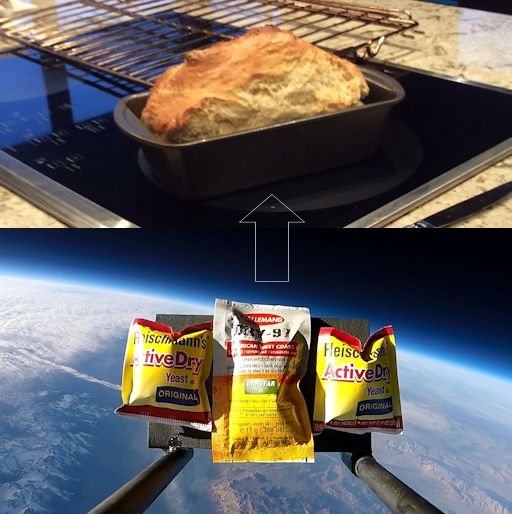
On March 17th, during the strongest geomagnetic storm of the current solar cycle, the students of Earth to Sky Calculus flew a Space Weather Buoy to the stratosphere. Along with radiation detectors and other sensors, the payload carried packets of brewer's and baker's yeast. En route to the stratosphere, the microbes experienced temperatures as low as -63 C and cosmic ray doses 40x Earth-normal.
To support the students' research, Eileen Weingram bought a packet of the baker's yeast. "It made a huge loaf of bread," she says. "Very yummy."
If this story whets your appetite, you can bake some "space bread" of your own. Packets of yeast are still available for only $49.95. Contact Dr. Tony Phillips to place your order--and let the baking begin! All sales support high altitude balloon flights to measure the effect of solar storms on Earth's atmosphere.