DECREASING CHANCE OF STORMS: NOAA forecasters have downgraded the chance of geomagnetic storms today to 35%. A CME expected to hit Earth's magnetic field on April 22nd has either missed or it is approaching much more slowly than expected, setting the stage for a very weak impact. Aurora alerts: text, voice.
VOLCANIC LIGHTNING: For the first time in more than 42 years, the Calbuco volcano in southern Chile has erupted. Two blasts in 24 hours on April 22nd sent plumes of ash and volcanic gases shooting at least 33,000 feet high, well into the altitudes where planes fly. One of the eruptions occured at night and put on a spectacular display of volcanic lightning:
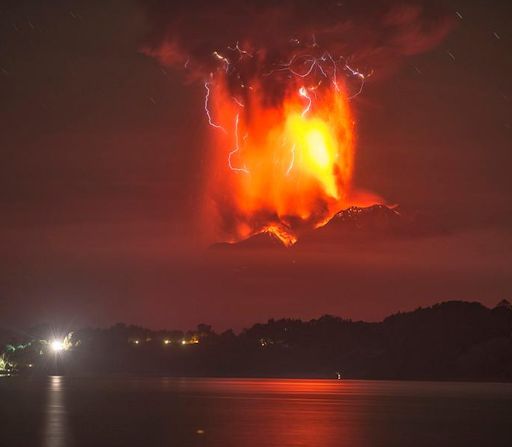
Researchers have long known that volcanic eruptions produce strong lightning. Findings published in a 2012 Eos article reveal that the largest volcanic storms can rival massive supercell thunderstorms in the American midwest. But why? Volcanic lightning is not well understood.
Lightning is nature's way of correcting an imbalance of electric charge. In ordinary thunderstorms, one part of a thundercloud becomes positively charged, and another part becomes negatively charged. This charge comes from collisions between particles: e.g., droplets of water and crystals of ice rub together, creating static electricity in much the same way as woolen socks rubbed against carpet. Lightning arcs between charge-separated regions.
Something similar must be happening inside volcanic plumes. One hypothesis holds that catapulting magma bubbles or volcanic ash are themselves electrically charged, and by their motion create charge-separated areas. Another possibility is that particles of volcanic ash collide with each other and become charged through triboelectric rubbing. In short, no one knows. It is a beautiful and terrifying mystery.
Stay tuned for more images as the eruption of Calbuco continues.
THE EDGE OF THE SUN: Fortunately for Earth, the sun is 93 million miles away. For the past two days, magnetic prominences have been lifting off the surface of the sun big enough to swallow our entire planet. Philippe Tosi photographed this example on April 22nd from the Pyrennes mountains of France:
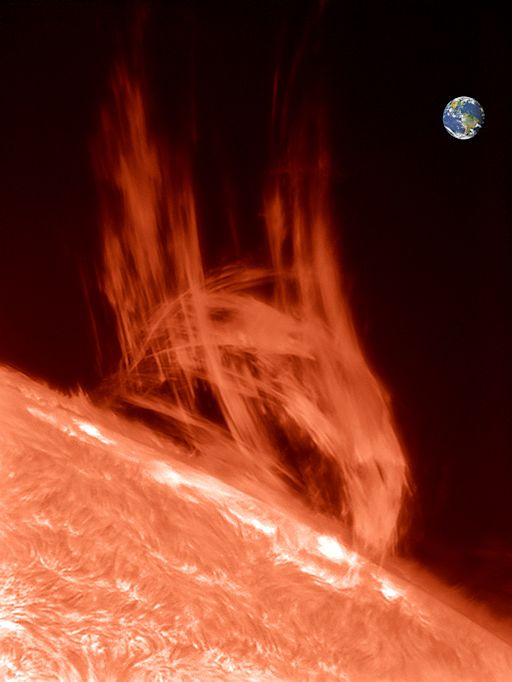
"It was a fantastic eruption," says Tosi.
"We are having a very active sun this week," agrees Jett Aguilar of Quezon City, the Philippines, who photographed two huge prominences yesterday. Bill Hrudey saw even more from his observatory in the Cayman Islands.
The face of the sun is peppered with sunspots--but none of them is active today. Astronomers with backyard solar telescopes are encouraged to monitor the edge. That's where the action is. Solar flare alerts: text, voice.
Realtime Space Weather Photo Gallery
SPACE YEAST MAKES SPACE BREAD: Thought experiment: Suppose you flew a packet of baker's yeast high above Earth's surface, to the edge of space itself, and exposed the microbes to a blast of cosmic rays. Then you made some bread. How would it taste? "Delicious," reports Eileen Weingram of Highland Lakes, New Jersey, who actually did the experiment:
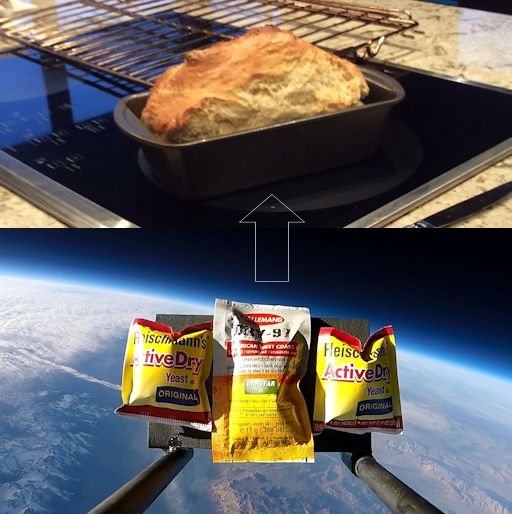
On March 17th, during the strongest geomagnetic storm of the current solar cycle, the students of Earth to Sky Calculus flew a Space Weather Buoy to the stratosphere. Along with radiation detectors and other sensors, the payload carried packets of brewer's and baker's yeast. En route to the stratosphere, the microbes experienced temperatures as low as -63 C and cosmic ray doses 40x Earth-normal.
To support the students' research, Eileen Weingram bought a packet of the baker's yeast. "It made a huge loaf of bread," she says. "Very yummy."
If this story whets your appetite, you can bake some "space bread" of your own. Packets of yeast are still available for only $49.95. Contact Dr. Tony Phillips to place your order--and let the baking begin! All sales support high altitude balloon flights to measure the effect of solar storms on Earth's atmosphere.