MICROBES IN THE STRATOSPHERE: In just a few hours, Spaceweather.com and the students of Earth to Sky Calculus are going to launch a colony of halobacteria to the stratosphere. The purpose of this ongoing experiment is to find out if the terretrial extremophile can survive Mars-like conditions high above Earth's surface. If the answer is "yes," cousins of halobacteria might one day be found on the Red Planet. Stay tuned for updates.
EXPLOSION ON THE SUN: For days, astronomers have been monitoring a magnificent filament of magnetism stretching across the face of the sun. This morning, April 28th, it erupted. NASA's Solar Dynamics Observatory recorded the blast:
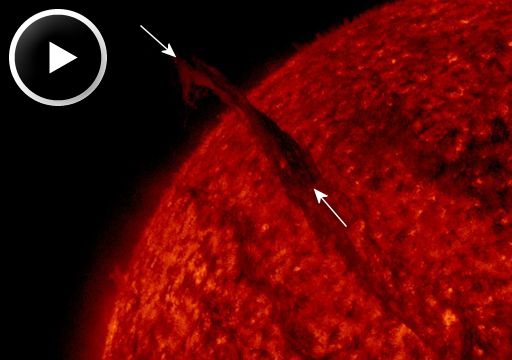
Hurled upward by magnetic instabilities, the erupting filament split the sun's atmosphere, creating a "canyon of fire." The glowing walls of the canyon trace the original channel where the filament was suspended by magnetic forces above the sun's surface. From end to end, the structure stretches more than 350,000 km--a real Grand Canyon:

A coronal mass ejection (CME) is also emerging from the blast site: SOHO image. At first glance, the CME appears to be moving well away from the sun-Earth line. However, coronagraph data are too preliminary to rule out a glancing blow to our planet in the days ahead. Stay tuned for updates. Solar flare alerts: text, voice.

Realtime Space Weather Photo Gallery
STUBBORN AURORAS: On April 27th, Earth passed through a fold in the heliospheric current sheet. This sparked a display of "stubborn auroras" around the Arctic Circle. Thomas Kast sends this picture from Vihiluoto, Finland:
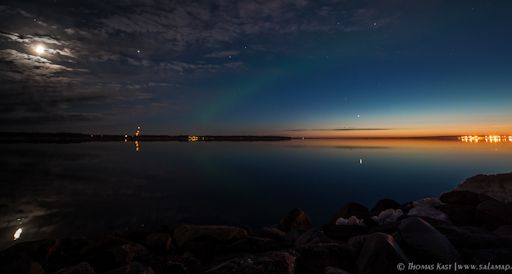
"Bright summer nights are taking over," says Kast. "When I took this photo at 1:28 am, the sun was only 11o below the horizon. As you see in the photo, the aurora not only had to fight against the twilight but also the city lights of Oulu on the right and the bright Moon to its left. "
"For two more days auroras can theoretically be seen here [at latitude +65 N]," he adds.
That might not be enough time. The next display of Arctic auroras is expected three days from now when a minor CME might sideswipe Earth's magnetic field. Just how stubborn can Northern Lights be? Stay tuned. Aurora alerts: text, voice.
VOLCANIC PLUME = COLORFUL SUNSETS: European MetOp satellites have been monitoring aerosols blasted into the atmosphere by Chile's Calbuco volcano on April 22nd. This 5-day movie shows a plume of sulfur dioxide spreading east from Chile to Brazil:

Credit: The Global Ozone Monitoring Experiment-2 (GOME-2) onboard MetOp-A and MetOp-B
The effect of this plume on Brazilian sunsets has been dramatic. Helio C. Vital of Rio de Janeiro reports: "Pushed by strong winds, aerosols from Calbuco reached Rio on April 26th and produced an spectacular display of bright unusual colors across most of the western sky during evening twilight. The red-magenta glow lasted until an hour after local sunset."
This is what he saw:
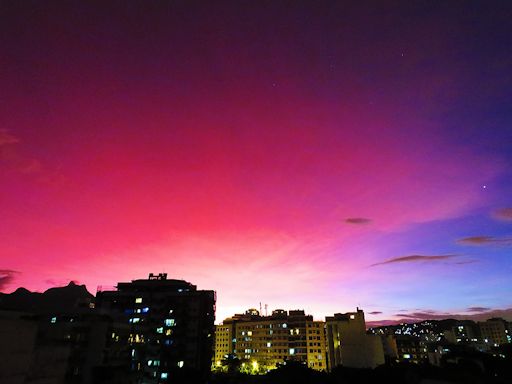
As the sun set and the twilight faded, Jupiter and the Moon over Rio were surrounded by a distinctly purple hue.
Purple is one of the telltale signs of a volcanic sunset. Fine volcanic aerosols in the stratosphere scatter blue light which, when mixed with ordinary sunset red, produces a violet hue. But purple isn't the only thing to look for, says atmospheric optics expert Les Cowley. In addition, he advises, sky watchers in Chile and Brazil should "be alert for a very bright yellow twilight arch, fine cloud structure in the arch seen through binoculars, and long diffuse rays and shadows."
Stay tuned for updates from beneath the volcanic plume.
Realtime Space Weather Photo Gallery