CME TO MISS EARTH: Yesterday, a massive filament of plasma exploded away from the sun's northeastern limb. The CME it hurled into space (movie) is not expected to hit Earth. Geomagnetic activity should remain low for the next 3 days as the CME sails wide of our planet. Aurora alerts: text, voice.

ALMOST-BLANK SUN: The sunspot number is plummeting toward zero. Only a few dark cores are peppering the face of the sun, and they are so small you might have trouble finding them in this April 29th image of the sun:

Almost no sunspots = almost no solar activity. The sun's X-ray output has flatlined, and NOAA forecasters estimate a scant 1% chance of strong flares in the next 24 hours.

If the sunspot number continues to drop, the sun could become completely blank. Blank, spotless suns are a sign that Solar Max is ending. Stay tuned for ... quiet? Solar flare alerts: text, voice.
Realtime Space Weather Photo Gallery
VOLCANIC GAS CROSSES THE ATLANTIC: European MetOp satellites have been monitoring aerosols blasted into the atmosphere by Chile's Calbuco volcano on April 22nd. A new 7-day movie shows a plume of sulfur dioxide crossing the Atlantic from South America to Africa:

Credit: The Global Ozone Monitoring Experiment-2 (GOME-2) onboard MetOp-A and MetOp-B
South Africans should be alert for "volcanic sunsets" in the evenings ahead when the plume reaches the tip of their continent.
When the plume crossed Brazil, it produced "an impressive display of bright exotic colors in the evening twilight sky," reports Helio C. Vital of Rio de Janeiro, Brazil. This is what he saw on April 27th:
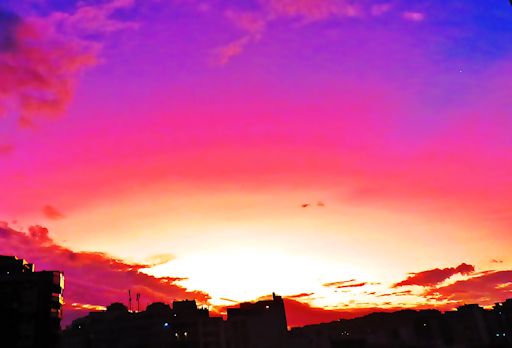
Many of Vital's photos show a distinctly purple hue. That is one of the telltale signs of a volcanic sunset. Fine volcanic aerosols in the stratosphere scatter blue light which, when mixed with ordinary sunset red, produces a violet hue. But purple isn't the only thing to look for, says atmospheric optics expert Les Cowley. In addition, he advises, sky watchers should "be alert for a very bright yellow twilight arch, fine cloud structure in the arch seen through binoculars, and long diffuse rays and shadows."
Stay tuned for updates from beneath the volcanic plume.
Realtime Space Weather Photo Gallery
MICROBES LAUNCHED TO THE STRATOSPHERE: On Tuesday afternoon, April 28th, Spaceweather.com and the students of Earth to Sky Calculus launched a colony of halobacteria 110,000 feet above Earth's surface. Why send microbes to the edge of space? For answers, scroll past the launch photo:

The purpose of this ongoing experiment is to find out if halobacteria can survive Mars-like conditions high above Earth's surface. If the answer is "yes," cousins of the terrestrial extremophile might one day be found on the Red Planet.
Some of the microbes traveling onboard the payload, pictured above, have been to the edge of space 3 times, where they have experienced sustained temperatures as low as -63 C and intense doses of cosmic radiation more than 40x Earth-normal. Can they survive this kind of treatment? Stay tuned for updates.