QUIET, NOT BORING: For the past few days, the sun has been very quiet. Quiet, however, doesn't mean boring. Low solar activity can have a huge effect on Earth. During periods of sustained quiet, cosmic rays increase, space junk accumulates, and the ionosphere collapses. To learn more about the surpising potency of the spotless sun, read "The Solar Cycle Turned Sideways."
MICROBES TRAVEL TO THE EDGE OF SPACE, CRASH-LAND: In an ongoing series of high-altitude balloon flights, Spaceweather.com and the students of Earth to Sky Calculus have been stress-testing halobacteria, an extremophile with an appetite for salt and UV rays. Here are some samples on April 28th, more than 100,000 feet above Earth's surface, absorbing 40x more cosmic radiation than control samples back home:

Repeatedly, the students have cultured these microbes and found that near-space flight agrees with them. For instance, the pink film in this petri dish are colonies of flown halobacteria, thriving post-flight.

Now, however, the students have found something that halobacteria cannot survive. A crash landing:
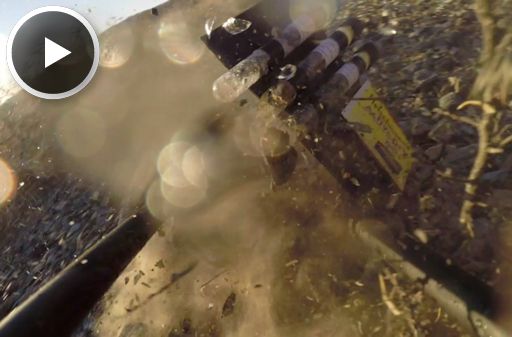
Two of the three test tubes shattered when they came down on a bed of sharp volcanic rock in the foothills of California's White Mountains. Talk about an unlucky break.
The test tubes were carrying microbes that had been aloft before--part of an experiment to see if halobacteria can survive multiple trips to the stratosphere. This is of interest to astrobiologists because conditions in Earth's stratosphere (temperature, pressure and radiation) are remarkably similar to the surface of Mars. If halobacteria can survive 100,000 feet above Earth, they might be able to survive on the Red Planet, too.
Now the payload is being re-designed to improve the cushioning of the test tubes, and soon a new batch of microbes will be flown to reboot and resume the research. After all, you can't keep a good extremophile down....
HOW DO WE PAY FOR THIS? All of the high-altitude balloon research featured on Spaceweather.com is crowd-funded, mainly by ordinary people and small businesses. The April 28th flight, for instance, was sponsored by a sail-cloth company in Hawaii. They donated $500 and, in return, we flew their logo to the edge of space: image. Would you like to become a sponsor? Contact Dr Tony Phillips for details.

Realtime Space Weather Photo Gallery
VOLCANIC GAS CROSSES THE ATLANTIC: European MetOp satellites have been monitoring aerosols blasted into the atmosphere by Chile's Calbuco volcano on April 22nd. A new 8-day movie shows a plume of sulfur dioxide (SO2) crossing the Atlantic from South America to Africa:

Credit: The Global Ozone Monitoring Experiment-2 (GOME-2) onboard MetOp-A and MetOp-B
South Africans should be alert for "volcanic sunsets" in the evenings ahead when the plume reaches the tip of their continent.
When the plume crossed Brazil, it produced "an impressive display of bright exotic colors in the evening twilight sky," reports Helio C. Vital of Rio de Janeiro, Brazil. This is what he saw on April 27th:
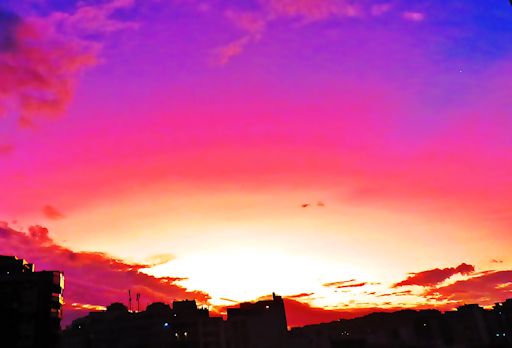
Many of Vital's photos show a distinctly purple hue. That is one of the telltale signs of a volcanic sunset. Fine volcanic aerosols in the stratosphere scatter blue light which, when mixed with ordinary sunset red, produces a violet hue. But purple isn't the only thing to look for, says atmospheric optics expert Les Cowley. In addition, he advises, sky watchers should "be alert for a very bright yellow twilight arch, fine cloud structure in the arch seen through binoculars, and long diffuse rays and shadows."
South African sunsets will probably be less vivid than their Brazilian counterparts, because the plume has spread out during its transit across the Atlantic. Stay tuned for updates. Solar flare alerts: text, voice