QUIET, NOT BORING: For the past few days, the sun has been very quiet. Quiet, however, doesn't mean boring. Low solar activity can have a huge effect on Earth. During periods of sustained quiet, cosmic rays increase, space junk accumulates, and the ionosphere collapses. To learn more about the surpising potency of the spotless sun, read "The Solar Cycle Turned Sideways." Solar flare alerts: text, voice
THE NEPAL EARTHQUAKE AND SPACE WEATHER: High above Earth, more than 60 km above sea level, there is a layer of our planet's atmosphere called "the ionosphere." It is where UV radiation from the sun strips electrons away from the atoms of normal air, creating a zone of charged gas that envelopes the globe.
The ionosphere is very sensitive to solar storms. Turns out, it can be sensitive to earthquakes, too. NASA is reporting that the magnitude 7.8 earthquake in Nepal on April 25th created waves of energy that penetrated the ionosphere and disturbed the distribution of electrons. Note the wave pattern, circled, in the upper panel of this ionospheric electron density plot:

Basically, these are waves of electron density rippling from a point in the ionosphere above the epicenter of the quake. The waves were measured by a science-quality GPS receiver in Lhasa, Tibet. It took about 21 minutes for the waves to travel 400 miles between the epicenter and the GPS receiving station.
The bottom panel of the plot is a "dynamic spectrum." Note the hot spots outlined in black. They show that the ionosphere was ringing with periods of ~2 and ~8 minutes. Presumably, these "tones" are related to atmospheric pressure waves billowing up from the trembling Earth below.
The ionosphere is the stage upon which much of space weather plays out. Auroras, meteors, and noctilucent clouds all occur there. The "Ionosphere Natural Hazards Team" at JPL studies how Earth itself affects this stage via earthquakes, volcanoes and tsunamis. You can read their report about the Nepal earthquake here.
Realtime Space Weather Photo Gallery
MICROBES TRAVEL TO THE EDGE OF SPACE, CRASH-LAND: In an ongoing series of high-altitude balloon flights, Spaceweather.com and the students of Earth to Sky Calculus have been stress-testing halobacteria, an extremophile with an appetite for salt and UV rays. Here are some samples on April 28th, more than 100,000 feet above Earth's surface, absorbing 40x more cosmic radiation than control samples back home:

Repeatedly, the students have cultured these microbes and found that near-space flight agrees with them. For instance, the pink film in this petri dish are colonies of flown halobacteria, thriving post-flight.

Now, however, the students have found something that halobacteria cannot survive. A crash landing:
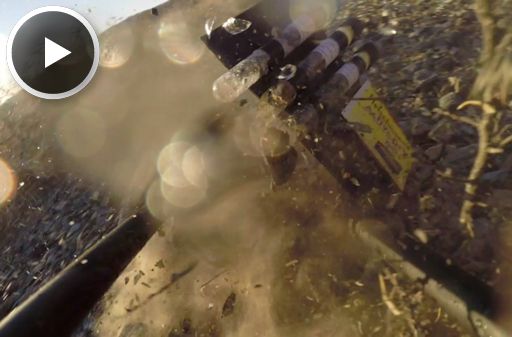
Two of the three test tubes shattered when they came down on a bed of sharp volcanic rock in the foothills of California's White Mountains. Talk about an unlucky break.
The test tubes were carrying microbes that had been aloft before--part of an experiment to see if halobacteria can survive multiple trips to the stratosphere. This is of interest to astrobiologists because conditions in Earth's stratosphere (temperature, pressure and radiation) are remarkably similar to the surface of Mars. If halobacteria can survive 100,000 feet above Earth, they might be able to survive on the Red Planet, too.
Now the payload is being re-designed to improve the cushioning of the test tubes, and soon a new batch of microbes will be flown to reboot and resume the research. After all, you can't keep a good extremophile down....
HOW DO WE PAY FOR THIS? All of the high-altitude balloon research featured on Spaceweather.com is crowd-funded, mainly by ordinary people and small businesses. The April 28th flight, for instance, was sponsored by a sail-cloth company in Hawaii. They donated $500 and, in return, we flew their logo to the edge of space: image. Would you like to become a sponsor? Contact Dr Tony Phillips for details.
