GEOMAGNETIC ACTIVITY: A minor geomagnetic storm is in progress on May 6th following the arrival of a CME at 01:43 UT. The CME's weak impact did not immediately spark bright auroras. However, storming could intensify as Earth passes through the CME's wake. Aurora alerts: text, voice
X-FLARE: The sun is no longer quiet. Emerging sunspot AR2339 unleashed an intense X2-class solar flare on May 5th at 22:11 UT. NASA's Solar Dynamics Observatory captured the extreme ultraviolet flash:

A pulse of UV radiation and X-rays from the flare caused a strong radio blackout over the Pacific side of Earth. This map shows the extent of the blackout, which affected frequencies below 20 MHz. Mariners, aviators, and ham radio operators are the type of people who might have noticed the disturbance.

The explosion also hurled a CME into space: movie. Traveling faster than 1100 km/s (2.5 million mph), the expanding cloud does not appear to be heading for Earth. Solar flare alerts: text, voice

In addition to causing a radio blackout, the flare also caused a radio burst. Immediately after the flare, a roar of static bellowed from the loudspeakers of shortwave receivers on Pacific isles and western parts of North America. Amateur radio astronomer Thomas Ashcraft of New Mexico recorded the outburst:

"The sound file is in stereo with one channel at 22 MHz and the other at 23 MHz," says Ashcraft. "It is very intricate if listened to with headphones."
What caused this burst of "solar static"? The same magnetic explosion that caused the flare also produced beams of electrons. As the electrons sliced through the sun's atmosphere, they generated a ripple of radio-loud plasma waves. Astronomers classify solar radio bursts into five types; this one was a mixture of Type III and Type V.
Realtime Space Weather Photo Gallery
PHOTOGRAPHING THE PRECESSION OF EARTH: The North Star is Polaris, but it wasn't always Polaris. Thousands of years ago, the spin axis of Earth pointed toward another star--brilliant Vega. This is because Earth, akin to a spinning top, slowly wobbles or "precesses". Astrophotographer Miguel Claro has long wondered what the sky would look like if Vega were still the North Star.
"After a long time of burning my mind with new ideas," says Claro. "I figured out how I could do it, developing what I think is, a totally new astrophotographic technique." Here it is:

This is a camera mounted on two clock drives. The axis of one clock drive points at Polaris, and rotates opposite to the spin of Earth. This freezes the motion of stars around today's North Star. The axis of the second clock drive points at Vega, and transfers the spin of our planet there. This contraption allowed Claro to compare the North Stars, Polaris vs. Vega, in the form of star trails:
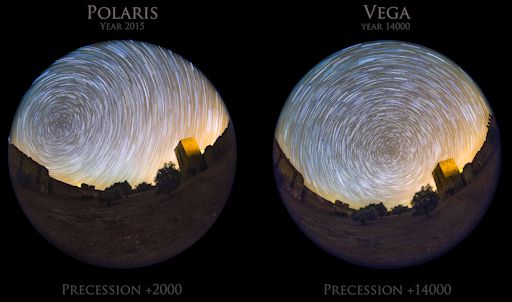
"All the images were taken from the Mourão Castle, in the Dark Sky Alqueva Reserve, the First Starlight Tourism Destination in the world, in Alentejo, Portugal," says Claro.
Claro's multi-drive system causes the landscape to move during the exposure. "I made a mask merging the landscape with the first frame to have a more pleasant result," he explains. More information about his technique may be found here.
Earth wobbles with a period of about 26,000 years. In only 14,000 years, Vega will become the North Star again. Thank you, Miguel Claro, for the preview.