CME AND COSMIC RAYS: A CME impact during the early hours of May 6th sparked a minor geomagnetic storm. The storm is subsiding on May 7th as Earth exits the CME's wake. Interestingly, one side-effect of the CME is lingering: The solar storm cloud swept away some of the cosmic rays surrounding Earth. According to ground-based neutron monitors, cosmic ray counts are down ~4%. Aurora alerts: text, voice
BIG SUNSPOT, CHANCE OF FLARES: Yesterday, sunspot AR2339 unleashed an intense X2-class solar flare. It might not be finished. The active region has doubled in size since yesterday, and it has a 'beta-gamma' magnetic field that harbors energy for more eruptions. Amateur astronomer Philippe Tosi sends this picture of the behemoth sunspot from his backyard in Nîmes, France:
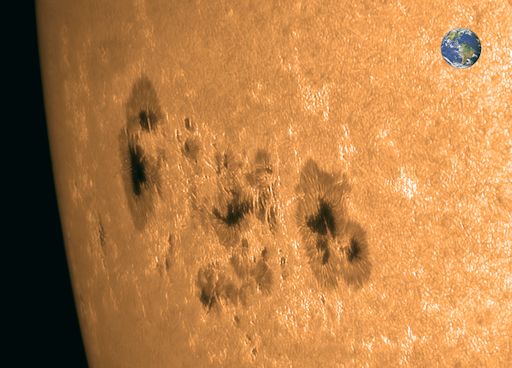
As the blue-circular insert shows, several of the sunspot's dark cores are larger than Earth itself. From end to end, the sunspot group sprawls more than 100,000 km. These dimensions make it an easy target for backyard solar telescopes. If you have one, take a look. You might catch some action. NOAA forecasters estimate a 55% chance of M-class flares and a 10% chance of X-flares on May 7th. Solar flare alerts: text, voice
Realtime Space Weather Photo Gallery
PHOTOGRAPHING THE PRECESSION OF EARTH: The North Star is Polaris, but it wasn't always Polaris. Thousands of years ago, the spin axis of Earth pointed toward another star--brilliant Vega. This is because Earth, akin to a spinning top, slowly wobbles or "precesses". Astrophotographer Miguel Claro has long wondered what the sky would look like if Vega were still the North Star.
"After a long time of burning my mind with new ideas," says Claro. "I figured out how I could do it, developing what I think is, a totally new astrophotographic technique." Here it is:

This is a camera mounted on two clock drives. The axis of one clock drive points at Polaris, and rotates opposite to the spin of Earth. This freezes the motion of stars around today's North Star. The axis of the second clock drive points at Vega, and transfers the spin of our planet there. This contraption allowed Claro to compare the North Stars, Polaris vs. Vega, in the form of star trails:
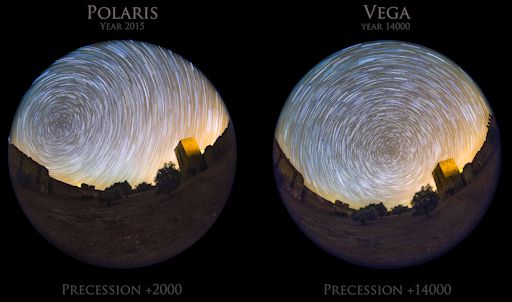
"All the images were taken from the Mourão Castle, in the Dark Sky Alqueva Reserve, the First Starlight Tourism Destination in the world, in Alentejo, Portugal," says Claro.
Claro's multi-drive system causes the landscape to move during the exposure. "I made a mask merging the landscape with the first frame to have a more pleasant result," he explains. More information about his technique may be found here.
Earth wobbles with a period of about 26,000 years. In only 14,000 years, Vega will become the North Star again. Thank you, Miguel Claro, for the preview.