GREEN AURORAS ON MARS: One day, when humans go to Mars, they might find that the Red Planet has green skies. NASA's MAVEN spacecraft has discovered widespread auroras on Mars--and not where researchers expected them to be. Get the full story from Science@NASA.
RED AURORAS ON EARTH: Most auroras are green. On May 10th, Alan Dyer witnessed an unusual display of red. "From my observing site near Gleichen, Alberta, the northern sky had a diffuse glow of normal green aurora," reports Dyer. "But overhead, the aurora took the form of a red arc across the sky." He captured the phenomenon in this 40 minute star-trailed exposure:
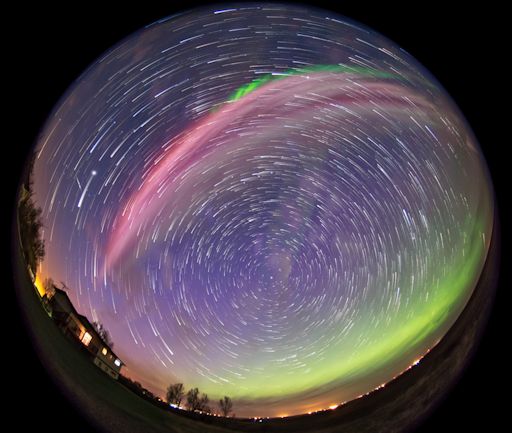
Red auroras are not fully understood. They occur some 300 to 500 km above Earth's surface, much higher than ordinary green auroras. Some researchers believe the red lights are linked to low energy electrons from the sun, which move too slowly to penetrate deeply into the atmosphere. When such electrons recombine with oxygen ions in the upper atmosphere, red photons are emitted. At present, space weather forecasters cannot predict when this will occur.
High-latitude sky watchers should be alert for more unusual displays tonight. An interplanetary shock wave hit Earth's magnetic field during the early hours of May 12th (~0145 UT), setting the stage for auroras. NOAA forecasters estimate a 60% chance of geomagnetic storms. Aurora alerts: text, voice
Realtime Space Weather Photo Gallery
MICROBES RETURN TO THE STRATOSPHERE: You can't keep a good extremophile down. On May 6th, six tiny vials of halobacteria returned to the stratosphere onboard an Earth to Sky Calculus suborbital helium balloon. Following a disastrous crash just one week earlier, the microbes reached an altitude of 110,962 feet:

This is part of an ongoing experiment to see if halobacteria can survive multiple trips to the edge of space. Astrobiologists are interested because conditions in Earth's stratosphere (temperature, pressure and cosmic radiation) are remarkably similar to the surface of Mars. If halobacteria can survive more than 100,000 feet above Earth, they might be able to survive on the Red Planet, too.
After a 2.5 hour flight, the microbes parachuted back to Earth, soft-landing not far from the Eureka Dunes in California's Death Valley National Park. A team of students from Earth to Sky Calculus recovered the microbes on the same day.
Now the analysis begins. After the recovery, two of the vials were immediately flown across the USA to the University of Maryland, where microbiologists Priya and Shil DasSarma are culturing the microbes. In their state-of-the-art lab, which is supported by NASA, the DasSarmas will analyze the samples for mutations and other changes resulting from the trip to the edge of space. At the same time, the students of Earth to Sky Calculus will conduct a parallel investigation in California using samples they kept for themselves. This collaboration between Spaceweather.com, Earth to Sky Calculus, and the DasSarmas could lead to some interesting astrobiological discoveries.
THIS RESEARCH IS CROWD-FUNDED: How do we pay for these flights? Actually, you pay for them. Readers of Spaceweather.com, mainly private individuals and small businesses, sponsor each and every research flight to the stratosphere. Our latest astrobiology launch was made possible by S2 Maui, a windsurf sail design company. Here is their logo sailing the thin air at 100,000 feet:

The logo is made of a new lightweight windsurf fabric called "SpaceLight," developed by S2 Maui's designer, Artur Szpunar, together with US-based sail cloth manufacturer, Dimension Polyant. Visiting the stratosphere was not only an opportunity to show S2 Maui's logo at the edge of space, but also a chance to expose the fabric to high doses of UV radiation at the top of Earth's atmosphere. "This was a valuable test of our new material in an appropriate environment," says Szpunar.
Become a sponsor: Readers, if you would like to sponsor a flight and see your logo at the edge of space, the cost is only $500. All proceeds go to cutting-edge student research. Contact Dr. Tony Phillips for details.