CHANCE OF STORMS ON MAY 17th: NOAA forecasters estimate a 45% chance of polar geomagnetic storms on May 17th when a CME is expected to deliver a glancing blow to Earth's magnetic field. The CME was hurled in our direction by a magnetic filament, which erupted away from the sun on May 13th. Aurora alerts: text, voice
SPRITE SEASON BEGINS: High above Earth in the realm of meteors and noctilucent clouds, a strange and beautiful form of lightning dances at the edge of space. Researchers call the bolts "sprites"; they are red, fleeting, and tend to come in bunches. Note to sky watchers: Sprite season is underway. Martin Popek photographed these specimens over Nydek, Czech republic, on May 13th:
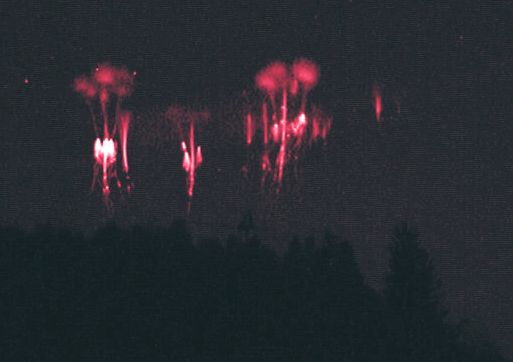
One night later, May 14th, near Santa Fe, New Mexico, "I captured my first sprites of the season," reports photographer Jan Curtis. "The thunderstorm that produced them was about 200 miles to my south-southwest."
Because sprites are associated with thunderstorms, they tend to occur in late spring and summer. Thunderstorm season is sprite season.
"Sprites are a true space weather phenomenon," explains lightning scientist Oscar van der Velde of the Technical University of Catalonia, Spain. "They develop in mid-air around 80 km altitude, growing in both directions, first down, then up. This happens when a fierce lightning bolt draws lots of charge from a cloud near Earth's surface. Electric fields [shoot] to the top of Earth's atmosphere--and the result is a sprite. The entire process takes about 20 milliseconds."
Although sprites have been seen for at least a century, most scientists did not believe they existed until after 1989 when sprites were photographed by cameras onboard the space shuttle. Now "sprite chasers" routinely photograph sprites from their own homes. "I used up a Watec 910HX security camera with UFOCapture software to catch my sprites," says Popek. Give it a try!
diagram: How to Look for Sprites (used with permission of sky-fire.tv)

VOLCANIC SUNSETS: Last month, on April 22nd, Chile's erupting Calbuco volcano blew plumes of ash and sulfurous gas more than 50,000 feet high. Since then, the swirling plumes have been spreading around the southern hemisphere. They are quite diffuse now, but still dense enough to color the sunsets of countries where they pass overhead. Just a few evenings ago, Dr. Peter Lowenstein witnessed a volcanic sunset over Murambi East, Mutare, Zimbabwe:

"Zimbabwe continues to have vivid sunsets caused by aerosols from the 22 April eruption of the Calbuco volcano," says Lowenstein. "This movie, which I made on May 10th, is a time lapse sequence of 28 photographs taken at about 20 second intervals."
The purple hue we see in Lowenstein's movie is one of the telltale signs of a volcanic sunset. Fine volcanic aerosols in the stratosphere scatter blue light which, when mixed with ordinary sunset red, produces a violet hue. Purple isn't the only color, though. Volcanic sunsets can also include a bright yellow twilight arch and long diffuse rays and shadows. All of these appeared over Zimbabwe.
Sky watchers in southern Africa, Argentina, Chile, southern parts of Brazil, Australia and New Zealand should remain alert for similar displays as Calbuco's fumes circumnavigate the southern hemisphere. Eventually the aerosols will dissipate. For now, however, the sunsets continue.
Realtime Space Weather Photo Gallery