UNSETTLED SOLAR WIND: Earth is passing through a stream of unsettled solar wind, and this is causing intermittent geomagnetic storms around the poles. May 19th began with a G2-class storm that is subsiding now, but could flare up again in the hours ahead. High-latitude sky watchers should remain alert for auroras. Aurora alerts: text, voice
SPRITE SEASON BEGINS: High above Earth in the realm of meteors and noctilucent clouds, a strange and beautiful form of lightning dances at the edge of space. Researchers call the bolts "sprites"; they are red, fleeting, and tend to come in bunches. Note to sky watchers: Sprite season is underway. Martin Popek photographed these specimens over Nydek, Czech republic, on May 13th:
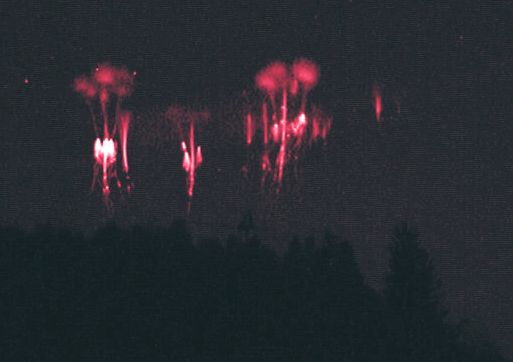
One night later, May 14th, near Santa Fe, New Mexico, "I captured my first sprites of the season," reports photographer Jan Curtis. "The thunderstorm that produced them was about 200 miles to my south-southwest."
Because sprites are associated with thunderstorms, they tend to occur in late spring and summer. Thunderstorm season is sprite season.
"Sprites are a true space weather phenomenon," explains lightning scientist Oscar van der Velde of the Technical University of Catalonia, Spain. "They develop in mid-air around 80 km altitude, growing in both directions, first down, then up. This happens when a fierce lightning bolt draws lots of charge from a cloud near Earth's surface. Electric fields [shoot] to the top of Earth's atmosphere--and the result is a sprite. The entire process takes about 20 milliseconds."
Although sprites have been seen for at least a century, most scientists did not believe they existed until after 1989 when sprites were photographed by cameras onboard the space shuttle. Now "sprite chasers" routinely photograph sprites from their own homes. "I used up a Watec 910HX security camera with UFOCapture software to catch my sprites," says Popek. Give it a try!
diagram: How to Look for Sprites (used with permission of sky-fire.tv)

MICROBES VISIT THE STRATOSPHERE, CHANGE COLOR: On May 16th, Spaceweather.com and the students of Earth to Sky Calculus flew more than 108 halobacteria to the edge of space. During the flight, a GoPro camera snapped this picture of the microscopic astronauts 110,466 feet above Earth's surface:

The microbes spent 2 hours in the stratosphere before parachuting back to Earth, landing in Death Valley. A first look at the samples, post-flight, confirms a finding from previous trips: When halobacteria visit the stratosphere, they change color.
Halobacteria are normally pink. They get their distinctive color from a molecule they contain called bacteriorhodopsin--a light sensitive protein that helps halobacteria convert light into chemical energy. Somehow, traveling to the edge of space causes the pink to go away. The effect is shown in this sequence of images:

Note how the halobacteria broth is pink when it launches and wan yellow when it lands. The color change doesn't mean the microbes have been wiped out. On the contrary, the students have shown many times that halobacteria survive near-space travel.
What's going on? To investigate, the students flew the microbes inside three different kinds of test tubes: (1) Pyrex, which is opaque to UV rays, (2) quartz, which is transparent to UV rays, and (3) a lead-shielded test tube, which blocks cosmic rays. Differences may reveal which type of space radiation interacts with bacteriorhodopsin to produce the color change and, moreover, how the microbes survive "tampering" with such a key bio-molecule.
Later this week, University of Maryland microbiologists Shil and Priya DasSarma will receive samples from the flight. In their state-of-the-art lab, which is supported by NASA, the DasSarmas will analyze the samples for mutations and other changes resulting from the trip to the edge of space. Understanding the color change is a key goal of their investigation.
Stay tuned for updates from this crowd-funded, student-led research.
Realtime Space Weather Photo Gallery