SUNSET SKY SHOW: When the sun goes down tonight, step outside and face west. The slender crescent Moon is shining through the twilight directly below Venus. Kouji Ohnishi sends this picture from Sugadaira, Nagano, Japan:
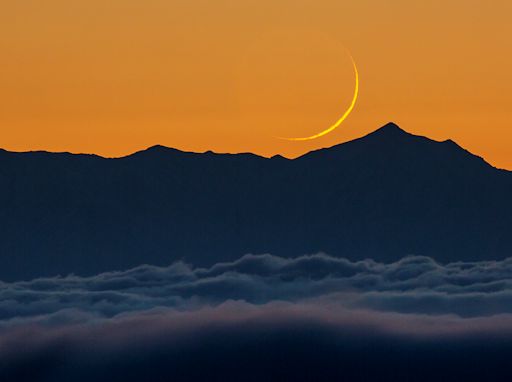
"The crescent moon was floating on a sea of clouds--very beautiful," says Ohnishi. "The mountains are Japan's Northern Alps."
Take a look! It's a nice way to end the day. [photo gallery]
DEEP SKY AURORAS: A solar wind stream hit Earth's magnetic field on May 18-19, sparking a G2-class geomagnetic storm. At the peak of the storm, Northern Lights crossed the Canadian Border into the USA. "The lights were faint, but beautiful," reports Donny Mott, who made a movie of the display over Spirit Lake, Idaho:
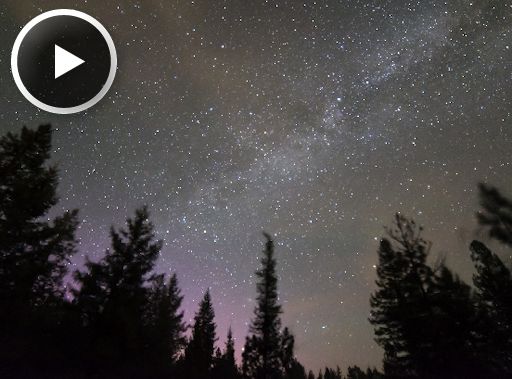
These are deep-sky auroras, barely visible to the human eye but an easy target for backyard cameras. "I used 13 second exposures at ISO 6400," says Mott. With those settings, his Sony A7s digital camera also picked up the Milky Way and the Andromeda galaxy. Both can be seen rising through the auroras in his time-lapse movie.
Geomagnetic activity is waning as Earth exits the solar wind stream. This means the only auroras for the next few nights will be of the faint, deep-sky variety. Photographers, crank up your exposure times and, if anything appears, submit your images here. Aurora alerts: text, voice
SPRITE SEASON BEGINS: High above Earth in the realm of meteors and noctilucent clouds, a strange and beautiful form of lightning dances at the edge of space. Researchers call the bolts "sprites"; they are red, fleeting, and tend to come in bunches. Note to sky watchers: Sprite season is underway. Martin Popek photographed these specimens over Nydek, Czech republic, on May 13th:
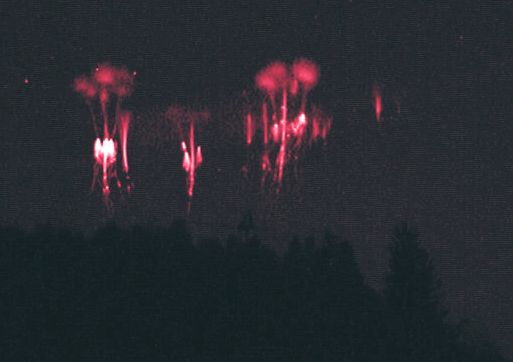
One night later, May 14th, near Santa Fe, New Mexico, "I captured my first sprites of the season," reports photographer Jan Curtis. "The thunderstorm that produced them was about 200 miles to my south-southwest."
Because sprites are associated with thunderstorms, they tend to occur in late spring and summer. Thunderstorm season is sprite season.
"Sprites are a true space weather phenomenon," explains lightning scientist Oscar van der Velde of the Technical University of Catalonia, Spain. "They develop in mid-air around 80 km altitude, growing in both directions, first down, then up. This happens when a fierce lightning bolt draws lots of charge from a cloud near Earth's surface. Electric fields [shoot] to the top of Earth's atmosphere--and the result is a sprite. The entire process takes about 20 milliseconds."
Although sprites have been seen for at least a century, most scientists did not believe they existed until after 1989 when sprites were photographed by cameras onboard the space shuttle. Now "sprite chasers" routinely photograph sprites from their own homes. "I used up a Watec 910HX security camera with UFOCapture software to catch my sprites," says Popek. Give it a try!
diagram: How to Look for Sprites (used with permission of sky-fire.tv)

Realtime Space Weather Photo Gallery