VERY QUIET SUN: With no sunspots actively flaring, the sun's X-ray output has flatlined. Solar activity is very low and likely to remain so for the next 24 hours. According to NOAA forecasters, the chance of an X-class flare on May 25th is no more than 1%. Solar flare alerts: text, voice

POLLEN CORONAS: It begins with a sneeze. Pollen floating through the air tickles your nose, and your body responds by expelling the allergen. Gesundheit! When the paroxysm subsides, look up at the sky. The same pollen that makes you sneeze can also make beautiful coronas around the sun, like this one photographed on May 24th by Peter Paul Hattinga Verschure of Deventer, the Netherlands:
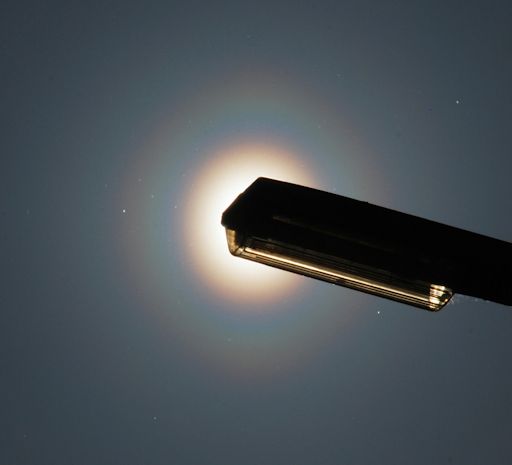
"Springtime pollen was drifting through the air of Deventer," says Verschure. "Hiding the sun behind a lamp post revealed this corona no more than 3 degrees wide." Sharpening the image uncovers an even wider network of colorful rings: click here.

Atmospheric optics expert Les Cowley explains the phenonenon: "Coronas are produced when light waves scatter from the outsides of small particles. Tiny droplets of water in clouds make most coronas, but opaque equal-sized pollen grains do even better. They make small but very colorful multi-ringed coronas."
"Unlike water droplets, pollens are non-spherical--and this adds to their magic," he continues. "Many have air sacs to help carry them in the wind. These align the grains to give beautiful elliptical coronas with bright spots." This is why Verschure's pollen corona looks the way it does.
As northern spring unfolds, pollen coronas become increasingly common. Look for them the next time your nose feels a tickle.
Realtime Space Weather Photo Gallery
VOLCANIC GAS CIRCUMNAVIGATES THE GLOBE: Last month, on April 22nd, Chile's Calbuco volcano erupted, blowing plumes of ash and sulfurous gas more than 50,000 feet high. Since then, the swirling plumes have spread around the southern hemisphere--traveling eastward from South America to southern Africa to Australia/New Zealand. Just a few days ago, the plumes completed the circle.
"We are seeing volcanic sunsets again in Rio," reports Brazilian photographer Helio de Carvalho Vital, who took this picture on May 17th:

Back in April, Vital was among the first to notice colorful sunsets in the immediate aftermath of Calbuco. "I spotted the first effects of the volcano on April 24 and monitored the bulk of the plume on April 26, 27 and 28 as it was heading east. Colorful sunsets were visible from Rio for a week after that."
A primary color of volcanic sunsets is purple: Fine volcanic aerosols in the stratosphere scatter blue light which, when mixed with ordinary sunset red, produces a violet hue. Purple isn't the only color, though. Volcanic sunsets can also include a bright yellow twilight arch and long diffuse rays and shadows.
After a 3 week intermission, purple has returned to Brazil. "It is subtle," notes Vital. "A camera is required to fully capture the effect. This suggests that the plumes are now much more tenuous than three weeks ago."
A purple sighting last night in New Zealand further suggests that Calbuco's exhaust is thinly spread around the southern hemisphere. Photographers in southern Africa, Argentina, Chile, southern parts of Brazil, and Australia should remain alert for similar displays.
Realtime Space Weather Photo Gallery