QUIET WITH A SLIGHT CHANCE OF STORMS: NOAA forecasters estimate a 30% chance of polar geomagnetic storms on May 29th when a minor solar wind stream is expected to hit Earth's magnetic field. Otherwise, solar and geomagnetic activity is very low. Aurora alerts: text, voice
RADAR ECHOES FROM THE NOCTILUCENT ZONE: Every summer since the late 1970s, radars probing Earth's upper atmosphere have detected strong echoes from altitudes between 80 km and 90 km. These altitudes comprise the "noctilucent zone," where water vapor crystallizes around meteor smoke to form icy noctilucent clouds (NLCs). The first NLCs of the 2015 northern summer season were spotted by NASA's AIM spacecraft on May 19th. The radar echoes have followed close behind.
Les Dean of the MST Radar Facility in Aberystwyth, Wales, reports: "We detected our first echoes of the summer season on May 26th."
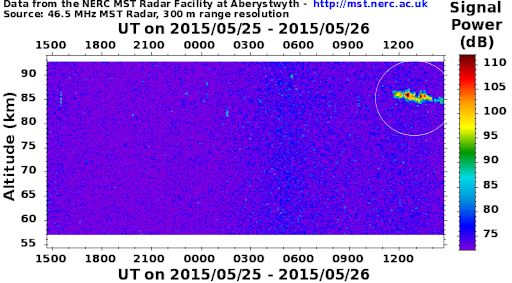
Researchers call them "Polar Mesospheric Summer Echoes" or "PMSEs." They occur over the Arctic during the months of May through August, and over the Antarctic during the months of November through February. These are the same months that NLCs appear.
But do the radar echoes actually come from noctilucent clouds? "The association is controversial," notes Dean. A leading theory holds that the ice particles in noctilucent clouds are electrically charged, and this makes them good reflectors of HF radio waves. However, NLCs are not always visible when the radar echoes are observed and vice versa. So the connection is not clear-cut.
One thing is sure: the season for both NLCs and PMSEs has begun. Stay tuned for more echoes from the noctilucent zone.
UPDATE: Using a forward-scatter meteor radar, Rob Stammes has also detected unusual reflections above the Polarlightcenter in Lofoten, Norway. See the data.
Realtime Space Weather Photo Gallery
GIANT FILAMENT IN 3D: The biggest thing on the sun today is not a sunspot. (In fact, the sun is almost completely spotless, but that's another story.) It's a vast filament of magnetism stretching almost 700,000 km across the solar disk. Cross your eyes to see the filament in 3D:

Paco Bellido took these pictures on May 27th from his backyard observatory in Cordoba, Spain. If you're having trouble making the filament "pop out" of the screen, follow Bellido's instructions here.
Giant filaments like this one are often unstable. They can erupt, hurling parts of themselves into space. Also, fragments falling back to the stellar surface explode, producing a type of flare called a "Hyder flare." No sunspots are required for this kind of solar activity.
Readers with backyard solar telescopes are encouraged to monitor developments.
Realtime Space Weather Photo Gallery
SPRITES OVER OKLAHOMA: On Saturday night, May 23rd, strong thunderstorms raked Texas and Oklahoma, producing torrential rains and deadly floods. Amateur astronomer Thomas Ashcraft could see the lightning bolts all the way from New Mexico--and not all of them were going down. "There was a bright display of sprites shooting up from the tops of the thunderclouds," says Ashcraft. He took this picture using a near-infrared camera at his observatory outside Santa Fe:
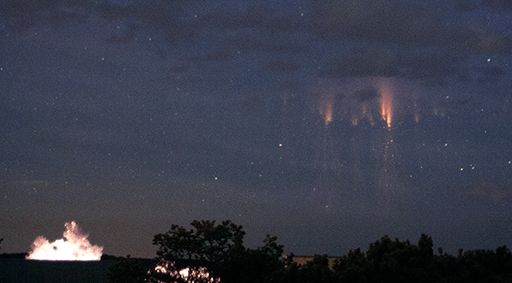
Sprites are an exotic form of lightning that appear very high above Earth's surface, at the edge of space itself.
"Sprites are a true space weather phenomenon," says lightning scientist Oscar van der Velde of the Technical University of Catalonia, Spain. "They develop in mid-air around 80 km altitude, growing in both directions, first down, then up. This happens when a fierce lightning bolt draws lots of charge from a cloud near Earth's surface. Electric fields [shoot] to the top of Earth's atmosphere--and the result is a sprite."
How exotic are they? This close-up view of the Oklahoma sprites says it all:
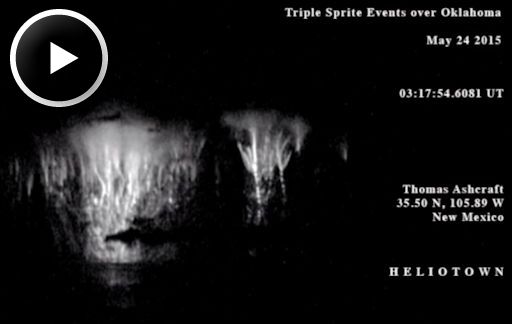
"Turn up the volume," advises Ashcraft. "In the movie you can hear the very low frequency radio crackles from individual lightning strokes."
Although sprites have been seen for at least a century, most scientists did not believe they existed until after 1989 when sprites were photographed by cameras onboard the space shuttle. Now "sprite chasers" routinely photograph sprites from their own homes. Give it a try.
