BREATH-TAKING COMET PICTURE: First, take a deep breath. Second, click here. That was a close-up image of Comet 67P/Churyumov-Gerasimenko taken by the European Space Agency's Rosetta spacecraft in Oct. 2014. Just released by the Rosetta science team, the startling photo shows the comet's rugged terrain from a point-blank distance of only 7.9 km. No wonder Philae bounced when it attempted landing! Stay tuned for more images from the Rosetta blog.
SCIENCE, CROWD-FUNDED BY ROMANCE: Using helium balloons, Spaceweather.com and the students of Earth to Sky Calculus are conducting cutting-edge research in astrobiology and cosmic radiation. Forinstance, on Saturday morning, May 30th, they plan to fly a batch of Antarctic microbes to the stratosphere to see if the extremophiles can survive Mars-like conditions 110,000 feet above Earth's surface. The flight is being funded by a proposal--a wedding proposal.
Earlier this month, Bruce Levine hired Earth to Sky Calculus to "pop the question" at the edge of space:

And.....?
"She said yes!" says Levine.
Levine is a space-buff and a regular reader of spaceweather.com. His fiancee, Cheryl Campo, is a scientist. Both live in Columbia, Maryland. "We met online," says Levine. "She picked up on a geeky reference from Back to the Future in my profile. We've been nerding out together ever since."
In exchange for flying his card, Levine paid $500 to sponsor an Earth to Sky Calculus research balloon flight. His contribution covers the cost of helium and other consumables required to get a research payload off the ground. Thanks, and congratulations, to Bruce and Cheryl!
Readers, would you like to have your proposal, birthday card, favorite picture or business logo flown to the edge of space? Please contact Dr. Tony Phillips to become a sponsor.
Realtime Space Weather Photo Gallery
NOCTILUCENT CLOUDS INTENSIFY: The northern summer season for noctilucent clouds (NLCs) is underway. Earth-orbiting satellites such as AIM and the International Space Station have been photographing the electric-blue clouds for days. On May 28th, sky watchers on Earth saw them, too. Andy Stables sends this picture from Isle of Skye, Scotland.

The fine-structured blue clouds floating above the dark, ordinary storm clouds are the NLCs. "The NLCs were coming through the twilight at 00:25 UT with some really nice ripple structures,"says Stables. They stretched about 15 degrees above the horizon."
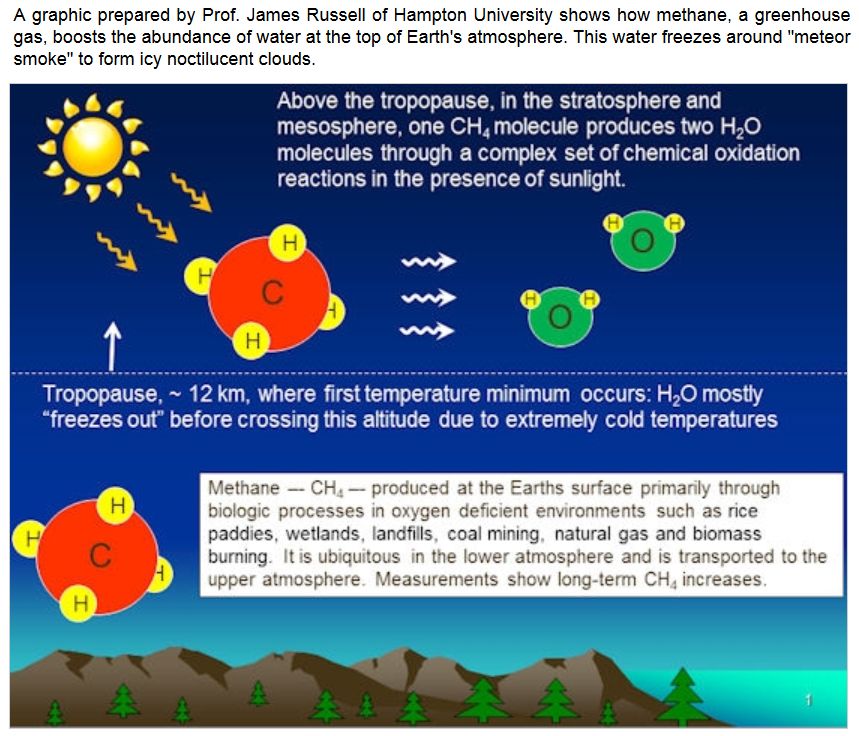
NLCs are Earth's highest clouds. Seeded by meteoroids, they float at the edge of space more than 80 km above the planet's surface. The clouds are very cold and filled with tiny ice crystals. When sunbeams hit those crystals, they glow electric-blue.
Noctilucent clouds first appeared in the 19th century after the eruption of super-volcano Krakatoa. At the time, people thought NLCs were caused by the eruption, but long after Krakatoa's ash settled, the clouds remained. In recent years, NLCs have intensified and spread with sightings as far south as Utah and Colorado. This could be a sign of increasing greenhouse gases in Earth's atmosphere.
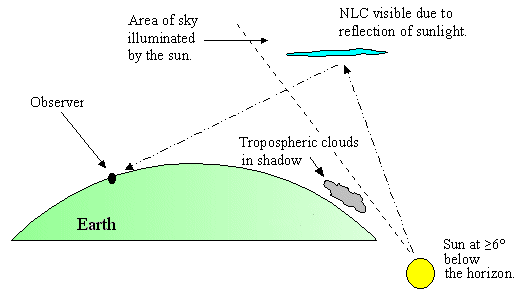
Observing tips: Look west 30 to 60 minutes after sunset when the Sun has dipped 6o to 16o below the horizon. If you see luminous blue-white tendrils spreading across the sky, you may have spotted a noctilucent cloud. Space Weather alerts: text, voice
RADAR ECHOES FROM THE NOCTILUCENT ZONE: Every summer since the late 1970s, radars probing Earth's upper atmosphere have detected strong echoes from altitudes between 80 km and 90 km. These altitudes comprise the "noctilucent zone," where water vapor crystallizes around meteor smoke to form icy noctilucent clouds (NLCs). The first NLCs of the 2015 northern summer season were spotted by NASA's AIM spacecraft on May 19th. The radar echoes have followed close behind.
Les Dean of the MST Radar Facility in Aberystwyth, Wales, reports: "We detected our first echoes of the summer season on May 26th."
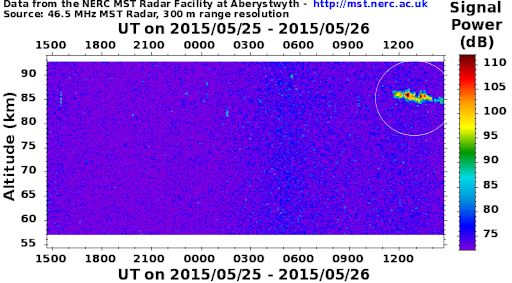
Researchers call them "Polar Mesospheric Summer Echoes" or "PMSEs." They occur over the Arctic during the months of May through August, and over the Antarctic during the months of November through February. These are the same months that NLCs appear.
But do the radar echoes actually come from noctilucent clouds? "The association is controversial," notes Dean. A leading theory holds that the ice particles in noctilucent clouds are electrically charged, and this makes them good reflectors of HF radio waves. However, NLCs are not always visible when the radar echoes are observed and vice versa. So the connection is not clear-cut.
One thing is sure: the northern season for both NLCs and PMSEs has begun. Stay tuned for more echoes from the noctilucent zone.
UPDATE: "What is happening 90 km above Earth's surface?" wonders researcher Rob Stammes at the Polarlightcenter in Lofoten, Norway. For the past two nights, he has detected intense radio reflections using a forward scatter meteor radar. The phenomenon is almost surely linked to the PMSEs and noctilucent clouds reported above.