DAYTIME METEOR SHOWER: Today, Earth is passing a stream of debris from an unknown comet, and this is causing one of the most intense meteor showers of the year. Ironically, most sky watchers won't notice because the shower peaks in broad daylight. Astronomers call these meteors "Arietids" because they emerge from the constellation Aries not far from the sun. A good way to experience the shower is via radar. Listen for their echoes on Space Weather Radio.
INCREASING SUNSPOT NUMBER: After a month of quiet, the sun is increasingly peppered with spots. A 3-day movie from NASA's Solar Dynamics Observatory shows the uptick in sunspot number. Click to set the scene in motion:

At the moment, not one of these sunspots poses a significant threat for strong flares. They all have relatively uncomplicated and stable magnetic fields, not prone to strong explosions. This could change, however, if their development proceeds apace. Stay tuned for updates. Solar flare alerts: text, voice
Realtime Space Weather Photo Gallery
NOT A RAINBOW: At this time of year, a colorful arc often appears in the noontime sky. It looks like a rainbow, but it's not. "We saw one During Saturday's June Bug parade in Baldwin, Wisconsin," reports Craig Braymen. "This picture barely does it justice."

Braymen witnessed a circumhorizontal arc--a rainbow-colored band of light caused by the sun shining through plate-shaped ice crystals in cirrus clouds. They are a phenomenon of spring and summer, forming only when the sun is more than 58 degrees above the horizon. As the name suggests, these arcs tend to hug the horizon, showing themselves most often over flat, sunny places like desert golf courses.
Realtime Space Weather Photo Gallery
NOCTILUCENT CLOUDS HOP THE ATLANTIC: In 2015, the first reports of noctilucent clouds (NLCs) came from Europe. Now the clouds have hopped the Atlantic, and Canadians are seeing them, too. "Despite the full Moon in the opposite part of the sky, the NLC display was quite noticeable," reports Alister Ling, who sends this picture from Edmonton, Alberta:

"To confirm it was not moonlit cirrus, I examined the clouds through binoculars," says Ling. "The classic waves and bands of NLCs are just gorgeous in binoculars."
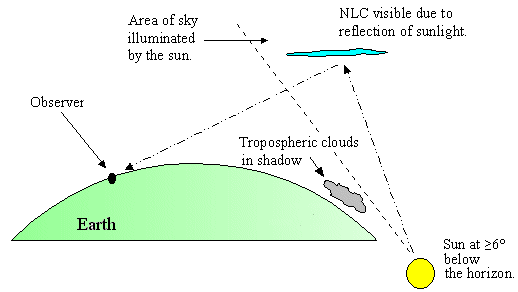
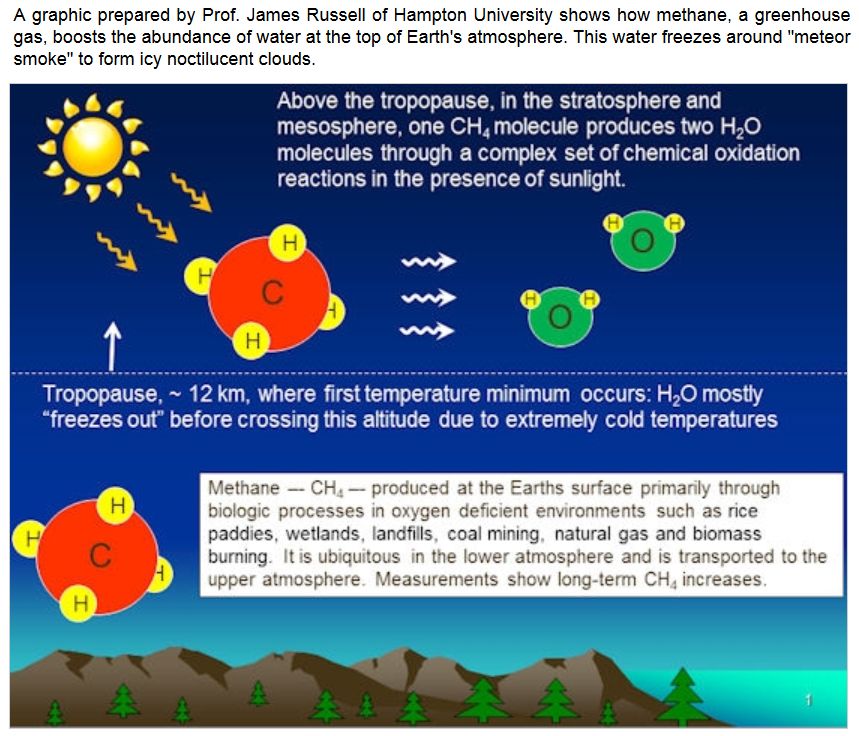
NLCs are Earth's highest clouds. Seeded by meteoroids, they float at the edge of space more than 80 km above the planet's surface. The clouds are very cold and filled with tiny ice crystals. When sunbeams hit those crystals, they glow electric-blue.
Noctilucent clouds first appeared in the 19th century after the eruption of super-volcano Krakatoa. At the time, people thought NLCs were caused by the eruption, but long after Krakatoa's ash settled, the clouds remained. In recent years, NLCs have intensified and spread with summer sightings as far south as Utah and Colorado. This could be a sign of increasing greenhouse gases in Earth's atmosphere.
Observing tips: Look west 30 to 60 minutes after sunset when the Sun has dipped 6o to 16o below the horizon. If you see luminous blue-white tendrils spreading across the sky, you may have spotted a noctilucent cloud. Solar flare alerts: text, voice