CO-ROTATING INTERACTION REGION: NOAA forecasters estimate a 45% chance of polar geomagnetic storms on June 8th when a co-rotating interaction region (CIR) is expected to hit Earth's magnetic field. CIRs are transition zones between fast- and slow-moving solar wind streams. Solar wind plasma piles up in these regions, producing density gradients and shock waves that do a good job of sparking auroras. Aurora alerts: text, voice
WEEKEND NOCTILUCENT CLOUDS: All weekend long, ripples of electric-blue have criss-crossed the evening skies of northern Europe. Saturday night in Estonia, for instance, looked like this:

"Using my Pentax K-30 digital camera, I created a panoramic image of the display," says photographer Jüri Voit. "It was widespread and beautiful."
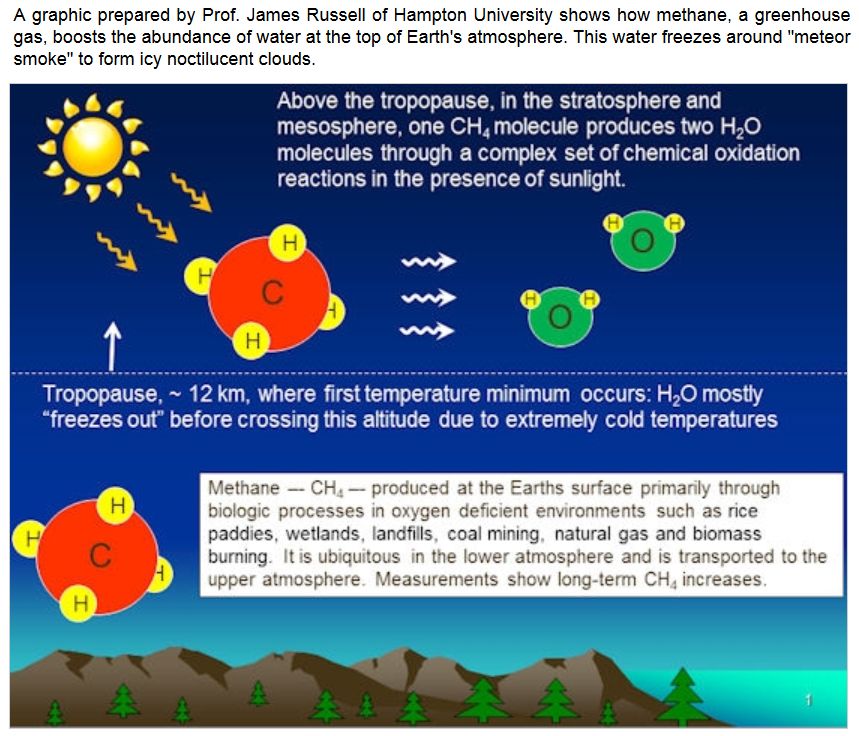
Summer is the season for noctilucent clouds (NLCs). They form at the edge of space, 82 km above Earth's surface, when diaphanous wisps of water vapor wrap themselves around meteoroids to form tiny ice crystals. The crystals are so tiny that they scatter blue light--hence the clouds' electric-blue color. Why summer? Ironically, that is the only time the upper atmosphere is cold enough for these icy clouds to form.
Noctilucent clouds first appeared in the 19th century after the eruption of super-volcano Krakatoa. At the time, people thought NLCs were caused by the eruption, but long after Krakatoa's ash settled, the clouds remained. In recent years, NLCs have intensified and spread with summer sightings as far south as Utah and Colorado. This could be a sign of increasing greenhouse gases in Earth's atmosphere.
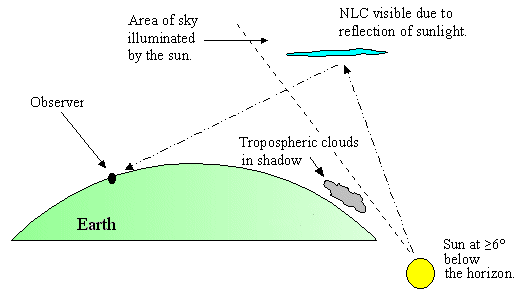
Observing tips: Look west 30 to 60 minutes after sunset when the sun has dipped 6o to 16o below the horizon. If you see luminous blue-white tendrils spreading across the sky, you may have spotted a noctilucent cloud.
NOT A RAINBOW: At this time of year, a colorful arc often appears in the noontime sky. It looks like a rainbow, but it's not. "We saw one during Saturday's June Bug parade in Baldwin, Wisconsin," reports Craig Braymen. "This picture barely does it justice."

Braymen witnessed a circumhorizon arc--a rainbow-colored band of light caused by the sun shining through plate-shaped ice crystals in cirrus clouds. Summer is the season for circumhorizontal arcs because they appear only when the sun is high in the sky--more than 58o above the horizon. The arc's enormous size and pure spectral colors make it one of the most beautiful of all ice halos.
At medium latitudes, like much of the USA, the arc is not rare.Typically, it can be seen several times each summer. In contrast, further north in much of Europe the circumhorizon arc is a rarity and impossible to see north of Copenhagen. See the charts in Les Cowley's web page 'How rare?' for the visibility at your location.
Realtime Space Weather Photo Gallery