QUIET WITH A CHANCE OF FLARES: Solar activity is low, but perhaps not for long. Growing sunspot AR2360 is facing Earth and has an unstable 'beta-gamma' magnetic field that harbors energy for M-class solar flares. NOAA forecasters estimate a 20% chance of M-flares on June 8th. Solar flare alerts: text, voice
SOLAR WIND SPARKS AURORAS: A solar wind stream hit Earth's magnetic field during the late hours of June 7th, sparking a G2-class geomagnetic storm. In the United States, surprised sky watchers from Washington to the Dakotas witnessed a rare display of summer auroras. Christian Begeman sends this picture from the outskirts of Isabel, SD:

"I was out shooting the Milky Way in rural Corson County,South Dakota, when I noticed the old familiar glow on the northern horizon," says Begeman. "Here is a shot of the auroras above the Korb windmill about 5 miles southeast of Isabel."
More auroras are in the offing as Earth moves deeper into the solar wind stream. NOAA forecasters estimate a 45% chance of polar geomagnetic storms on June 8th. Aurora alerts: text, voice
NOCTILUCENT CLOUDS: For many sky watchers, seeing auroras is a rare treat. Ditto for noctilucent clouds. "To witness auroras and noctilucent clouds at the same time is almost unimaginable," says photographer Harlan Thomas, "but as luck would have it, last night I was in the right place to see them both." This was the scene above Baker Lake, Alberta on June 8th:

He took the picture during the peak of a G2-class geomagnetic storm. Electric-blue noctilucent clouds hugged the horizon while green auroras danced overhead. "The juxtaposition was gorgeous."
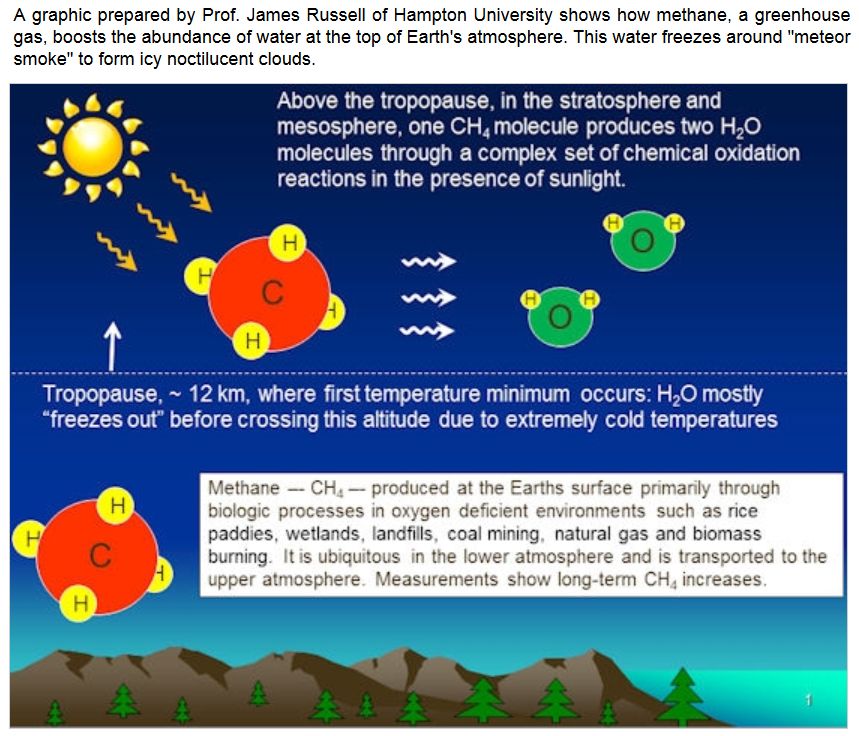
Summer auroras are rare, but summer is the season for noctilucent clouds. NLCs form at the edge of space, 82 km above Earth's surface, when diaphanous wisps of water vapor wrap themselves around meteoroids to form tiny ice crystals. The crystals are so tiny that they scatter blue light--hence the clouds' electric-blue color. Why summer? Ironically, that is the only time the upper atmosphere is cold enough for these icy clouds to form.
Noctilucent clouds first appeared in the 19th century after the eruption of super-volcano Krakatoa. At the time, people thought NLCs were caused by the eruption, but long after Krakatoa's ash settled, the clouds remained. In recent years, NLCs have intensified and spread with summer sightings as far south as Utah and Colorado. This could be a sign of increasing greenhouse gases in Earth's atmosphere.
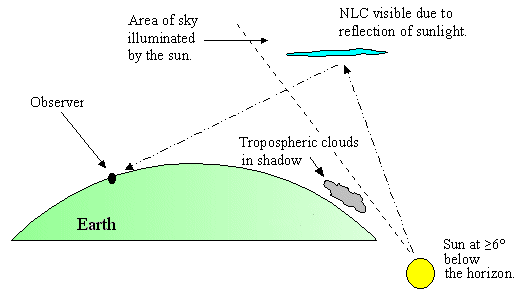
Observing tips: Look west 30 to 60 minutes after sunset when the sun has dipped 6o to 16o below the horizon. If you see luminous blue-white tendrils spreading across the sky, you may have spotted a noctilucent cloud.
NOT A RAINBOW: At this time of year, a colorful arc often appears in the noontime sky. It looks like a rainbow, but it's not. "We saw one during Saturday's June Bug parade in Baldwin, Wisconsin," reports Craig Braymen. "This picture barely does it justice."

Braymen witnessed a circumhorizon arc--a rainbow-colored band of light caused by the sun shining through plate-shaped ice crystals in cirrus clouds. Summer is the season for circumhorizontal arcs because they appear only when the sun is high in the sky--more than 58o above the horizon. The arc's enormous size and pure spectral colors make it one of the most beautiful of all ice halos.
At medium latitudes, like much of the USA, the arc is not rare.Typically, it can be seen several times each summer. In contrast, further north in much of Europe the circumhorizon arc is a rarity and impossible to see north of Copenhagen. See the charts in Les Cowley's web page 'How rare?' for the visibility at your location.
Realtime Space Weather Photo Gallery