INCOMING CME? A magnetic filament connected to sunspot AR2364 erupted on June 9th around 1900 UT, producing a C3-class solar flare. Material flying away from the blast site might deliver a glancing blow to Earth's magnetic field later this week. This possibility is not yet confirmed by a complete set of coronagraph data. Stay tuned for updates. Solar flare alerts: text, voice
MICROBES IN THE STRATOSPHERE: On June 8th, Spaceweather.com and the students of Earth to Sky Calculus flew another batch of halobacteria to the stratosphere onboard a suborbital helium balloon. Two species made the trip: Halorubrum lacusprofundi from Antarctica and NRC-1 from North America. Here is the view from the payload 106,661 feet above Earth's surface:
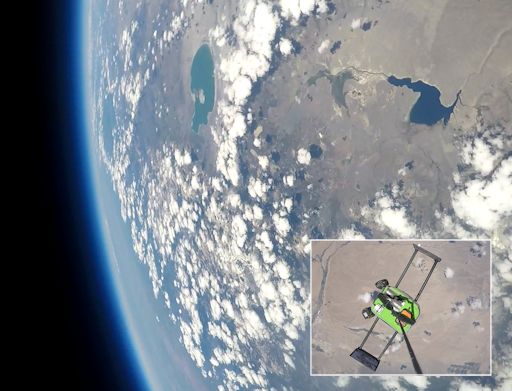
Tiny white vials on top of the payload (inset) contain the halobacteria--more than 1011 individual microbes. En route to the stratosphere they were exposed to temperatures as low as -63 C and cosmic radiation dose rates more than 100x greater than on the ground below. Amazingly, billions of the microbes survived this harsh treatment as the flight went on more almost three hours. The Antarctic microbes appear to be especially resiliant.
Astrobiologists have often asked themselves, could halobacteria survive on the planet Mars? Ultimately, balloon flights could help answer that question. Microbiologists Shil and Priya DasSarma are analyzing our flown samples at their NASA-supported laboratory at the University of Maryland. They may be able to unravel the high-altitude survival strategies of this amazing terrestrial extremophile.
HEY THANKS! The students wish to thank Spaceweather.com reader Stuart Bayne for sponsoring this flight. Stuart's $500 contribution paid for the helium and other supplies necessary to get the balloon off the ground. To say "thanks," we flew a picture of Stuart's older brother to the edge of space:

"My brother's birthday is next month," he explains. "I plan to use this picture to make an out-of-this-world birthday card."
Readers, if you would like to sponsor a launch, we can send your family to the edge of space, too. Contact Dr. Tony Phillips to book a flight.
Realtime Space Weather Photo Gallery
AURORAS AND LIGHTNING: A solar wind stream hit Earth's magnetic field during the late hours of June 7th, sparking a G2-class geomagnetic storm. In the United States, surprised sky watchers from Maine to Washington witnessed a rare display of summer auroras. Outside of Rochester, Minnesota, photographer Marcella Chester recorded the green glow alongside a June thunderstorm:
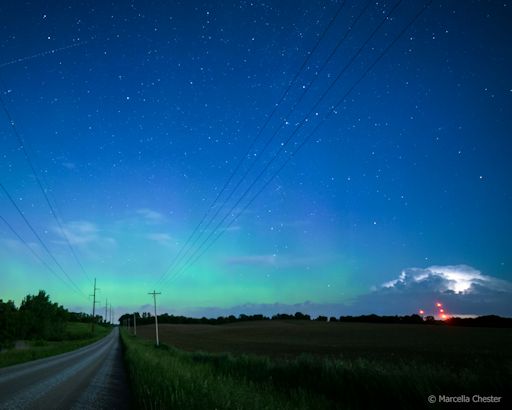
"I've never seen auroras and lightning visible side by side before," marvels Chester. "These photos were taken between 2 and 3 am on Monday, June 8th."
At about the same time in Hartford, Wisconsin, Jake Stehli witnessed a similar display. "The auroras were visible to the naked eye with lightning in a thunderhead on the horizon as well," he says.
Researchers have long known that geomagnetic storms happen most often in spring and fall. In other words, auroras prefer equinoxes. That's why seeing them so close to the summer solstice is remarkable.
The show is subsiding, but might not be finished. NOAA forecasters estimate a 45% chance of polar geomagnetic storms on June 10th as the solar wind continues to blow. Aurora alerts: text, voice
MEANWHILE IN THE SOUTHERN HEMISPHERE: The ongoing solar wind event is sparking auroras around both ends of the Earth. Before daybreak on June 9th, Taichi Nakamura of Dunedin, New Zealand, opened the shutter of his camera for a deep-sky exposure and recorded ... a sea lion:
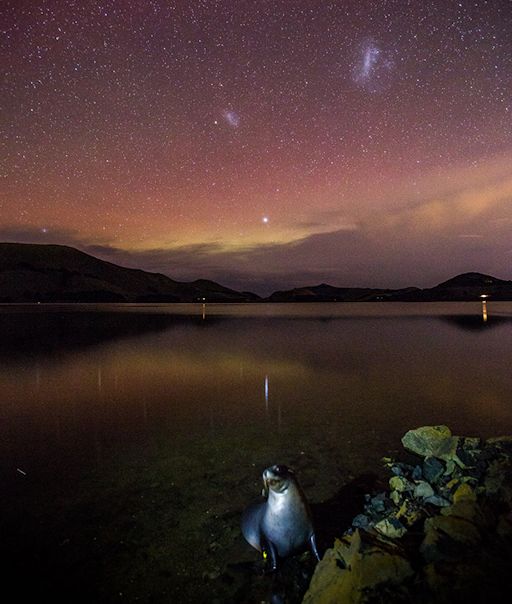
"I met a cute new friend while observing a beautiful display," says Nakamura. "Overhead, widespread red auroras surrounded the Magellanic clouds. The red-rimmed Milky Way was beautiful as well."

Red auroras are not fully understood. They occur some 300 to 500 km above Earth's surface, much higher than ordinary green auroras. Some researchers believe the red lights are linked to low energy electrons from the sun, which move too slowly to penetrate deeply into the atmosphere. When such electrons recombine with oxygen ions in the upper atmosphere, red photons are emitted. At present, space weather forecasters cannot predict when this will occur. They are as unexpected as ... a sea lion in a geomagnetic storm.