AMAZING NEWS--COMET LANDER PHONES HOME: Seven months after the European Space Agency lost contact with its comet lander, Philae, the probe has unexpectedly radioed Earth. "Philae is doing very well: It has an operating temperature of -35ºC and has 24 Watts available," says DLR Philae Project Manager Dr. Stephan Ulamec. "The lander is ready for operations." Last November, Philae bounced into shadows on the surface of comet 67P. Starved of solar power, it fell asleep. Now, with the comet approaching the sun, Philae has been able to wake up again. Congratulations to the ESA for a very pleasant surprise.
CO-ROTATING INTERACTION REGION: NOAA forecasters estimate a 50% chance of polar geomagnetic storms on June 14-15 when a co-rotating interaction region (CIR) is expected to hit Earth's magnetic field. CIRs are transition zones between fast- and slow-moving solar wind streams. Solar wind plasma piles up in these regions, producing density gradients and shock waves that do a good job of sparking auroras. Aurora alerts: text, voice
AN INCREASE IN COSMIC RAYS: For the past month, solar activity has been low. The last big burst of solar activity happened on May 5th when an X2-class solar flare erupted from the sun's eastern limb. Since then ... quiet. To investigate the effect of low solar activity on the atmosphere, Spaceweather.com and the students of Earth to Sky Calculus have been launching helium balloons at ~weekly intervals. Equipped with X-ray and gamma-ray sensors, the balloons measure ionizing radiation all the way from ground level to the stratosphere. Here are the results:


During the past month of low solar activity, ionizing radiation in the stratosphere has increased by 10%. This may seem counterintuitive, but there is a simple explanation: The radiation we measure is dominated by cosmic rays--a mix of subatomic particles, X-rays and gamma-rays that come from outside the solar system. Explosions on the sun (especially CMEs) tend to push these cosmic rays away from Earth. During the past month, however, there have been relatively few CMEs. Fewer CMEs means more cosmic rays. Yin-yang.
Cosmic rays are an important form of space weather. They matter to anyone who steps foot on an airplane. According to NASA, a 100,000 mile frequent flier will absorb a dose of radiation equivalent to 10 chest X-rays--all from cosmic rays. Cosmic rays have also been linked to cloud cover, lightning, and they may play some role in climate change.
If the sun remains quiet, cosmic rays could increase even more. Stay tuned for updates from the stratosphere.
Realtime Space Weather Photo Gallery
SUNSET PLANETS: If you love stargazing, there's a date you should mark on your calendar: June. That's right, the whole month. Throughout the month of June 2015, the two brightest planets, Venus and Jupiter, will be converging in the sunset sky. Last night in Vulcan, Alberta, photographer Alan Dyer caught them lining up with 1st-magnitude star Regulus:
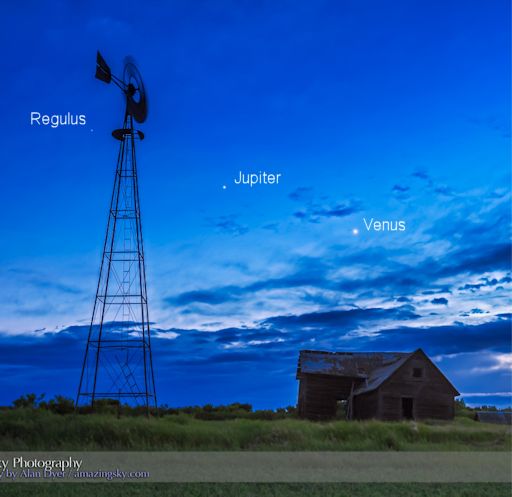
"Venus and Jupiter were visible even through light clouds," says Dyer. "It was a beautiful sight."
The convergence will continue for the rest of the month. Every night you can see the two planets drawing closer together. By the end of June, Venus and Jupiter will be a jaw-dropping 1/3rd of a degree apart. That's less than the width of a full Moon. You'll be able to hide the pair behind the tip of your pinky finger held at arm's length.
Observing tips: When the sun goes down, step outside and look west. You don't have to wait until the sky fades to black. Venus and Jupiter are so bright, you can see then shining through the twilight. In fact, some people say the planets are especially beautiful when they are surrounded by the cobalt hue of the early evening sky. Browse the realtime photo gallery for daily sightings.
Realtime Space Weather Photo Gallery
MICROBES IN THE STRATOSPHERE: On June 8th, Spaceweather.com and the students of Earth to Sky Calculus flew another batch of halobacteria to the stratosphere onboard a suborbital helium balloon. Two species made the trip: Halorubrum lacusprofundi from Antarctica and NRC-1 from North America. Here is the view from the payload 106,661 feet above Earth's surface:
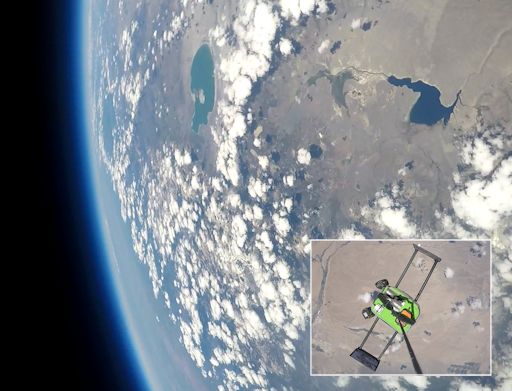
Tiny white vials on top of the payload (inset) contain the halobacteria--more than 1011 individual microbes. En route to the stratosphere they were exposed to temperatures as low as -63 C and cosmic radiation dose rates more than 100x greater than on the ground below. Amazingly, billions of the microbes survived this harsh treatment as the flight went on more almost three hours. The Antarctic microbes appear to be especially resiliant.
Astrobiologists have often asked themselves, could halobacteria survive on the planet Mars? Ultimately, balloon flights could help answer that question. Microbiologists Shil and Priya DasSarma are analyzing our flown samples at their NASA-supported laboratory at the University of Maryland. They may be able to unravel the high-altitude survival strategies of this amazing terrestrial extremophile.
HEY THANKS! The students wish to thank Spaceweather.com reader Stuart Bayne for sponsoring this flight. Stuart's $500 contribution paid for the helium and other supplies necessary to get the balloon off the ground. To say "thanks," we flew a picture of Stuart's older brother to the edge of space:

"My brother's birthday is next month," he explains. "I plan to use this picture to make an out-of-this-world birthday card."
Readers, if you would like to sponsor a launch, we can send your family to the edge of space, too. Contact Dr. Tony Phillips to book a flight.