QUIET WITH A CHANCE OF FLARES: Solar activity is low, but the chance of flares is increasing. Prompted by the emergence of big new sunspot AR2371, NOAA forecasters have boosted the odds of an M-class eruption to 30% on June 17th. Solar flare alerts: text, voice
SUNSET SKY SHOW: Readers, if you have not been paying attention to the early evening sky, please start. The two brightest planets, Venus and Jupiter, are converging in the west for a spectacular side-by-side conjunction. Photographer Cat Connor sends this picture from Mammoth Lakes, California:

"The sight of Venus and Jupiter reflecting in a pond and setting over the Sierra Nevada mountain town of Mammoth Lakes was simply breathtaking," says Conner. "To take the picture I used a Nikon D700 digital camera. A 20s exposure at ISO 6400 revealed not only the bright planets, but also the starry background."
Photographers, take note of those settings, because the sunset sky show is going to continue for the rest of the month. Dates of special interest: On June 18th Venus and Jupiter will be only 6 degrees apart, so close together that they could fit inside the bowl of the Big Dipper. On June 19th, the crescent Moon joins the show, together with Venus and Jupiter forming a bright isosceles triangle in the sunset sky. One night later, on June 20th, the vertices rearrange themselves, forming yet another isosceles triangle. Never has a geometry lesson been so beautiful.
The nights of June 19th and 20th are good nights to look through a telescope. Even a small telescope will show you the fat crescent phase of Venus, the cloudtops and largest moons of Jupiter, and the rugged terrain of Earth's own Moon. Swing your optics around the triangle for a fast-paced heavenly show.
The main event occurs on June 30th. On that night, Venus and Jupiter will be a jaw-dropping 1/3rd of a degree apart--less than the diameter of a full Moon. You'll be able to hide the pair behind your little pinky finger outstretched at arm's length. Mark your calendar and enjoy the show!
Realtime Space Weather Photo Gallery
NOCTILUCENT CLOUDS VS. STREET LIGHTS: Last night, a bright display of noctilucent clouds (NLCs) appeared in the night sky over Germany. "I saw the noctilucent clouds in the car while driving through the town of Greifswald around midnight," reports Markus Blaurock. "They were easily visible despite street lights."

Blaurock's photo, above, shows that noctilucent clouds can be seen even in light polluted cities. This means that everyone should be alert for them.
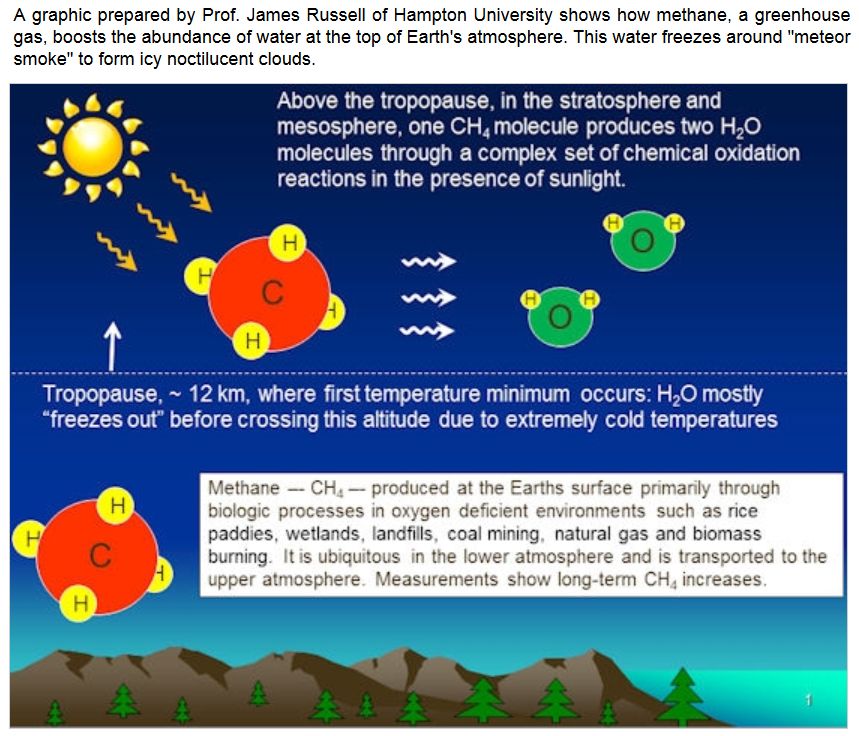
Noctilucent clouds first appeared in the 19th century after the eruption of super-volcano Krakatoa. At the time, people thought NLCs were caused by the eruption, but long after Krakatoa's ash settled, the clouds remained. In recent years, NLCs have intensified and spread with sightings as far south as Utah and Colorado. This could be a sign of increasing greenhouse gases in Earth's atmosphere.
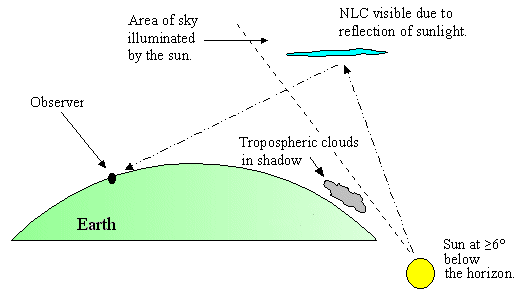
Observing tips: Look west 30 to 60 minutes after sunset when the Sun has dipped 6o to 16o below the horizon. If you see luminous blue-white tendrils spreading across the sky, you may have spotted a noctilucent cloud.
ANTARCTIC AURORAS: With the approach of southern winter, night is falling across Antarctica. The night sky, however, is anything but dark. "On June 11th, the South Pole lit up with one of the best displays of auroras anyone has seen in years," reports Liz Widen, a science engineer wintering over at McMurdo Station. "The show lasted more an hour."

"They were extremely vivid and active," says Widen. "It was hard to keep taking photos, however, with a wind chill of -45 C."
More southern lights could be in the offing. NOAA forecasters estimate a 60% chance of polar geomagnetic storms on June 16th as Earth exits a high-speed solar wind stream. Aurora alerts: text, voice
MAMMATUS CLOUDS: On June 8th, during a gap between storms, a remarkable cloud formation appeared over Munster, Indiana. "I have never seen anything like it," says Cassandra Sotos, who photographed the apparition:

These are called "mammatus clouds." Named for their resemblance to a cow's underbelly, they sometimes appear at the end of severe thunderstorms when the thundercloud is breaking up. They are interesting in part because they're formed by sinking air. (Most clouds are formed by rising air.) Contrary to myth, however, they don't continue sinking downward to form tornadoes.
"The upside down convection was stunning," says Sotos.
Researchers have called mammatus clouds an "intriguing enigma," because their inner workings are not fully understood. The clouds are fairly common but often go unnoticed because potential observers have been chased indoors by the rain. If you are one of them, go back outside when the downpour stops; you could witness a beautiful mystery in the sky.
Realtime Space Weather Photo Gallery