HAPPY SOLSTICE: Tomorrow is the longest day of the year in the northern hemisphere, and the shortest day in the south--that is, the "June solstice." The exact moment of the solstice is Sunday, June 21st, at 12:38 pm EDT (16:38 UT). This marks the beginning of summer in the north and winter in the south. Happy solstice!
CELESTIAL TRIANGLE: When the sun sets tonight, go outside and face west. There, splayed across the sunset sky, is a beautiful lesson in geometry. Venus, Jupiter, and the crescent Moon have converged to form a scalene triangle--a three-sided polygon with sides of unequal length. In the Adirondack mountains of New York, artist Sally J. Smith created a special sculpture to frame the event:

"The skies cleared here in time for me to set up this 'planet portal' I made just for the occasion," says Smith, who creates environmental sculptures like this one at her outdoor studio in Wadhams, NY.
If you have a telescope, take a quick tour of the triangle's verticles. Even cheap department store 'scopes will show you the fat crescent phase of Venus, the moons of Jupiter, and the rugged landscape of the Moon.
After this weekend, the Moon moves away from the planets--but the show won't be over. Venus and Jupiter will continue to converge, drawing ever closer to one another until June 30th. On that night, the two planets will be a jaw-dropping 1/3rd of a degree apart--less than the diameter of a full Moon. You'll be able to hide the pair behind your little pinky finger outstretched at arm's length. Mark your calendar and enjoy the show!
Realtime Space Weather Photo Gallery
SOLSTICE AURORA WATCH: On June 18th, sunspot AR2371 unleashed the strongest solar flare in nearly 2 months. The M3-class explosion caused a brief shortwave radio blackout over North America, and it hurled a CME into space. SOHO (the Solar and Heliospheric Observatory) recorded a movie of the expanding cloud:

The CME is not heading directly for Earth. Nevertheless, it is probably geoeffective. According to NOAA computer models, the CME should deliver a glancing blow to our planet's magnetic field during the late hours of June 21st. High-latitude sky watchers should be alert for solstice auroras. Aurora alerts: text, voice
Realtime Space Weather Photo Gallery
NOCTILUCENT CLOUDS VS. STREET LIGHTS: On June 17th, a bright display of noctilucent clouds (NLCs) appeared in the night sky over Germany. "I saw the noctilucent clouds in the car while driving through the town of Greifswald around midnight," reports Markus Blaurock. "They were easily visible despite street lights."

Blaurock's photo, above, shows that noctilucent clouds can be seen even in light polluted cities. This means that everyone should be alert for them.
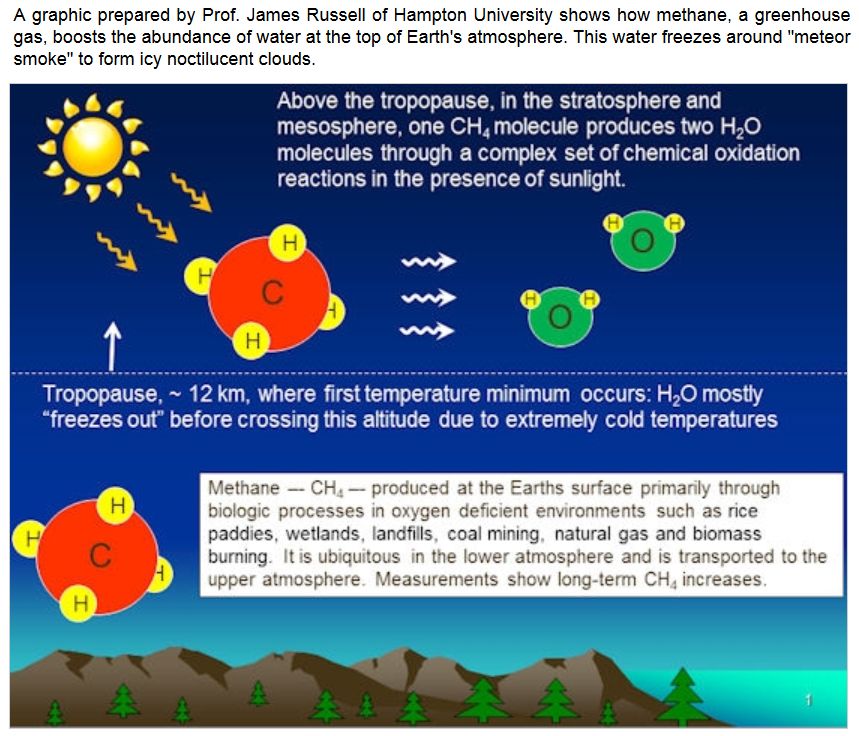
Noctilucent clouds first appeared in the 19th century after the eruption of super-volcano Krakatoa. At the time, people thought NLCs were caused by the eruption, but long after Krakatoa's ash settled, the clouds remained. In recent years, NLCs have intensified and spread with sightings as far south as Utah and Colorado. This could be a sign of increasing greenhouse gases in Earth's atmosphere.
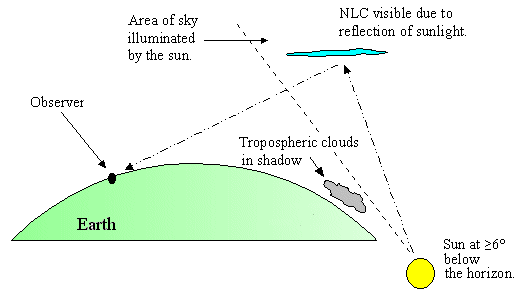
Observing tips: Look west 30 to 60 minutes after sunset when the Sun has dipped 6o to 16o below the horizon. If you see luminous blue-white tendrils spreading across the sky, you may have spotted a noctilucent cloud.