CME IMPACT, MORE TO COME: A minor CME hit Earth's magnetic field on June 21st at approximately 1600 UT. The weak impact did not cause an immediate geomagnetic storm. At least two more CMEs are en route, including the full-halo CME described below. This means geomagnetic storms remain possible in the nights ahead despite the muted effect of today's strike. Aurora alerts: text, voice
FULL HALO CME: Sunspot AR2371 erupted on June 21st at 01:42 UT, producing an M2-class solar flare and a full-halo CME. Click to view a movie of the storm cloud, which is heading directly for Earth:

Geomagnetic storms are likely when the CME reaches Earth, probably on June 23rd or 24th. Its impact will add to that of two lesser CMEs already en route. NOAA analysts are modeling the full-halo CME now and, shortly, they will give their estimates for its arrival time and the severity of the resulting storm. Stay tuned for updates. Aurora alerts: text, voice
HAPPY SOLSTICE: Today is the June solstice--the longest day of the year in the northern hemisphere, and the shortest day in the south. The exact moment of the solstice is 12:38 pm EDT, when the sun reaches its highest declination on the celestial sphere (+23.5o). To mark the occasion, Richard Sears photographed this sun halo over Atwater, California:

"Happy solstice!" says Sears.
The long days of northern summer are excellent times to look for sun halos. They are formed by ice crystals in high cirrus clouds, which are freezing cold no matter how hot it gets on the ground below. Keep an eye on the solstice sun for rainbow-colored arcs in the surrounding sky.
Realtime Space Weather Photo Gallery
SUNSET SKY SHOW--IT'S NOT OVER YET: All weekend long, people around the world watched with pleasure as Venus, Jupiter, and the slender cresent Moon converged in the sunset sky. Pavel Gabzdyl photographed the triangular conjunction over Brno, Czech Republic:
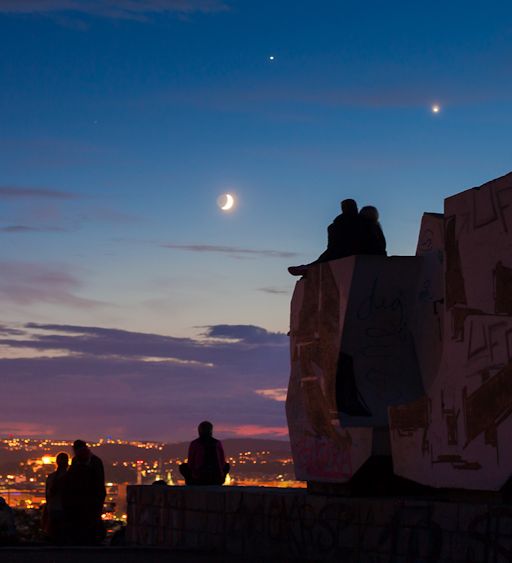
"The three bright lights were visible even before the sun set," says Gabzdyl. "We could not take our eyes off of them."
As the new week unfolds, the Moon is moving away from the planets--but the show is far from over. In the evenings ahead, Venus and Jupiter will draw closer and closer to one another. On June 30th, they will be a jaw-dropping 1/3rd of a degree apart. You'll be able to hide the pair behind your little pinky finger outstretched at arm's length. Such a close pairing of bright planets is truly mesmerizing. Mark your calendar and enjoy the show!
Realtime Space Weather Photo Gallery