SEVERE GEOMAGNETIC STORM IN PROGRESS: A severe G4-class geomagnetic storm is in progress on June 22nd. This follows a series of rapid-fire CME strikes to Earth's magnetic field during the past 24 hours. Magnetic fields in the wake of the latest CME are strongly coupled to Earth's own magnetic field. This is a condition that could sustain the geomagnetic storm for many hours to come. High- and mid-latitude sky watchers should be alert for auroras tonight, especially during the hours around local midnight. Aurora alerts: text, voice
EARTH-DIRECTED SOLAR FLARE, RADIO BLACKOUT: Sunspot AR2371 has erupted again, producing a strong M6.5 class solar flare. NASA's Solar Dynamics Observatory captured the flare's extreme ultraviolet flash on June 22nd at 18:23 UT:
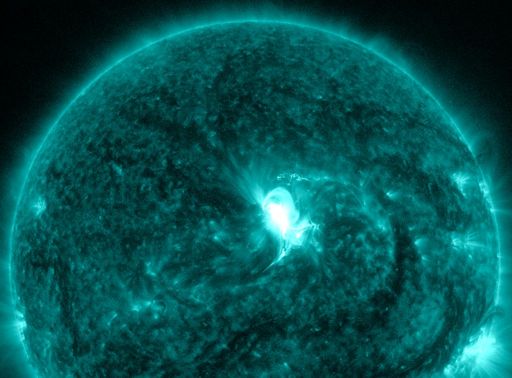
X-ray and UV radiation from the flare ionized the upper layers of Earth's atmosphere, producing a moderately-strong blackout of shortwave and low-frequency radio signals over North America. The North American blackout is subsiding now. An even deeper radio blackout is still underway around both of Earth's poles. This is due to solar protons and electrons being funneled into the polar regions by Earth's magnetic field. A blackout map from NOAA shows the geographical distribution of the radio disturbances. Solar flare alerts: text, voice

NEUTRONS IN THE STRATOSPHERE: For nearly two years, Spaceweather.com and the students of Earth to Sky Calculus have been using helium balloons to monitor X-rays and gamma-rays in the stratosphere. Their successful program has detected multiple radiation events in response to solar storms. On June 18th they added something new. For the first time, the group's Space Weather Payload included a bubble chamber for measuring neutrons. The device flew 109,012 feet above California's Sierra Nevada mountain range, then parachuted back to Earth, landing near Death Valley National Park. The results: Neutrons were detected.

Circled above are some of the bubbles that formed as neutrons passed through the chamber. By counting the bubbles, it is possible to estimate the total dose of neutron radiation absorbed during the 3 hour flight. The answer is 600 microRads (energy range 200 keV - 15 MeV). Interestingly, this is almost the same dose detected by onboard X-ray and gamma-ray sensors: 620 microRads (energy range 10 keV to 20 MeV). Lesson: if you only count X-rays and gamma-rays, then you are missing at least half of the radiation in the atmosphere. Neutrons matter, too.
Indeed, neutrons are a very important form of cosmic radiation, providing much of the biologically effective radiation dose at altitudes of interest to aviation and space tourism. Low-energy neutrons also cause single-event upsets in aircraft avionics, especially devices that contain Boron 10. Adding a neutron sensor to the Space Weather Payload allows the students to monitor this type of radiation at altitudes ranging from ground level to 120,000 feet.
Realtime Space Weather Photo Gallery
SUNSET SKY SHOW--IT'S NOT OVER YET: All weekend long, people around the world watched with pleasure as Venus, Jupiter, and the slender cresent Moon converged in the sunset sky. Pavel Gabzdyl photographed the triangular conjunction over Brno, Czech Republic:

"The three bright lights were visible even before the sun set," says Gabzdyl. "We could not take our eyes off of them."
As the new week unfolds, the Moon is moving away from the planets--but the show is far from over. In the evenings ahead, Venus and Jupiter will draw closer and closer to one another. On June 30th, they will be a whisper-thin 1/3rd of a degree apart. You'll be able to hide the pair behind your little pinky finger outstretched at arm's length. Such a close pairing of bright planets is truly mesmerizing. Mark your calendar and enjoy the show!
Realtime Space Weather Photo Gallery