SOLSTICE GEOMAGNETIC STORM: A series of CMEs hit Earth's magnetic field on June 22nd, producing a severe G4-class geomagnetic storm. Northern Lights spilled across the Canadian border into more than a dozen US states, including places as far south as Colorado, Georgia, Virginia and Arkansas. "The auroras did not disappoint," says Chris Cook, who witnessed the display from Cape Cod, Massachusetts:

"They were visible in deep twilight!" he adds. "I positioned myself on a beach overlooking Cape Cod Bay so I could capture the reflection in the water at low tide."
More auroras are in the offing as Earth's magnetic field reverberates from the CME strikes. NOAA forecasters estimate a 90% chance of polar geomagnetic storms on June 23rd, subsiding only a little to 70% on June 24th. Aurora alerts: text, voice
MEANWHILE ... ANOTHER CME IS ON THE WAY: Big sunspot AR2371 erupted again on June 22nd (18:23 UT), producing a strong M6.5 class solar flare. NASA's Solar Dynamics Observatory recorded the extreme ultraviolet flash:
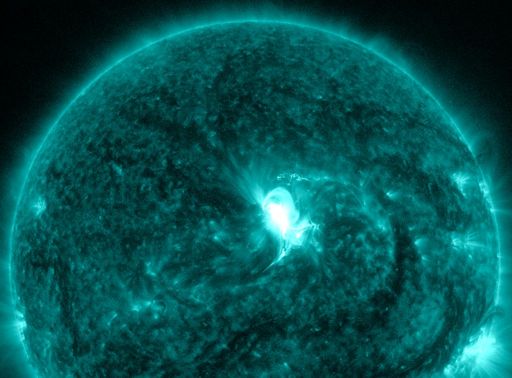
X-ray and UV radiation from the flare ionized the upper layers of Earth's atmosphere, causing a blackout of some shortwave radio signals over North America (blackout map). Mariners and ham radio operators, in particular, may have noticed disturbances at frequencies below ~20 MHz.

The explosion also hurled a full-halo CME directly toward Earth: movie. NOAA analysts are still modeling the storm cloud to estimate its likely time of arrival. Best guess: June 24th. Sky watchers should prepare for more geomagnetic stoms and auroras on Wednesday night. Solar flare alerts: text, voice

Realtime Space Weather Photo Gallery
NEUTRONS IN THE STRATOSPHERE: For nearly two years, Spaceweather.com and the students of Earth to Sky Calculus have been using helium balloons to monitor X-rays and gamma-rays in the stratosphere. Their successful program has detected multiple radiation events in response to solar storms. On June 18th they added something new. For the first time, the group's Space Weather Payload included a bubble chamber for measuring neutrons. The device flew 109,012 feet above California's Sierra Nevada mountain range, then parachuted back to Earth, landing near Death Valley National Park. The results: Neutrons were detected.

Circled above are some of the bubbles that formed as neutrons passed through the chamber. By counting the bubbles, it is possible to estimate the total dose of neutron radiation absorbed during the 3 hour flight. The answer is 600 microRads (energy range 200 keV - 15 MeV). Interestingly, this is almost the same dose detected by onboard X-ray and gamma-ray sensors: 620 microRads (energy range 10 keV to 20 MeV). Lesson: if you only count X-rays and gamma-rays, then you are missing at least half of the radiation in the atmosphere. Neutrons matter, too.
Indeed, neutrons are a very important form of cosmic radiation, providing much of the biologically effective radiation dose at altitudes of interest to aviation and space tourism. Low-energy neutrons also cause single-event upsets in aircraft avionics, especially devices that contain Boron 10. Adding a neutron sensor to the Space Weather Payload allows the students to monitor this type of radiation at altitudes ranging from ground level to 120,000 feet.