GEOMAGNETIC STORM IN CME'S WAKE: As expected, a CME hit Earth's magnetic field on June 24th. At first the impact had little effect, but now a G1-class geomagnetic storm is in progress as Earth passes through the CME's wake. High latitude sky watchers should remain alert for auroras. Aurora alerts: text or voice.
ANOTHER CME IS ON THE WAY: Since June 21st, four CMEs have hit Earth's magnetic field. A fifth is on the way. Sunspot AR2371 erupted again during the early hours of June 25th, producing an M7.9-class solar flare and a lopsided CME. The Solar and Heliospheric Observatory photograhed the storm cloud, which raced away from the sun faster than 2000 km/s (4.5 million mph):

The CME will probably sideswipe Earth's magnetic field on June 27th. NOAA computer models, due out later today, will refine the cloud's predicted arrival time and establish probabilities for geomagnetic storms. Stay tuned. Aurora alerts: text or voice.
THE SOLSTICE STORM: The current solar cycle has not been good to sky watchers. Years of weak solar activity have produced few widespread displays of the aurora boreais. The Solstice Storm of 2015 changed all that. A series of CMEs hit Earth's magnetic field on June 22nd, producing a severe G4-class geomagnetic storm. Northern Lights spilled across the Canadian border into more than 20 US states. Jason Brownlee sends this picture from Bend, Oregon:
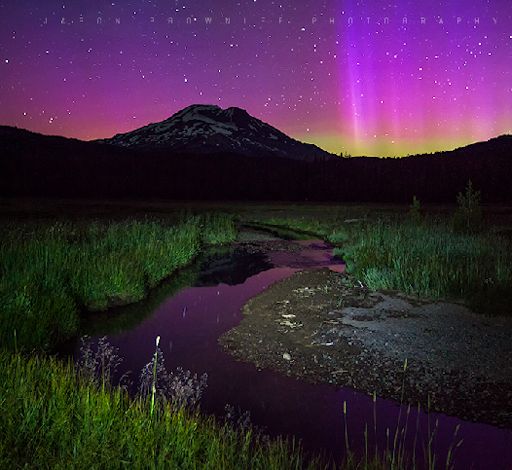
"I photographed the auroras from the edge of Soda Creek in the Cascade Mountains," says Brownlee.
The lights descended even farther south than Oregon. Sky watchers saw auroras in the states of California, New Mexico, Colorado, Arizona, Texas, Georgia, Virginia and Arkansas--just to name a few. Browse the realtime aurora gallery for more sightings:
NOT A UFO: Many people who went outdoors to look for auroras on June 22nd saw auroras -- and something more. "We noticed a ghostly cloud-like object moving in an arc from the southeast to the northeast," says Lauri Kangas of Fort Frances, Ontario (Canada). "My wife commented that it was the closest thing she has seen to a UFO!" Kangas took this picture of the apparition:
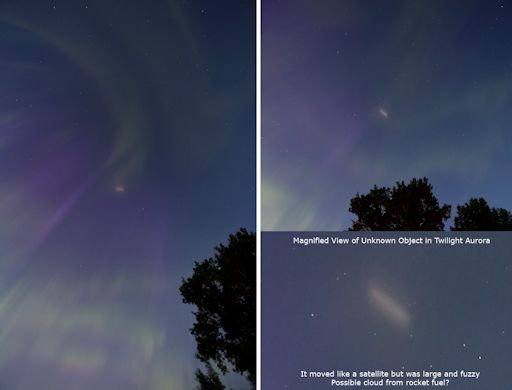
David Jones of Lawrenceville, Georgia saw it, too. "At first I thought it was an airplane traveling south to north very slowly, but then I noticed it looked kind of fuzzy," he says. "As it continued traveling north, the star-like object clearly had a circle of mist or fog around it. I could also see smaller lights around the main one that appeared to twinkle."
This was not a UFO. Satellite expert Marco Langbroek explains: "On June 23 at 01:51:58 UT, the European Space Agency launched a Vega rocket with the Sentinel-2A satellite from Kourou, French Guyana. What [Kangas and others saw] is probably gases from the rocket's last engine burn."
The Sentinel-2 series of satellites is dedicated to observing Earth and its oceans. On June 22nd, in a reversal of roles, the people of Earth were observing Sentinel-2. Visit Langbroek's blog for more information.
Realtime Space Weather Photo Gallery
NEUTRONS IN THE STRATOSPHERE: For nearly two years, Spaceweather.com and the students of Earth to Sky Calculus have been using helium balloons to monitor X-rays and gamma-rays in the stratosphere. Their successful program has detected multiple radiation events in response to solar storms. On June 18th they added something new. For the first time, the group's Space Weather Payload included a bubble chamber for measuring neutrons. The device flew 109,012 feet above California's Sierra Nevada mountain range, then parachuted back to Earth, landing near Death Valley National Park. The results: Neutrons were detected.
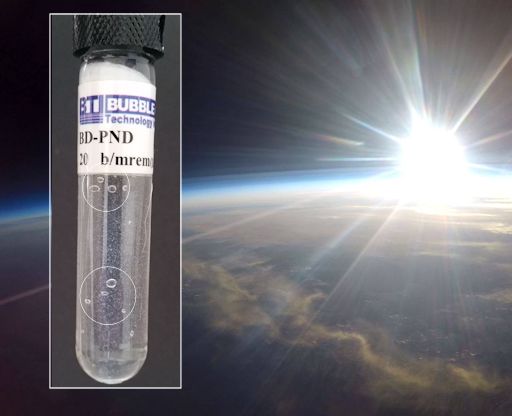
Circled above are some of the bubbles that formed as neutrons passed through the chamber. By counting the bubbles, it is possible to estimate the total dose of neutron radiation absorbed during the 3 hour flight. The answer is 600 microRads (energy range 200 keV - 15 MeV). Interestingly, this is almost the same dose detected by onboard X-ray and gamma-ray sensors: 620 microRads (energy range 10 keV to 20 MeV). Lesson: if you only count X-rays and gamma-rays, then you are missing at least half of the radiation in the atmosphere. Neutrons matter, too.
Indeed, neutrons are a very important form of cosmic radiation, providing much of the biologically effective radiation dose at altitudes of interest to aviation and space tourism. Low-energy neutrons also cause single-event upsets in aircraft avionics, especially devices that contain Boron 10. Adding a neutron sensor to the Space Weather Payload allows the students to monitor this type of radiation at altitudes ranging from ground level to 120,000 feet.