CO-ROTATING INTERACTION REGION: NOAA forecasters estimate a 40% chance of polar geomagnetic storms on July 10th when a co-rotating interaction region (CIR) is expected to hit Earth's magnetic field. CIRs are transition zones between fast- and slow-moving solar wind streams. Solar wind plasma piles up in these regions, producing density gradients and shock waves that do a good job of sparking auroras. Aurora alerts: text or voice.
SOLAR ACTIVITY: Solar activity is low, but it is not zero. Today in Nîmes, France, astrphotographer Philippe Tosi observed a massive filament of plasma erupting from the sun's southwestern limb. As the blue-marble inset shows, the structure was big enough to swallow Earth:

Despite the twisting ferocity of the explosion, the sun's gravity kept the filament under control. Most of the mass in Tosi's photo fell back to the surface of the sun where it was reabsorbed. The explosion was not geoeffective.
The face of the sun is peppered with spots, but none of them is flaring. Amateur astronomers with solar telescopes are encouraged to scan the limb of the sun, instead. Apparently, that is where the action is.
Realtime Space Weather Photo Gallery
NOCTILUCENT CLOUDS: Summer is the season for noctilucent (night-shining) clouds, and the month of July is often when they are at their best. On July 6th, Jüri Voit photographed these electric-blue ripples over Estonia:
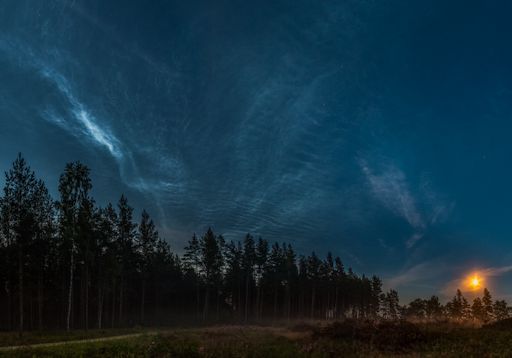
"The combination of moonlight and noctilucent clouds (NLCs) was magical," says Voit. "What a night!"
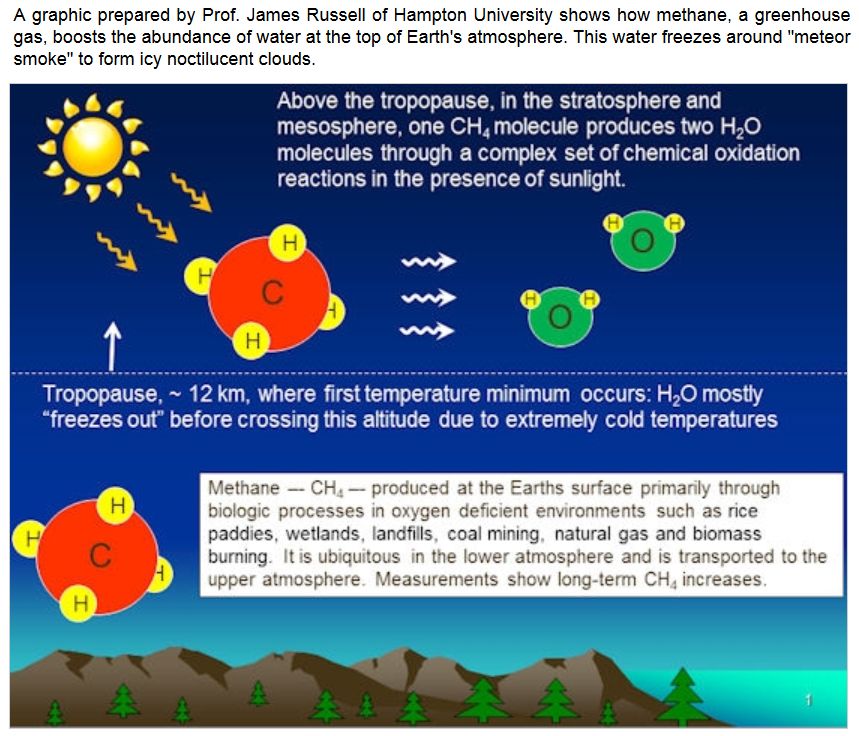
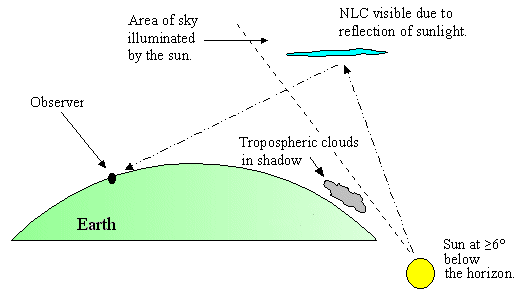
NLCs are Earth's highest clouds. Seeded by meteoroids, they float at the edge of space more than 80 km above the planet's surface. The clouds are very cold and filled with tiny ice crystals. When sunbeams hit those crystals, they glow electric-blue.
Noctilucent clouds first appeared in the 19th century after the eruption of super-volcano Krakatoa. At the time, people thought NLCs were caused by the eruption, but long after Krakatoa's ash settled, the clouds remained. In recent years, NLCs have intensified and spread with summer sightings as far south as Utah and Colorado. This could be a sign of increasing greenhouse gases in Earth's atmosphere.
Observing tips: Look west 30 to 60 minutes after sunset when the Sun has dipped 6o to 16o below the horizon. If you see luminous blue-white tendrils spreading across the sky, you may have spotted a noctilucent cloud.
CANADIAN WILDFIRE SEASON: "Minnesota has several unusual seasons: winter, mosquito, and road construction, to name a few," says Aaron Seefeld of Hastings, MN. "Over the last few years, another season has emerged - Canadian wildfire season. The skies turn grey and objects in the sky turn red, if they're visible at all." He photographed this smoke-reddened Moon on July 3rd:

"On the night of 3 July, a waning full Moon was masked by the smoke particles hanging in the air," says Seefel. "It was supposed to rise at 22:02 local time, but - despite 'clear' skies - didnt appear until close to 23:00. When it did start to emerge, it was deep red."
The smoke plumes from Canadian wildfires are so large and dense that NASA satellites have been photographing them from space. Here is an example from the Terra satellite on June 30th.

In addition to reddening the Moon, Canadian smoke is also dimming the sun, allowing big sunspots like AR2381 to pop into view at sunset. Charles Russell sends this report from Greenville, Michigan: "The thick smoke in the upper atmosphere as a result of the wildfires in Canada acted as a filter, which allowed me to see and capture this photo with clusters of sunspots clearly visible on the solar disk!"
"Canadian wildfire season" is affecting the skies of more than a dozen US states. Monitor the realtime photo gallery for more smokey sightings.