GEOMAGNETIC STORM: As predicted, a minor G1-class geomagnetic storm broke out during the late hours of July 10th when a high-speed solar wind stream hit Earth's magnetic field. "Aurora and pillars were visible to the naked eye, becoming bright at times," reports Randy Halverson from South Dakota's Badlands National Park. This is what he saw:

Auroras were also sighted above Vermont, Massachusetts, North Dakota, Wisconsin, Maine, and Michigan, and in eastern parts of Canada.
The storm is subsiding now. NOAA forecasters estimate a 55% chance that it could flare up again on July 11th as the solar wind continues to blow. Aurora alerts: text or voice.
NOCTILUCENT CLOUDS OVER EUROPE: High above Europe, Earth's upper atmosphere has been very active this week. First, observers saw red sprites dancing across the tops of thunderstorms. And now a bright display of electric-blue noctilucent clouds (NLCs) is underway. Rayann Elzein sends this picture, taken just after nightfall on July 10th, from Nijmegen, The Netherlands:

"This was my second evening this week seeing NLCs in the Dutch sky!" says Elzein. "And tonight the clouds were infinitely brighter than earlier in the week. They also presented many more shapes and lasted longer." Similar reports are coming in from Denmark, Sweden, Germany, Latvia, and Slovakia.
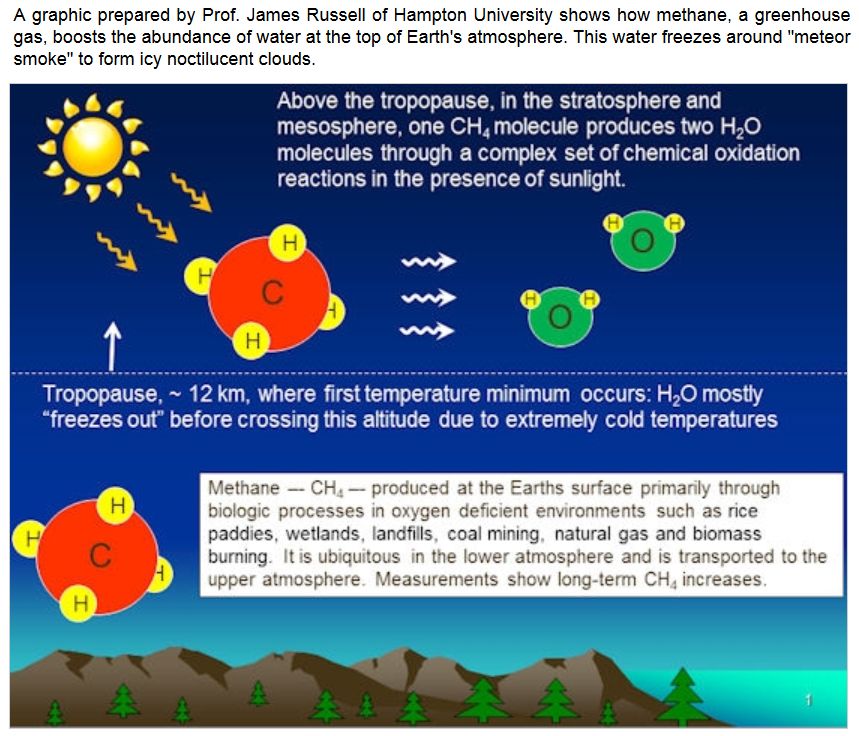
NLCs are Earth's highest clouds. Seeded by meteoroids, they float at the edge of space more than 80 km above the planet's surface. The clouds are very cold and filled with tiny ice crystals. When sunbeams hit those crystals, they glow electric-blue.
Noctilucent clouds first appeared in the 19th century after the eruption of super-volcano Krakatoa. At the time, people thought NLCs were caused by the eruption, but long after Krakatoa's ash settled, the clouds remained. In recent years, NLCs have intensified and spread with summer sightings as far south as Utah and Colorado. This could be a sign of increasing greenhouse gases in Earth's atmosphere.
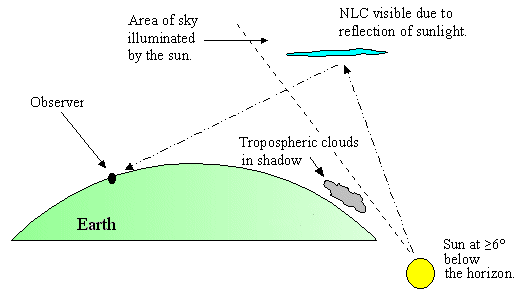
Observing tips: Look west 30 to 60 minutes after sunset when the Sun has dipped 6o to 16o below the horizon. If you see luminous blue-white tendrils spreading across the sky, you may have spotted a noctilucent cloud.
PLUTO IS NOT ALONE: New Horizons is now less than 3 days from Pluto. For years, the "dwarf" planet has been little more than a fuzzy blob in the eyepieces of distant telescopes. Not even the Hubble Space Telescope could see it clearly. Those days are over. On July 7th, New Horizons snapped this image of Pluto and its biggest moon Charon from a distance of only 5 million miles:

Neither Pluto nor Charon is a "fuzzy blob." Moreover, the crisp images reveal many interesting differences: The reddish materials that color Pluto seem to be completely absent on Charon. On Charon, only a dark polar region interrupts the light gray terrain.
"These two objects have been together for billions of years, in the same orbit, but they are totally different," says Alan Stern of the Southwest Research Institute (SwRI) in Boulder, Colorado. Stern is the principal investigator for the New Horizons mission.
Charon is about 750 miles (1200 kilometers) across, about half the diameter of Pluto—making it the solar system's largest moon relative to its planet. "Charon is now emerging as its own world," adds John Spencer, another member of the science team at the SwRI. "Its personality is beginning to really reveal itself."
On July 14th, when New Horizons makes its closest approach to the Pluto-Charon system, the images it beams back will have 500 times better resolution than we see today. Stay tuned!