GEOMAGNETIC STORMS ON JULY 13TH: A stream of high-speed solar wind is buffeting Earth's magnetic field, and this is causing G1-class geomagnetic storms on July 13th. Sky watchers in several northern-tier US states saw auroras before sunrise on Monday. Philip Granrud sends this picture from the Salish Mountains of Montana:

"The Northern Lights came out outta the blue as they often do," says Granrud. "This was one of the most colorful and visible-to-the-eye displays I have seen in the last year in Montana. A large chunk of NW Montana can be seen below. Urban lights in the foreground come from the cities of Kalispell, Whitefish, Evergreen, and Columbia Falls."
High-latitude sky watchers should be alert for auroras tonight. NOAA forecasters estimate a 30% chance of polar geomagnetic storms as the solar wind continues to blow. Aurora alerts: text or voice.
THE FARSIDE OF PLUTO: Pluto has two sides: the nearside that New Horizons will see when it buzzes the dwarf planet on July 14th, and the farside that it won't. New Horizons just took the best picture it will ever take of Pluto's farside from a distance of 2.5 million miles:

Alan Stern, New Horizons principal investigator at the Southwest Research Institute in Boulder, Colorado, describes this image as "the last, best look that anyone will have of Pluto's farside for decades to come."
Of particular interest on the farside are four dark spots connected to a dark belt that circles Pluto's equatorial region. What continues to pique the interest of scientists is their similar size and even spacing. "It's weird that they're spaced so regularly," says New Horizons program scientist Curt Niebur at NASA Headquarters. Jeff Moore of NASA's Ames Research Center is equally intrigued: "We can't tell whether they're plateaus or plains, or whether they're brightness variations on a completely smooth surface." The spots appear on the side of Pluto that always faces its largest moon, Charon.
No one knows what these spots are, but there is hope for a solution to the mystery: "When we combine images like this of the farside with composition and color data the spacecraft has already acquired but not yet sent to Earth, we expect to be able to read the history of this face of Pluto," says Moore.
When New Horizons makes its closest approach to Pluto in just two days, it will focus on the nearside of the dwarf planet. On the morning of July 14, New Horizons will pass about 7,800 miles (12,500 kilometers) from the face with a large heart-shaped feature that's captured the imagination of people around the world.
SPACE WEATHER FORECAST FOR PLUTO: Forcasting space weather in the immediate vicinity of Earth is challenging. Forecasting space weather 3 billion miles away at the edge of the known solar system is almost impossible. Nevertheless, researchers at the Goddard Space Flight Center may have done it. Using a supercomputer model named "Enlil", they have tracked the motions of solar storms since January 2015 to predict conditions around Pluto in mid-July. Watch the movie, then read more about their predictions below:
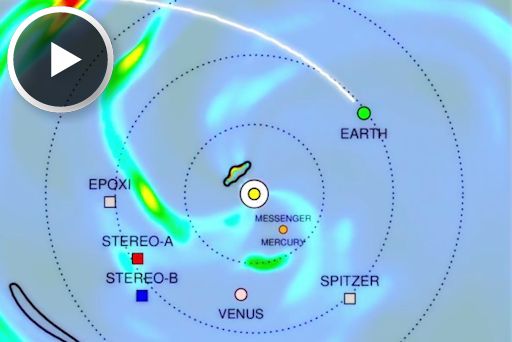
"We set the simulation to start in January of 2015, because the particles passing Pluto in July 2015 took some six months to make the journey from the sun," says Dusan Odstricil of Goddard, who created the Enlil computer code in the 1990s. "During that time there were 120 separate CMEs."
"Our simulation estimates that during the New Horizon approach, Pluto might be immersed in a region with very low solar wind densities, lasting for about one month," says Odstricil. "This will be followed by a large merged region, which could significantly compress Pluto's atmosphere."
This is one of the first space weather forecasts ever attempted so far from Earth. Needless to say, it is unlikely to be a perfect reflection of reality. Odstricil says his model could be off by two to three weeks. However, comparing the models with actual measurements from New Horizons will help make far-out space weather forecasts more accurate in the future.
Realtime Space Weather Photo Gallery