SWx FORECAST VIDEO: Harvard undergraduate Matthew Cappucci has created another forecast video for the readers of spaceweather.com. Check it out! Aurora alerts: text or voice.
PLUTO FLYBY: New Horizons made its closest approach to Pluto this morning, just 7,750 miles above the dwarf planet's surface. Now the waiting begins. During the flyby, the spacecraft was too busy taking pictures and gathering data to communicate with Earth. Mission controllers will receive their first status report from New Horizons this evening after 9 pm EDT letting them know that the spacecraft survived the encounter. Check for updates at the New Horizons home page.
Tired of waiting? Readers of spaceweather.com, many of whom are experienced image processors, have been working with the latest photos of Pluto. Brent from Orlando, Florida, produced this enhanced view of the entire planet as seen by New Horizons on July 13th:
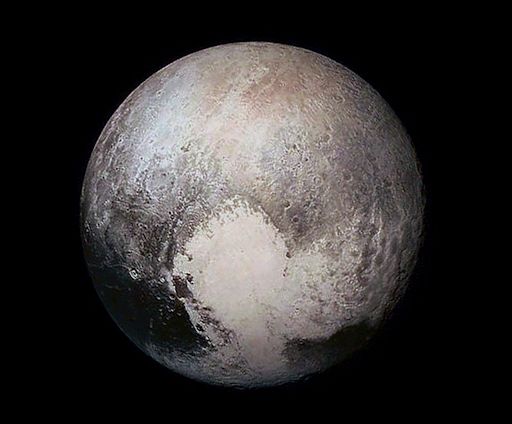
"When I saw the original photo, I ran it through my processing programs: Regi6 (clarifying), Regi4 (tone map), Neb2 (color balance), and Gimp2 (depth merge)," he explains. "Enjoy!"
Additional views of Pluto, both original and alternative, may be found in the Realtime Photo Gallery:
GEOMAGNETIC STORM: A solar wind stream hit Earth's magnetic field on July 13th, sparking a G1-class geomagnetic storm. Technically, such a storm is considered "mild," but this one produced an extra dose of auroras. "I got more than I bargained for considering this was just a G1-class event," reports Lukasz Gornisiewicz of Wainwright, Alberta, Canada. "It was amazing to see the aurora ripping up the twilight, and trying to fight the sunrise!" He recorded the occasion with a self-portrait:
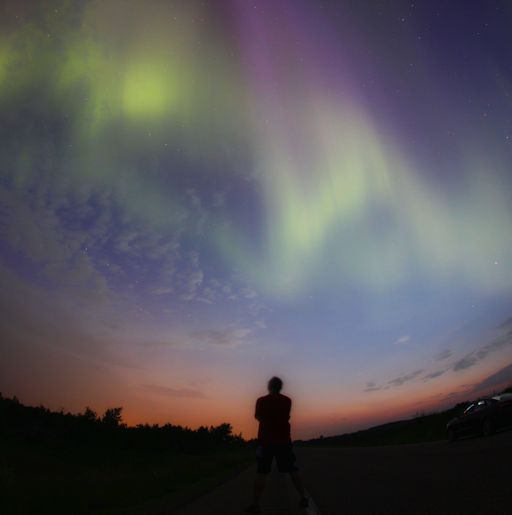
This prococious storm sparked Northern Lights in the USA as far south as Nebraska. "Surprisingly, auroras appeared over the 2015 Nebraska Star Party!" reports amateur astronomer Patrick Cullis. Not quite as surprising, there was also a "gorgeous display" over McMurdo Station at the South Pole.
The solar wind is subsiding now, and the auroras are fading away. NOAA forecasters estimate a 50% chance of additional geomagnetic storms on July 14th, declining to only 20% on July 15-16th. Aurora alerts: text or voice.
ICE AGE NEWS REPORTS ARE EXAGGERATED: Stop the presses. The mainstream media is reporting a sensational new study about the sun's inner magnetic dynamo. According to a double-dynamo model advanced by researchers at Northumbria University in the UK, solar activity could drop by 60% in the 2030s, mimicking conditions during the Little Ice Age of the 17th century. A widely copied quote-fragment from lead researcher Valentina Zharkova states that "...we found that our predictions showed an accuracy of 97%." In fact, the model has never successfully predicted any future solar activity. So far it has only been used to "predict" solar cycles from 1976 to 2008. Almost any model can be fine-tuned to match the past. As forecasting tools, previous dynamo models have failed spectacularly. The double-dynamo model of Zharkova et al may yet prove to be correct, but until it passes the test of correctly predicting future solar activity, there is little reason to worry about an historic decline in sunspots, much less an Ice Age.
Realtime Space Weather Photo Gallery