WEEKEND AURORA WATCH: Earth is expected to pass through a minor stream of solar wind this weekend, causing geomagnetic activity around the poles. High-latitude sky watchers should be alert for "deep-sky" auroras on July 25th and 26th. (Deep sky auroras: Auroras that are barely visible to the naked eye, but look great in photographic exposures of a few seconds or more.) Aurora alerts: text or voice.
RADS ON A PLANE: Many people think that only astronauts have to worry about cosmic radiation. Not so. Regular air travelers are exposed to cosmic rays, too. This week, Spaceweather.com's Dr. Tony Phillips and the students of Earth to Sky Calculus flew across the United States to conduct a transcontinental launch of space weather balloons. They took radiation sensors on board the plane to find out how many cosmic rays they would absorb during the flight. Here are the data they collected:

Radiation levels in the cabin of the Airbus 319 (Spirit Airlines FL640) tripled within ten minutes after takeoff, and were nearly 30 times ground level by the time the plane reached cruising altitude at 39,000 feet. Summing over the entire flight, the sensors measured about 1 mrem of radiation--similar to a dental x-ray. (Note: an earlier comparison to the annual dose of ground-level cosmic rays was incorrect.)
There was no solar storm in progress. The extra radiation was just a regular drizzle of cosmic rays reaching down to aviation altitudes. This radiation is ever-present and comes from supernovas, black holes, and other sources across the galaxy. Solar activity modulates the intensity of cosmic rays. Gusts of solar wind and CMEs can actually cause radiation levels to drop by sweeping aside cosmic rays near Earth. Periods of low solar activity, on the other hand, allow radiation levels to rise.
Solar activity is not the only variable: Radiation levels vary within the plane itself. Different-colored lines in the data plot, above, represent different locations inside the cabin. On this particular flight, dose rates were highest in First Class and lowest near the toilets in the rear. This gradient is not understood; presumably, it has something to do with the way the fuselage and fuel tanks interact with energetic particles. The altitude of the plane matters as well. When the cruising altitude increased about two hours into the flight, dose rates increased accordingly. All of these factors make radiation levels onboard airplanes unpredictable.
The radiation sensors are the same ones that Earth to Sky Calculus routinely flies onboard helium balloons to measure cosmic rays in the stratosphere. They detect X-rays and gamma-rays in the energy range 10 keV to 20 MeV. These energies span the range of medical X-ray machines and airport security scanners.
Stay tuned for updates from the return flight.
Realtime Space Weather Photo Gallery
NOCTILUCENT CLOUDS: Summer is the season for noctilucent clouds (NLCs), and the month of July is often when they are at their best. Indeed, a bright display is underway on July 24/25 over northern Europe. Ronny Tertnes sends this picture from Bergen, Norway:

"There were lots of noctilucent clouds over Norway last night," says Tertnes. "Some passing storm clouds drifted in front of the NLCs, setting the statge for an extra-dramatic shot."
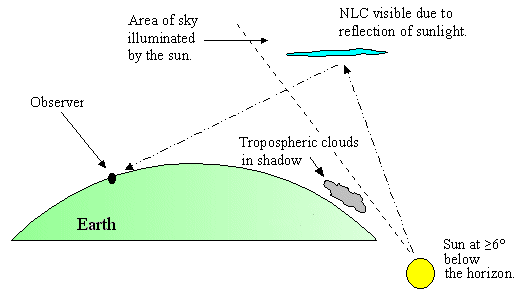
Tertnes's photo illustrates the difference between ordinary clouds and NLCs. Common rain clouds are low, scudding 5 to 10 km above Earth's surface. They are dark at night when the sun is absent. Noctilucent clouds, on the other hand, float at the edge of space, approximately 82 km high, and they glow electric-blue even at midnight.
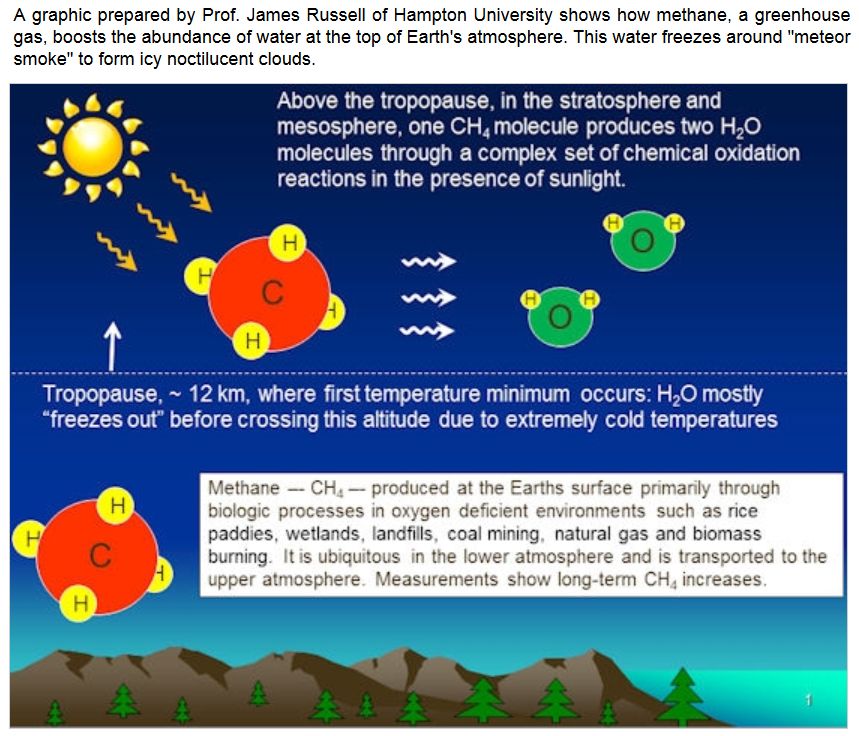
Noctilucent clouds first appeared in the 19th century after the eruption of super-volcano Krakatoa. At the time, people thought NLCs were caused by the eruption, but long after Krakatoa's ash settled, the clouds remained. In recent years, NLCs have intensified and spread with summer sightings as far south as Utah and Colorado. This could be a sign of increasing greenhouse gases in Earth's atmosphere.
Observing tips: Look west 30 to 60 minutes after sunset when the Sun has dipped 6o to 16o below the horizon. If you see luminous blue-white tendrils spreading across the sky, you may have spotted a noctilucent cloud.