QUIET WITH A SLIGHT CHANCE OF FLARES: Solar activity is very low, and it is likely to remain so. There are only two sunspots on the Earthside of the sun; neither has the type of unstable magnetic field that harbors energy for strong explosions. NOAA forecasters put the odds of an M-class flare today at only 5%. Solar flare alerts: text or voice.
ALPHA CAPRICORNID METEOR SHOWER: Earth is passing through a stream of debris from Comet 169P/NEAT, source of the annual alpha Capricornid meteor shower. Last night (July 25-26), NASA's network of all-sky meteor cameras picked up 8 alpha Capricornid fireballs over the USA, including this one above Mount Hopkins, Arizona:
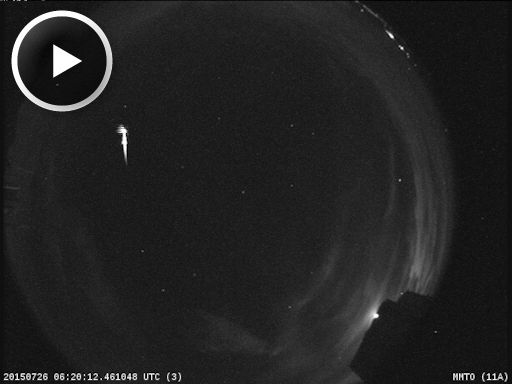
This is an annual shower, which peaks every year between the 25th and 30th of July. Peak rates are typically no higher than 5 to 10 meteors per hour.
Every year, however, the alpha Capricornids are improving. According to the research of meteor experts Peter Jenniskens and Jeremie Vaubaillon, the debris stream is slowly drifting across Earth's orbit, so that each year our planet passes a little closer to its heart. The bulk of the dust will not be in Earth's path until the 24th century. If their predictions are correct, the Alpha Capricornids will become a major annual storm in 2200 - 2400 A.D., one that will be "stronger than any current annual shower."
Until then, sky watchers should remain alert for a relatively small number of alpha Capricornid fireballs in the nights ahead. Observers in both hemispheres can see this minor but beautiful shower. The best time to look is during the hours around local midnight when the constellation Capricorn reaches its highest point in the southern sky.
Realtime Space Weather Photo Gallery
RADS ON A PLANE: Many people think that only astronauts have to worry about cosmic radiation. Not so. Regular air travelers are exposed to cosmic rays, too. This week, Spaceweather.com's Dr. Tony Phillips and the students of Earth to Sky Calculus flew across the United States to conduct a transcontinental launch of space weather balloons. They took radiation sensors on board the plane to find out how many cosmic rays they would absorb during the flight. Here are the data they collected:

Radiation levels in the cabin of the Airbus 319 (Spirit Airlines FL640) tripled within ten minutes after takeoff, and were nearly 30 times ground level by the time the plane reached cruising altitude at 39,000 feet. Summing over the entire flight, the sensors measured about 1 mrem of radiation--similar to a dental x-ray. (Note: an earlier comparison to the annual dose of ground-level cosmic rays was incorrect.)
There was no solar storm in progress. The extra radiation was just a regular drizzle of cosmic rays reaching down to aviation altitudes. This radiation is ever-present and comes from supernovas, black holes, and other sources across the galaxy. Solar activity modulates the intensity of cosmic rays. Gusts of solar wind and CMEs can actually cause radiation levels to drop by sweeping aside cosmic rays near Earth. Periods of low solar activity, on the other hand, allow radiation levels to rise.
Solar activity is not the only variable: Radiation levels vary within the plane itself. Different-colored lines in the data plot, above, represent different locations inside the cabin. On this particular flight, dose rates were highest in First Class and lowest near the toilets in the rear. This gradient is not understood; presumably, it has something to do with the way the fuselage and fuel tanks interact with energetic particles. The altitude of the plane matters as well. When the cruising altitude increased about two hours into the flight, dose rates increased accordingly. All of these factors make radiation levels onboard airplanes unpredictable.
The radiation sensors are the same ones that Earth to Sky Calculus routinely flies onboard helium balloons to measure cosmic rays in the stratosphere. They detect X-rays and gamma-rays in the energy range 10 keV to 20 MeV. These energies span the range of medical X-ray machines and airport security scanners.
Stay tuned for updates from the return flight.