DECREASING CHANCE OF STORMS: NOAA forecasters have downgraded the chance of polar geomagnetic storms on July 29th to 30% as Earth exits a stream of fast-moving solar wind. Even if a storm does break out, auroras will likely be muted by the glare of the waxing Blue Moon. [forecast video] Aurora alerts: text or voice.
HALOBACTERIA SET A NEW HIGH-ALTITUDE RECORD: Astrobiologsts have long wondered if halobacteria, a terrestrial extremophile with a special talent for shielding itself from UV radiation, could survive on the planet Mars. To find the answer, the students of Earth to Sky Calculus have been flying halobacteria onboard balloons to the top of Earth's atmosphere. During their latest flight on July 20th, the microbes set a high-altitude record for their species. Here they are 118,134 feet above the Sierras of central California:

Note the circled tubes in the image. Those contain Halorubrum lacusprofundi, a species of halobactera that normally lives in Antarctica's Deep Lake. These microbes have cold-tolerant proteins and DNA repair mechanisms that could help them adapt to space-like environments. The previous altitude record for this species, set just last month, was 111,000 ft. This is almost two miles higher than before.
During the July 20th flight, onboard sensors registered temperatures as low as -57 C, air pressures only 1% of sea level, and cosmic radiation levels more than 40 times Earth-normal. Those are conditions akin to the planet Mars. The students have already shown that halobacteria can survive trips like this. Now, working with microbiologists Shil and Priya DasSarma of the University of Maryland, they are working to measure survival rates, growth curves, and possible mutations among the survivors. Results will contribute to an important body of knowledge about the prospects for life on Mars -- past, present, and future.
HEY THANKS! This flight was sponsored by J.R. Biggs whose $500 donation bought the helium and other supplies nessesary to break the altitude record for halobacteria. To say "thanks," we flew a birthday card for his son Aidan:

Aidan looks like a future member of Earth to Sky Calculus...
Readers, if you would like to sponsor a research balloon--and see your birthday card, photo, business logo, or small item at the edge of space--please contact Dr. Tony Phillips to book a flight.
Tomorrow: The Pfotzer Maximum over New Hampshire and California
DAYTIME PLANETS: Usually, astronomers wait until the sun sets to start taking pictures of the heavens. Yesterday (July 28th) in Malaysia, astrophotographer Shahrin Ahmad showed that darkness is not required. "I photographed four planets in broad daylight," he says. Here they are bracketed by the sun and Moon:

From left to right are crescent-shaped Venus, Jupiter, Mercury, and ringed Saturn. "We were blessed with a good clean sky over Sri Damansara," says Ahmad. "Mercury was surprisingly easy to spot, despite the fact that it was located about 5º from the Sun."
This kind of daytime astronomy is made possible, in part, by modern GOTO telescopes. Once the computerized telescope is aligned on the sky, it can find planets and other objects at any time of day. Some targets, like Venus, are arguably more beautiful when surrounded by daytime blue than nighttime black. Look for more daytime shots scattered throughout the Realtime Photo Gallery:
Realtime Space Weather Photo Gallery
WILL THE MOON REALLY TURN BLUE? When someone says "Once in a Blue Moon," you know what they mean: rare, seldom, even absurd. This year it means "the end of July." For the second time this month, the Moon is about to become full. There was one full Moon on July 2nd, and now another is coming on July 31st. According to modern folklore, the second full Moon in a calendar month is "blue." Strange but true: Sometimes the Moon really turns blue. Scroll past the waxing full Moon, photographed on July 25th by Giuseppe Petricca of Pisa, Italy, for more information:
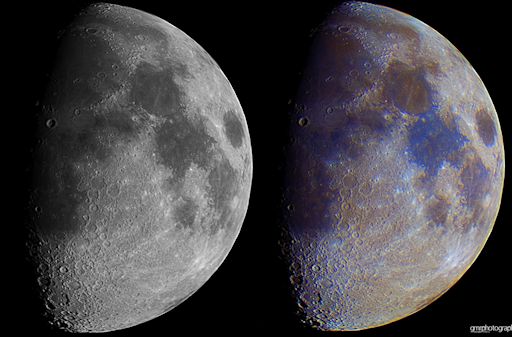
The blue areas in the color-enhanced image (right) are caused by titanium in lunar soil. [more]
A truly-blue Moon usually requires a volcanic eruption. Back in 1883, for example, people saw blue moons almost every night after the Indonesian volcano Krakatoa exploded with the force of a 100-megaton nuclear bomb. Plumes of ash rose to the very top of Earth's atmosphere, and the Moon became an azure-colored disk.
Krakatoa's ash was the reason. Some of the plumes were filled with particles 1 micron wide, about the same as the wavelength of red light. Particles of this special size strongly scatter red light, while allowing blue light to pass through. Krakatoa's clouds thus acted like a blue filter. People also saw blue-colored Moons in 1983 after the eruption of the El Chichon volcano in Mexico. And there are reports of blue Moons caused by Mt. St. Helens in 1980 and Mount Pinatubo in 1991.
Forest fires can do the same trick. A famous example is the giant muskeg fire of Sept. 1953 in Alberta, Canada. Clouds of smoke containing micron-sized oil droplets produced lavender suns and blue Moons all the way from North America to England. At this time of year, summer wildfires often produce smoke with an abundance of micron-sized particles–just the right size to turn the Moon truly blue. Sky watchers in western parts of the USA and Canada, where wildfires are in progress, could experience this phenomenon.