GEOMAGNETIC STORM: Arriving a full day earlier than expected, a CME hit Earth's magnetic field on August 15th (~0800 UT). The impact triggered a strong G3-class geomagnetic storm, now subsiding. Sanjana Greenhill observed these auroras just before sunrise over Anchorage, Alaska:

"The Northern Lights were very bright," says Greenhill.
The CME (movie) that caused the display was propelled toward Earth by a magnetic filament, which erupted on the sun August 12th. A fast-moving solar wind stream is expected to arrive in the wake of the CME. The combined impact of the CME and arrival of the solar wind could energize geomagnetic activity for the rest of the weekend. High-latitude sky watchers should remain alert for auroras. Aurora alerts: text or voice

HAPPY BIRTHDAY AT THE EDGE OF SPACE: Photographer Annika Ebbinghaus turned 30 today, Aug. 15th--and what better way to celebrate than with an Edge of Space Birthday Card? Here she is 111,000 feet above Earth's surface:

"Happy birthday Annika!" says her mother, Adelheid Ebbinghaus, who made a generous donation to Earth to Sky Calculus to fly the card. "You are my sunshine…, and I love you so much!" Annika is starting a new career as a photographer (heavenlyphotography@web.de). She is starting at the top!
GIGANTIC JETS ABOVE HURRICANE HILDA: Yesterday, we reported a rare apparition of sprites above Hurricane Hilda. Steve Cullen, who lives in Hawaii where the storm is heading, spotted them in video from the Canada-France-Hawaii Telescope CloudCam atop Maunakea. A closer look at the video, however, reveals that the dancing forms were not sprites. Instead, Hurricane Hilda has gigantic jets:
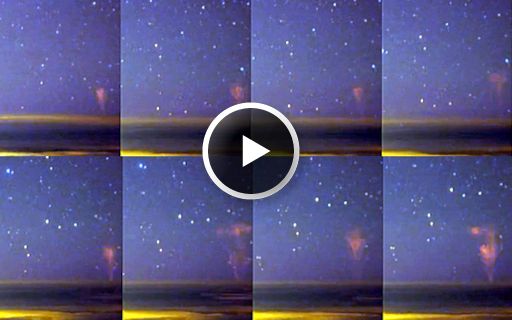
Think of them as sprites on steroids: Gigantic jets are lightning-like discharges that spring from the tops of thunderstorms, reaching all the way from the thunderhead to the ionosphere more than 50 miles overhead. They're enormous and powerful.
"Gigantic jets are much more rare than sprites," says Oscar van der Velde, a member of the Lightning Research Group at the Universitat Politècnica de Catalunya. "While sprites were discovered in 1989 and have since been photographed by the thousands, it was not until 2001-2002 that gigantic jets were first recorded from Puerto Rico and Taiwan." Only a few dozen gigantic jets have ever been seen, mostly over open ocean.
Because gigantic jets are so rare, researchers are paying special attention to Hurricane Hilda. "Observations in recent years suggest that large thunderstorm clusters embedded in tropical cyclones harbor favorable conditions for gigantic jets. Hilda seems to confirm this. Extreme turbulent mixing in the storm top may assist in triggering these events," he says.
Gigantic jets, and their cousins the sprites, reach all the way up to the edge of space alongside meteors, noctilucent clouds, and some auroras. This means they are a true space weather phenomenon. Indeed, some researchers believe cosmic rays help trigger these exotic forms of lightning, but the link is controversial.
Stay tuned for more observations of Hilda's cloudtops as it approaches Hawaii.
INFERIOR CONJUNCTION OF VENUS: This weekend, Venus is passing almost directly between Earth and the sun—an event astronomers call "an inferior conjunction of Venus." The night side of Venus is now facing Earth, with only a sliver of its illuminated dayside visible from our side of the conjunction. Joe Mcbride sends this picture, taken on Aug. 15th, from Grand Rapids, Michigan:

"During the past week, it has been interesting to watch the crescent rotate around as Venus got closer to the sun, and then passed it," says McBride.
This is arguably the most beautiful time to observe Venus--but also the most perilous. Even when a telescope is pointed perfectly at Venus, the indirect glare of the nearby sun can damage the eyes of anyone looking through the eyepiece.
Anthony J. Cook of the Griffith Observatory has some advice for observers: "I have observed Venus at conjunction, but only from within the shadow of a building, or by adding a mask to the front end of the telescope to fully shadow the optics from direct sunlight. This is tricky with a refractor or a catadioptric, because the optics start at the front end of the tube. Here at Griffith Observatory, I rotate the telescope dome to make sure the lens of the telescope is shaded from direct sunlight, even through it means that the lens will be partially blocked when aimed at Venus. With our Newtonian telescope, I add a curved cardboard mask at the front end of the tube to shadow the primary mirror."
Potential observers should take precautions as outlined above. That said, if you have a GOTO telescope, command it to slew to Venus this evening. The crescent is marvelous.
Realtime Space Weather Photo Gallery