(ALMOST NO) CHANCE OF FLARES: There are only two small sunspots on the Earth-facing side of the sun, and neither one has the type of unstable magnetic field that harbors energy for strong explosions. NOAA forecasters estimate a scant 1% chance of M- or X-type solar flares on Aug. 17th. Solar flare alerts: text or voice
NORTHERN LIGHTS RE-APPEAR IN THE ARCTIC: For the past few months, Arctic skies have been too bright to see auroras--even at midnight. Now, however, darkness is returning and so are the Northern Lights. On Aug. 17th, Marketa S. Murray photographed this outburst of auroras over Fairbanks, Alaska:

"Finally, we have enough darkness here in the land of the Midnight Sun for auroras to be visible," says Murray. "It's great to see them again."
The outburst was the luminous aftershock of a CME that hit Earth's magnetic field on Aug. 15th. The impact sparked a strong G3-class geomagnetic storm on Saturday, followed by lesser G1-class disturbances on Sunday and Monday. As Murray's photo shows, Earth's magnetic field is still unsettled on Aug. 17th. NOAA forecasters estimate a 40% to 60% chance of more geomagnetic storms in the next 24 hours. Aurora alerts: text or voice
SPRITES AND TROLLS AT THE EDGE OF SPACE: We all know what comes out of the bottom of thunderclouds: lightning. But rarely do we see what comes out of the top. On August 10th, astronauts onboard the International Space Station were perfectly positioned to observe red sprites dancing atop a cluster of storms in Mexico. They snapped this incredible photo:
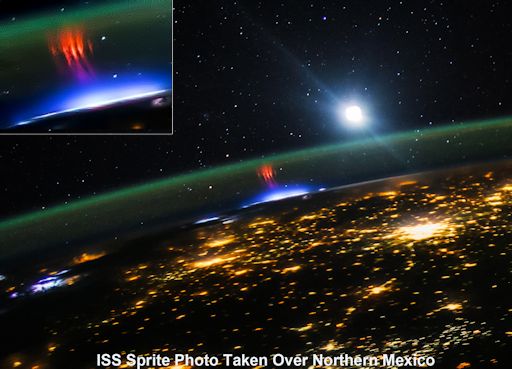
This shows just how high sprites can go. The photo shows their red forms reaching all the way from the thunderstorm below to a layer of green airglow some 100 km above Earth's surface. This means sprites touch the edge of space, alongside auroras, meteors and noctilucent clouds. They are a true space weather phenomenon.
A few minutes after the astronauts saw the sprites, they spotted a related creature--a "Troll." It jumped up to the left of the sprites:
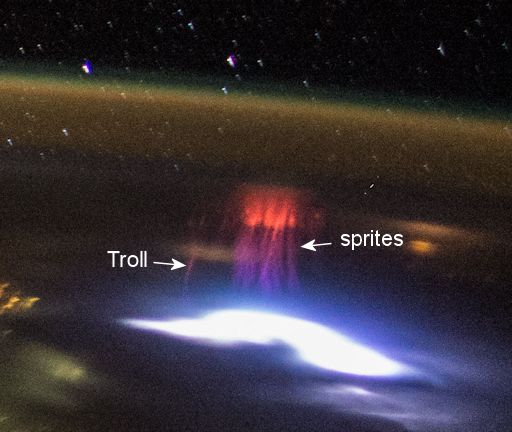
"Trolls are also known as 'secondary transient luminous events," explains Oscar van der Velde, a member of the Lightning Research Group at the Universitat Politècnica de Catalunya. "They are occasionally observed alongside big clusters of sprites, and they can reach 40-60 km high."
Van der Velde says that sprites can actually pull Earth's ionosphere down toward the thunderstorm. When the gap shrinks, and the local electric field intensifies, Trolls appear.
You don't have to be onboard a spaceship to see these exotic forms of lightning. "Sprite chasers" regularly photograph the upward bolts from their own homes. Van der Velde has photographed Trolls from ground-level, too. "I recorded these trolls last October over a storm over the Mediterranean Sea west of Sardinia and Corsica," he says. Browse the sprite gallery for more examples.
Realtime Space Weather Photo Gallery