(ALMOST NO) CHANCE OF FLARES: There is only one small solitary sunspot on the Earth-facing side of the sun, and it poses no threat for strong flares. NOAA forecasters estimate a scant 1% chance of M- or X-type solar flares on Aug. 18th. Solar flare alerts: text or voice
A RARE FORM OF AURORAS: A surprisingly strong G3-class geomagnetic storm erupted on Aug. 15th when a CME hit Earth's magnetic field. Two nights later, as the storm was subsiding, midnight sky watchers in North America witnessed a rare and beautiful form of aurora--a "proton arc." Paul Zizka photographed the phenomenon on Aug. 17th from Banff, Alberta:
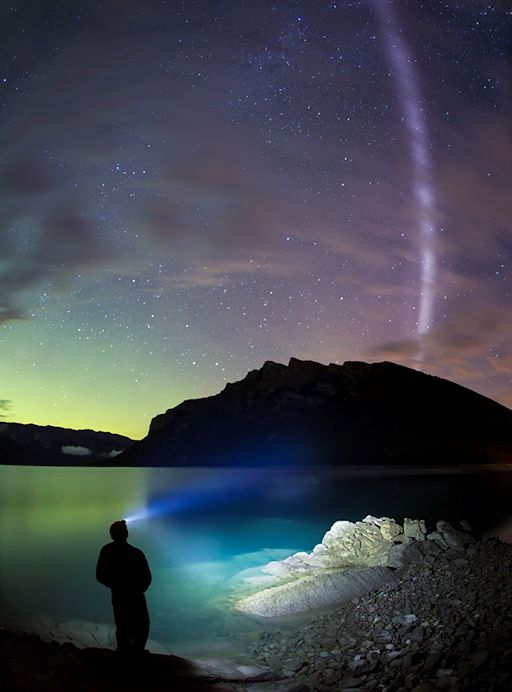
"It was incredible," says Zizka. "The whitish pillar remained nearly stationary for over 30 minutes--enough time for a self-portrait."
In Val Marie, Saskatchewan, photographer Sherri Grant saw a purple proton arc cutting across the Milky Way. And in Oroville, Washington, at the Table Mountain Star Party, campers witnessed at least two more arcs.
Ordinary auroras are caused by electrons, which rain down on Earth's atmosphere from above. Atoms of oxygen and nitrogen, excited by the pitter-patter of electrons, form dynamic curtains of light. Protons have a different effect. For reasons not fully understood, protons normally trapped in our planet's ring current sometimes rain down on Earth's atmosphere during geomagnetic storms. En route, they excite a type of plasma wave called "EMIC"--short for electromagnetic ion cyclotron waves. The result is not a curtain, but rather a tight arc of light as shown above.
Many of the photographers who witnessed proton arcs on Aug. 17th have been observing auroras for years, yet they had never seen this phenomenon before. Geomagnetic storms still have the capacity to surprise! Aurora alerts: text or voice
SOLAR TORNADO: It's a good thing that Earth is 150 million kilometers from the sun. Otherwise we might have close encounters like this:
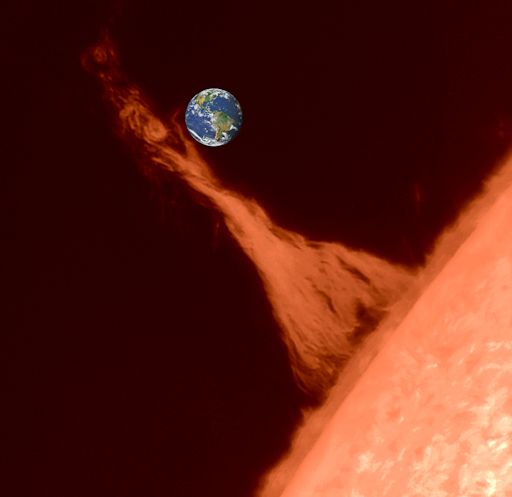
French astrophotographer Philippe Tosi took the picture on August 17th, and he inserted an image of Earth for scale. The twisting plume of plasma stands more than 60,000 km (more than 5x the diameter of our planet) above the sun's surface.
"To me," says Tosi, "it looks like a woman dribbling Earth like a basketball." Others have likened the structure to the Eiffel Tower and a tornado.
Aug. 18th marks is the third day in a row that the twister has been sighted. To monitor its progress, observers with backyard solar telescopes are encouraged to train their optics on the sun's western limb. Or look in the realtime photo gallery:
Realtime Space Weather Photo Gallery
SPRITES AND TROLLS AT THE EDGE OF SPACE: We all know what comes out of the bottom of thunderclouds: lightning. But rarely do we see what comes out of the top. On August 10th, astronauts onboard the International Space Station were perfectly positioned to observe red sprites dancing atop a cluster of storms in Mexico. They snapped this incredible photo:
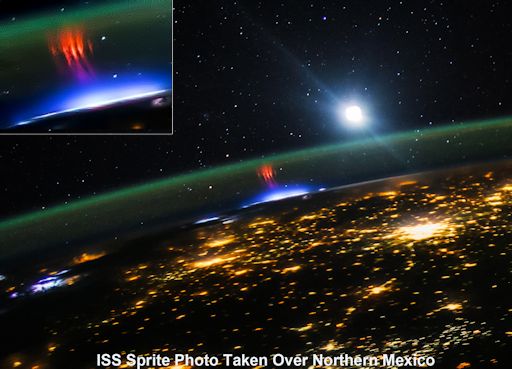
This shows just how high sprites can go. The photo shows their red forms reaching all the way from the thunderstorm below to a layer of green airglow some 100 km above Earth's surface. This means sprites touch the edge of space, alongside auroras, meteors and noctilucent clouds. They are a true space weather phenomenon.
A few minutes after the astronauts saw the sprites, they spotted a related creature--a "Troll." It jumped up to the left of the sprites:
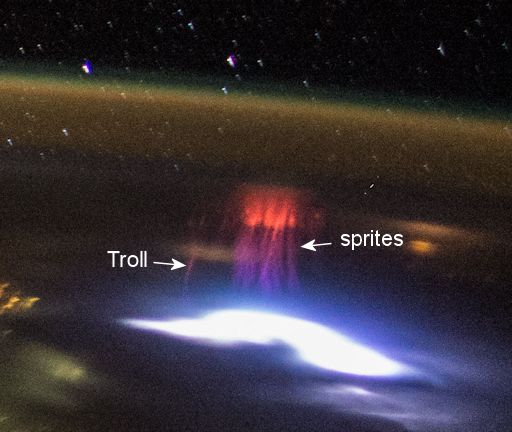
"Trolls are also known as 'secondary transient luminous events," explains Oscar van der Velde, a member of the Lightning Research Group at the Universitat Politècnica de Catalunya. "They are occasionally observed alongside big clusters of sprites, and they can reach 40-60 km high."
Van der Velde says that sprites can actually pull Earth's ionosphere down toward the thunderstorm. When the gap shrinks, and the local electric field intensifies, Trolls appear.
You don't have to be onboard a spaceship to see these exotic forms of lightning. "Sprite chasers" regularly photograph the upward bolts from their own homes. Van der Velde has photographed Trolls from ground-level, too. "I recorded these trolls last October over a storm over the Mediterranean Sea west of Sardinia and Corsica," he says. Browse the sprite gallery for more examples.