CHANCE OF WEEKEND STORMS: NOAA forecasters estimate a 40% chance of polar geomagnetic storms today, increasing to 70% by Aug. 23rd. These storms, if they occur, would be caused by a pair of solar wind streams now heading for Earth. High-latitude sky watchers should be alert for auroras this weekend. Aurora alerts: text or voice
GROWING SUNSPOT: Since the day before yesterday, sunspot AR2403 has more than quadrupled in size. It is now more than 90,000 km wide and poses a threat for M-class solar flares. John Ashley photographed it through the smokey atmosphere of Kila, Montana, on Aug. 20th:

"One good thing about our forest fires is that the smoke makes it easier to see sunspots," says Ashley. "The current grouping of sunspot AR 2403 is heading towards a central location [on the solar disk] and should offer excellent views in the days ahead."
It might offer some excellent flares, too. Just this morning, Aug. 21st at 0220 UT, AR2304 unleashed the first M-flare in 45 days: movie. A flash of extreme UV radiation ionized the top of Earth's atmosphere, causing a minor HF radio blackout over the western Pacific Ocean. This event could be the herald of more eruptions to come, so stay tuned. Solar flare alerts: text or voice
Realtime Space Weather Photo Gallery
SPRITES AND TROLLS AT THE EDGE OF SPACE: We all know what comes out of the bottom of thunderclouds: lightning. But rarely do we see what comes out of the top. On August 10th, astronauts onboard the International Space Station were perfectly positioned to observe red sprites dancing atop a cluster of storms in Mexico. They snapped this incredible photo:
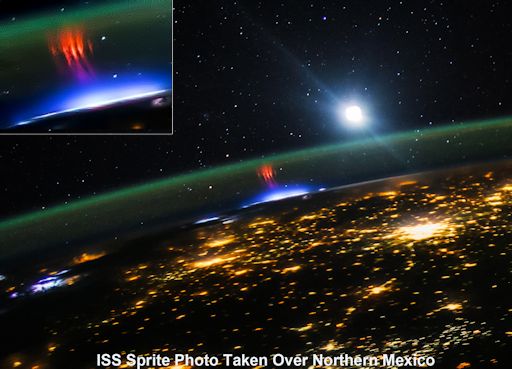
This shows just how high sprites can go. The photo shows their red forms reaching all the way from the thunderstorm below to a layer of green airglow some 100 km above Earth's surface. This means sprites touch the edge of space, alongside auroras, meteors and noctilucent clouds. They are a true space weather phenomenon.
A few minutes after the astronauts saw the sprites, they spotted a related creature--a "Troll." It jumped up to the left of the sprites:
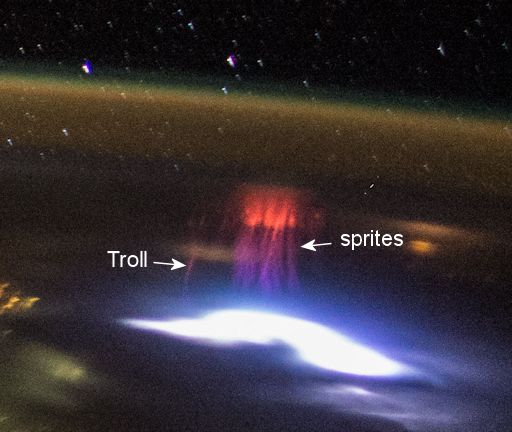
"Trolls are also known as 'secondary transient luminous events," explains Oscar van der Velde, a member of the Lightning Research Group at the Universitat Politècnica de Catalunya. "They are occasionally observed alongside big clusters of sprites, and they can reach 40-60 km high."
Van der Velde says that sprites can actually pull Earth's ionosphere down toward the thunderstorm. When the gap shrinks, and the local electric field intensifies, Trolls appear.
You don't have to be onboard a spaceship to see these exotic forms of lightning. "Sprite chasers" regularly photograph the upward bolts from their own homes. Van der Velde has photographed Trolls from ground-level, too. "I recorded these trolls last October over a storm over the Mediterranean Sea west of Sardinia and Corsica," he says. Browse the sprite gallery for more examples.
RADIO STORM ON JUPITER: Two days ago, amateur astronomer Thomas Ashcraft of New Mexico pointed his radio telescope at the sun, something he does on a regular basis to monitor solar activity. As if on cue, the loud speaker erupted in a series of hisses and crackles. However, the source of the static wasn't the sun--it was Jupiter. "I detected a powerful radio storm on Jupiter," he says. Click on the image to play the 'rat-a-tat-tat' sounds of the giant planet:
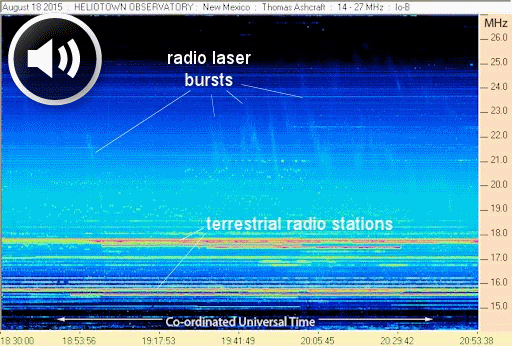
"Jupiter was overhead at noon local time and right in the sweet spot of my radio telescope," says Ashcraft. "The radio storm lasted a full two hours."
Jupiter is a powerful source of shortwave radio bursts. They come from natural radio lasers in the giant planet's magnetosphere. Electrical currents flowing between Jupiter's upper atmosphere and the volcanic moon Io can boost these emissions to power levels easily detected by ham radio antennas on Earth. That's what happened on August 18th. Each of the sharp crackles in the recording coresponds to a single radio laser beam sweeping past Earth as Jupiter rotates.
Ashcraft notes that Jupiter is passing behind the sun this week, "so Jupiter is about as far away from Earth as it ever gets. I detected these bursts from a distance of 955,022,185 kilometers."
To learn more about radio storms on Jupiter, and how you can observe them yourself, visit NASA's RadioJove web site.