STILL WAITING FOR CMEs: A pair of CMEs expected to reach Earth on Aug. 24th did not arrive on time. This means they are slower and less potent than previously thought. NOAA forecasters have downgraded the chance of a G1-class geomagnetic storm on Aug. 25th to 35%. Aurora alerts: text or voice
ON THE OTHER HAND, WHO NEEDS CMEs? Even without the impact of a CME, Earth's magnetic field was unsettled enough on Aug. 24th to create a spectacular display of auroras over the south pole. Liu Yang sends this picture from the China's Zhongshan Station in Antarctica:

"A giant green spiral expanded from north to south, which is always seen at the polar boundary of the auroral belt," says Yang. "It was a strong display."
The source of the display was a solar wind stream, which has been buffeting Earth's magnetic field ahead of the incoming CMEs. For more photos from around the world, stay tuned to the realtime aurora gallery:
HUGE SUNSPOT FACES EARTH: Yesterday, sunspot AR2403 was huge. Today it is 25% bigger. Philippe Tosi photographed the growing active region from his backyard observatory in Nîmes, France. Scroll down and behold almost 200,000 km of dark magnetism:

Tosi inserted a picture of Earth for scale. The primary cores of AR2403 are as large as our entire planet. These dimensions make it an easy target for backyard solar telescopes.
Moreover, AR2403 has a 'beta-gamma-delta' magnetic field that harbors energy for strong explosions. NOAA forecasters estimates a 65% chance of M-class solar flares and a 10% chance of X-flares on Aug. 25th. Any eruptions will almost surely be geoeffective. Aurora alerts: text or voice
Realtime Space Weather Photo Gallery
SPACE YEAST SURVIVE AND MUTATE: Yeast and people have a lot in common. About 1/3rd of our DNA is the same. Indeed, the DNA of yeast is so similar to that of humans, yeast can actually live with human genes spliced into their genetic code. This is why Spaceweather.com and the students of Earth to Sky Calculus have been flying yeast to the edge of space. Understanding how the microbes respond to cosmic rays could tell us how human cells respond as well. Here are three strains of yeast (one per test tube) flying 113,936 feet above Earth's surface on August 15th:

The student in the picture is Joey, a high school senior, hitching a ride to the stratosphere along with the yeast. Joey and other members of the student research team are busy measuring growth curves and mutation rates for the space-traveling yeast.
One result is already clear: Yeast are incredibly tough. En route to the stratosphere they were frozen solid at temperatures as low as -63C, and they experienced dose rates of ionizing radiation 100x Earth normal. Survival rates in some of the returning samples were close to 100%.
Photo-micrographs show that yeast mutates in the stratosphere. This image, for instance, shows a colony of white mutants alongside the normal red colonies of Saccharomyces cerevisiae (HA2):
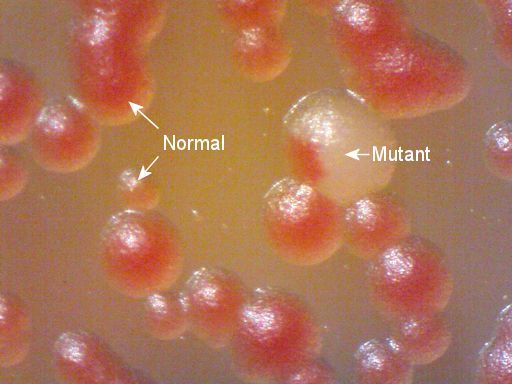
In addition to the white mutation shown above, the students have also observed petite mutants, which are a sign of changes in the cells' mitochondrial genome. These changes are of interest to space biologists because the DNA repair mechanisms of yeast are remarkably similar to those of human beings. In particular, proteins encoded by yeast RAD genes are closely related to proteins used by human cells to undo radiation damage.
Another flight of the yeast is scheduled for this Wednesday, Aug. 26th. What mutants will emerge this time? Stay tuned!
HEY THANKS: The students wish to say thanks to Dan Salkovitz, who sponsored the August 15th balloon flight. In exchange for his generous donation of $500, they flew Dan himself to the edge of space:

Readers, if you would like to sponsor an upcoming student research flight, and see your favorite picture flown to the stratosphere, please contact Dr. Tony Phillips to make arrangements.