THE *REAL* SUPERMOON IS NEXT MONTH: Many observers are calling this weekend's full Moon a "supermoon" because it is less than a day from perigee (the closest point to Earth on the Moon's elliptical orbit). In fact, next month's full Moon is even better. It will be less than an hour from perigee. Moreover, the supermoon of Sept. 27-28th will be eclipsed by Earth's shadow, turning it a beautiful shade of celestial red visible from Europe, the Americas, and parts of Africa. Mark your calendar!

NORTHERN LIGHTS, NO PARKA REQUIRED: Arctic skies are dimming again after a rare burst of August auroras. For the past few days, Earth has been passing through a region of space where interplanetary magnetic fields opened a crack in the magnetosphere. Solar wind poured in to fuel displays like this one over Anchorage, Alaska:
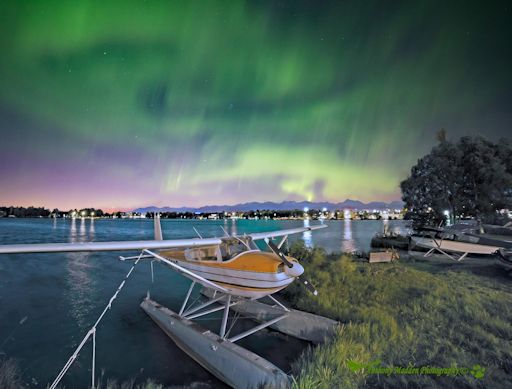
"The sky was full of lights," says Anthony Madden, who took the picture from Lake Hood Airport on Aug. 28th. "The best part was, it was warm enough that I did not need a parka."
The storms are subsiding now, but they could return on Sept. 2nd when Earth crosses through a fold in the heliospheric current sheet. This is called a "solar sector boundary crossing," and NOAA forecasters estimate a 70% chance of polar geomagnetic storms when it occurs. Aurora alerts: text or voice
THE EDGE OF THE SUN: Giant sunspot AR2403 has departed, leaving the face of the sun mostly blank. Amateur astronomer Sergio Castillo of Corona, CA, decided to look for something else to photograph. "My search didn't take long," he says, "because there are plenty of beautiful prominences on the solar limb." This is what he saw on Aug. 29th:
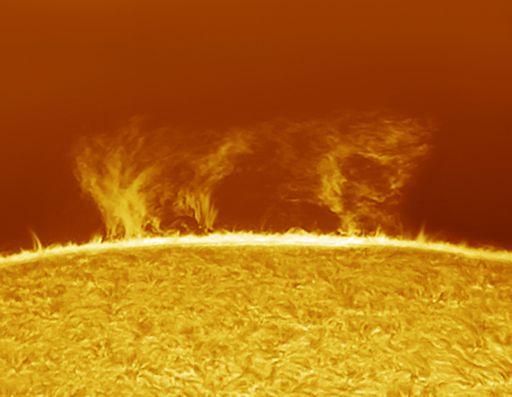
The massive structure is more than 30,000 km tall and 100,000 km wide. Planet Earth could fit through the central arch with room to spare. (Croquette, anyone?)
Prominences are plumes of hot plasma held aloft by magnetic fields on the sun. Typical prominences last a few days, until the underlying magnetic supports become unstable and collapse. This one has already been visible for several days, so a photogenic explosion could be in the offing. Amateur astronomers with solar telescopes and filters are encouraged to monitor developments.
Realtime Space Weather Photo Gallery
THE SUN SWALLOWS A COMET: On Friday, Aug.28th, the sun swallowed a comet. The Solar and Heliospheric Observatory (SOHO) spotted the icy vistor from the outer solar system making a headlong plunge into our star. One comet went in; none came out. Click to play the movie:

Heated by the sun at point blank range, the comet's fragile ices vaporized, leaving at most a "rubble pile" of rock and gravel scattered along its sungrazing orbit. Any remains are invisible from Earth.
The comet, R.I.P., was probably a member of the Kreutz family. Kreutz sungrazers are fragments from the breakup of a single giant comet many centuries ago. They get their name from 19th century German astronomer Heinrich Kreutz, who studied them in detail. Several Kreutz fragments pass by the sun and disintegrate every day. Most, measuring less than a few meters across, are too small to see, but occasionally a bigger fragment like this one (~10 m to 50 m) attracts attention.
Because of their common parentage, sungrazers often come in clusters. For this reason, it wouldn't be surprising to find yet another one in the offing. Monitor Karl Battam's Sungrazing Comet twitter feed for more sightings.
Realtime Space Weather Photo Gallery