GROUND CURRENTS IN NORWAY: Last night (Sept. 1-2), a monitoring station in Lofoten, Norway, detected a brief but strong surge of electrical currents running through the soil. This could be a sign that Earth crossed through a fold in the heliospheric current sheet--also known as a "solar sector boundary crossing." The crossing sets the stage for possible geomagnetic storms later today when a high-speed solar wind stream is expected to arrive, further disturbing the geomagnetic field. High-latitude sky watchers should be alert for auroras on Sept. 2-3. Aurora alerts: text or voice
156 YEARS AGO, A GEOMAGNETIC MEGA-STORM: On Sept. 2nd, a billion-ton coronal mass ejection (CME) slammed into Earth's magnetic field. Campers in the Rocky Mountains woke up in the middle of the night, thinking that the glow they saw was sunrise. No, it was the Northern Lights. People in Cuba read their morning paper by the red illumination of aurora borealis. Earth was peppered by particles so energetic, they altered the chemistry of polar ice.
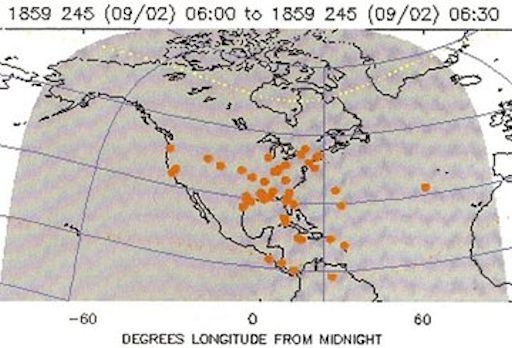
Hard to believe? It really happened--exactly 156 years ago. This map shows where auroras were sighted in the early hours of Sept. 2, 1859:
As the day unfolded, the gathering storm electrified telegraph lines, shocking technicians and setting their telegraph papers on fire. The "Victorian Internet" was knocked offline. Magnetometers around the world recorded strong disturbances in the planetary magnetic field for more than a week.
The cause of all this was an extraordinary solar flare witnessed the day before by British astronomer Richard Carrington. His sighting marked the discovery of solar flares and foreshadowed a new field of study: space weather. According to the National Academy of Sciences, if a similar storm occurred today, it would cause a trillion dollars in damage to society's high-tech infrastructure and require four to ten years for complete recovery.
In fact, a similar flare did occur just a few years ago. On July 23, 2012, a CME of rare power rocketed away from the sun. The storm was in all respects at least as strong as the 1859 Carrington event. The only difference is, it missed. no harm done. The July 2012 event serves as a reminder, however, that extreme space weather is not a thing of the past.
Realtime Space Weather Photo Gallery
RED SPRITES OVER EUROPE: As September begins, solar activity is low. Nevertheless, space weather continues. High above thunderstorms in Europe, red sprites are dancing across the cloudtops, reaching up to the edge of space itself. Martin Popek photographed these specimens yesterday from Nýdek, the Czech republic:

"I used a zoom lens for a close-up view of these sprites, which could just be seen over the treetops as they jumped upward from a distant storm," says Popek.
Inhabiting the upper reaches of Earth's atmosphere alongside noctilucent clouds, meteors, and some auroras, sprites are a true space weather phenomenon. Some researchers believe they are linked to cosmic rays: subatomic particles from deep space striking the top of Earth's atmosphere produce secondary electrons that, in turn, could provide the spark that triggers sprites.
Although sprites have been seen for at least a century, most scientists did not believe they existed until after 1989 when sprites were photographed by cameras onboard the space shuttle. Now "sprite chasers" regularly photograph the upward bolts from their own homes. Give it a try.
SPACE STATION TRANSITS A PROMINENCE: In recent years, astrophotographers have become increasingly adept at catching the International Space Station during split-second transits of the sun. The winged form of the behemoth spaceship looks beautiful when backlit by fiery plasma, and on more than one occasion it has been seen in conjunction with active sunspots. Now, for perhaps the first time, Thierry Legault of Paris, France, has captured the silhouette of the ISS passing in front of a solar prominence:

"This was no accident," says Legault. "Using Calsky to predict the circumstances of the transit, I positioned my telescope 1 mile north of the central transit line so that the ISS would pass directly between me and the prominence."
His pinpoint preparations worked, and he captured more than 30 video frames of the ISS zooming across the face of the sun. The complete crossing may be seen on Youtube.
Solar observers are paying extra attention to prominences this week because that is almost the only thing to see. With only a few small sunspots dotting the solar disk, the face of the sun is nearly featureless. Plumes of plasma rising over the sun's limb are the photo-op du jour--even better when a spaceship joins the show.