FLAT-LINING: Solar activity is very low. With no flare-producing sunspots on the solar disk, the sun's X-ray output is flat-lining. NOAA forecasters say the odds of a strong solar flare on Sept. 3rd is no more than 1%. Solar flare alerts: text or voice

RED AIRGLOW OVER CHILE: On Sept. 1st, astrophotographer Yuri Beletsky hiked into the Atacama Desert of Chile for a deep exposure of the Milky Way. He got that and much more. "There was a stunning display of red airglow," he says. It surrounded the Milky Way like a celestial bulls-eye:
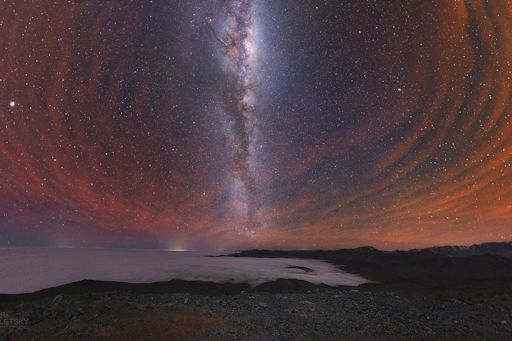
Airglow is aurora-like phenomenon caused by chemical reactions in the upper atmosphere. Human eyes seldom notice the faint glow, but It can be photographed on almost any clear dark night, anywhere in the world.
The curious thing about Beletsky's photo is not the presence of airglow, but rather its color--red. Airglow is usually green, the color of light from oxygen atoms some 90 km to 100 km above Earth's surface. Where does the red come from? Instead of oxygen, OH can produce the required color. These neutral molecules (not to be confused with the OH- ion found in aqueous solutions) exist in a thin layer 85 km high where gravity waves impress the red glow with a dramatic rippling structure.
"It was a truly special night," says Beletsky. "Pure tranquility."
Realtime Space Weather Photo Gallery
NOCTILUCENT ROCKET EXHAUST: Yesterday, Sept. 2nd, an Atlas V rocket blasted off from Cape Canaveral carrying a Navy communications satellite to orbit. The dawn launch was much anticipated by local sky watchers. Waking up early turned out to be a good decision. "What see saw blew our, and everyone's, minds," reports Jack Jewell, who took these pictures from a grassy hill near the NASA causeway:

"I've seen enough launches just before sunrise to know that sunlit rocket plumes against a darkish sky can be magical," says Jewell. "This was one of the best."
The Atlas V created a man-made noctilucent cloud. Water vapor in the rocket's exhaust crystallized in the high atmosphere, creating an icy cloud that turned blue when it was hit by the rays of the morning sun. Years ago, space shuttle launches produced similar displays.
Natural noctilucent clouds form around Earth's poles when water vapor in the mesosphere crystalizes around meteor smoke. Sometimes they spread as far south as Colorado and Utah, but rarely or never Florida. Electric-blue over the Sunshine State requires a rocket launch. Browse the realtime photo gallery for more images of the Atlas V exhaust:
Realtime Space Weather Photo Gallery
156 YEARS AGO, A GEOMAGNETIC MEGA-STORM: On Sept. 2nd, a billion-ton coronal mass ejection (CME) slammed into Earth's magnetic field. Campers in the Rocky Mountains woke up in the middle of the night, thinking that the glow they saw was sunrise. No, it was the Northern Lights. People in Cuba read their morning paper by the red illumination of aurora borealis. Earth was peppered by particles so energetic, they altered the chemistry of polar ice.
Hard to believe? It really happened--156 years ago. This map shows where auroras were sighted in the early hours of Sept. 2, 1859:

As the day unfolded, the gathering storm electrified telegraph lines, shocking technicians and setting their telegraph papers on fire. The "Victorian Internet" was knocked offline. Magnetometers around the world recorded strong disturbances in the planetary magnetic field for more than a week.
The cause of all this was an extraordinary solar flare witnessed the day before by British astronomer Richard Carrington. His sighting marked the discovery of solar flares and foreshadowed a new field of study: space weather. According to the National Academy of Sciences, if a similar storm occurred today, it would cause a trillion dollars in damage to society's high-tech infrastructure and require four to ten years for complete recovery.
In fact, a similar flare did occur just a few years ago. On July 23, 2012, a CME of rare power rocketed away from the sun. The storm was in all respects at least as strong as the 1859 Carrington event. The only difference is, it missed. No harm done. The July 2012 event serves as a reminder, however, that extreme space weather is not a thing of the past.