EMERGING SUNSPOT: A new sunspot is emerging in the sun's southern hemisphere: movie. Since yesterday, AR2414 has more than quadrupled in size, and it has a 'beta-gamma' magnetic field that harbors energy for M-class solar flares. This could end a weeks-long stretch of low solar activity. Stay tuned. Solar flare alerts: text or voice

BIG AURORAS: Yesterday, Sept. 11th, a stream of solar wind and a minor CME hit Earth's magnetic field almost simultaneously. The result was a strong (G3-class) geomagnetic storm that sparked bright lights around the Arctic Circle. Veteran aurora photographer Ole Salomonsen says "it was not only the best display of the season so far, but maybe one of the best I have ever witnessed." He sends this self-portrait, an aurora silhouette, from Tromsø, Norway:
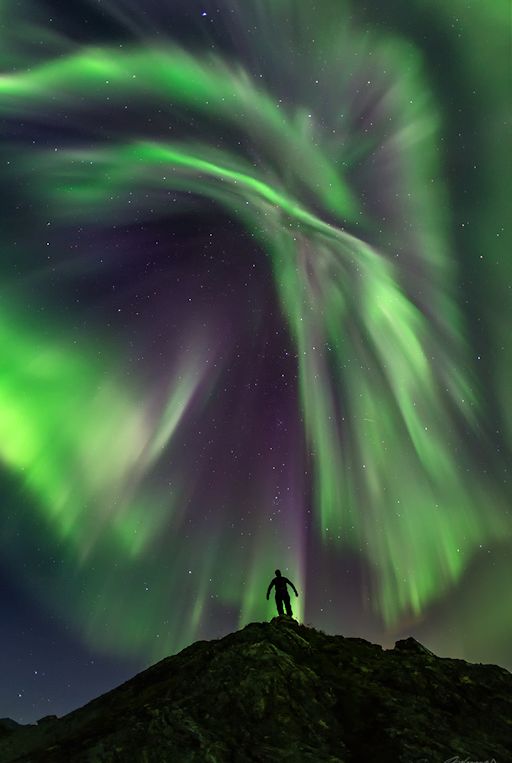
"I could not resist putting my self into the shot to show the scale of things," he says. "It looks out of proportion, but this is how it really was! The auroras were enormous."
During the peak of the storm, Northern Lights were seen in the USA as far south as New York, Wisconsin, and Washington State.
The storm is subsiding now, but it could flare up again as Earth passes through the wake of the CME. NOAA forecasters estimate a 70% chance of polar geomagnetic storms on Sept. 12th. Aurora alerts: text or voice
THE MORNING PLANET SHOW: Planets are gathering in the morning sky. Venus and Jupiter have recently emerged as morning "stars," rising in the east ahead of the sun, joining Mars in an array of lights that lets early risers view 1/3rd of the solar system at a glance. The display will continue--and improve--as autumn unfolds. This was the view on Sept. 10th:
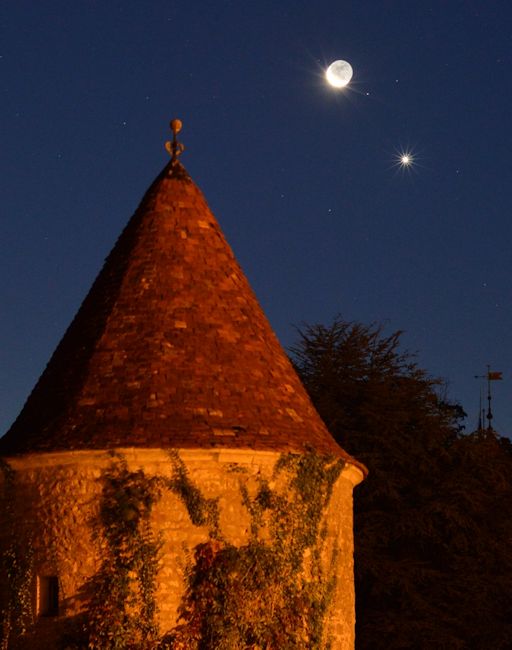
Jean-Baptiste Feldmann took the picture from Nuits-Saint-Georges, France, just before sunrise on Thursday. At the time, the crescent Moon was passing by Venus en route to Jupiter, adding its luster to that of the planets. "It was a beautiful view," says Feldmann.
More scenes like this are in the offing. On Oct. 8th the crescent Moon will have another close encounter with Venus (sky map), followed one day later by a near miss of Jupiter and Mars (sky map). Every morning thereafter, the planets will converge until Oct. 24th - Oct. 29th when they fit within a circle only 5o wide (sky maps: #1, #2, #3, #4, #5, #6). Typical binoculars can see a patch of sky about 6o or 7o degrees wide. So when the triangle of planets shrinks to 5o, they will fit together inside a binocular field of view. Imagine looking through the eyepiece and seeing three planets--all at once.


By the time October comes to an end, the planetary triangle will start breaking apart. But there are still two dates of special interest: Nov. 6th and 7th (sky maps: #1, #2). On those increasingly wintry mornings, the crescent Moon will swoop in among the dispersing planets for a loose but beautiful conjunction.


Look east before sunrise. There's a lot to see.
Realtime Space Weather Photo Gallery
WILDFIRE AT THE EDGE OF SPACE: On Sept. 6th, Spaceweather.com and the students of Earth to Sky Calculus launched a space weather balloon equipped with radiation sensors. It was a regular flight, part of their weekly program to monitor cosmic rays in the atmosphere. En route to the stratosphere, cameras on the payload looked back and observed an enormous wildfire. This is the view from 109,600 feet:

The massive plume of smoke, pictured right, is coming from the Rough Fire, an 86,000 acre inferno raging through King's Canyon National Park in central California. Smoke from the fire is choking much of the Sierra Nevada mountain range where our space weather balloons are launched.
We've been using balloons and Geiger tubes to monitor cosmic radiation for the past two years. This particular balloon flight attempted something new: using microbes to measure radiation. Five different strains of yeast were flown alongside conventional radiation sensors to calibrate the microbes' response to cosmic rays. This kind of experiment could lead to new and improved techniques for measuring the biological effectiveness of high-altitude radiation.
HEY THANKS! The students of Earth to Sky Calculus wish to thank Dr. Mark Casafrancisco, whose generous donation of $500 made this research flight possible. Here is his business card floating in the stratosphere:

"Sending my business card to space not only allows me to support your student research program, but also shows how proud I am of our out-of-this-world family of stellar staff and pediatric dentists at Monarch Pediatric Dental Centre in Vancouver, BC, Canada!" he says.
Readers, if you would like to sponsor a research flight and see your photo at the edge of space, please contact Dr. Tony Phillips to make arrangements.