PARTIAL SOLAR ECLIPSE: Today, Sept. 13th at approximately 0700 UT, the Moon passed in front of the sun, off-center, producing a partial eclipse visible from the southern reaches of Africa and parts of Antarctica. Photographers with images of this remote eclipse are encouraged to share them here.
THE SUN IS STUBBORNLY QUIET: Despite the emergence of a new and unstable sunspot (AR2414), the sun remains stubbornly quiet. There hasn't been a strong flare in weeks, and the sun's X-ray output is very low. NOAA forecasters estimate a scant 10% chance of M-class solar flares on Sept. 13th. Solar flare alerts: text or voice
MORE AURORAS IN THE OFFING: So far, September has been a great month for auroras. A series of solar wind streams, mixed with one or two minor CMEs, has buffeted Earth's magnetic field almost non-stop for the past two weeks. The resulting G1- to G3-class geomagnetic storms have caused displays like this:
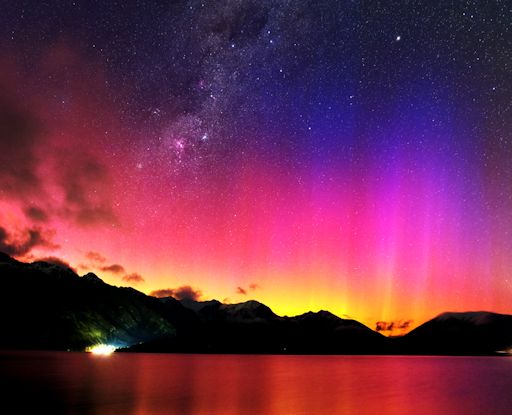
Minoru Yoneto took the picture on September 11th from Queenstown, New Zealand. "A big stream of solar wind gave us four lovely colors of Southern Lights," he says.
One reason for the recent spate of auroras is the coming change of seasons. For reasons that are not fully understood, auroras love equinoxes. At this time of year even gentle gusts of solar wind can spark a nice display of Northern or Southern Lights
Two gusts are on the way. NOAA forecasters expect streams of solar wind to reach Earth on Sept. 13th and Sept. 15th, sparking renewed displays of high-latitude auroras. Monitor the realtime photo gallery for updates. Aurora alerts: text or voice
EAST COAST GREEN FLASH: Last Monday, Sept. 7th, Spaceweather.com reader Don Koenigsberg woke up early to watch the sun rise from Atlantic City, NJ. He was vacationing on Labor Day. The holiday began with a flash of green:
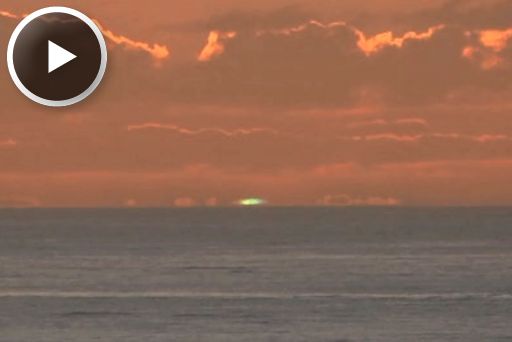
"It was a great way to begin the day," says Koenigsberg. "I thought the video was interesting because green flashes can be difficult to see on the East Coast due to less than ideal atmospheric conditions."
Indeed, says atmospheric optics expert Les Cowley, "flashes from the west coast are MUCH more common. Mock-mirage green flashes - the type most frequently photographed - need temperature inversions. These inversions are readily generated along the west coast by the combination of cold offshore ocean current and warm air from inland. Almost daily green flashes have sometimes been seen from San Francisco!"
Green flashes on the east coast tend to be of a different type: "the classical Omega flash," says Cowley. "This occurs when there is warm air immediately over the ocean and the air temperature gradient changes rapidly with height. For the flash to be visible the warm air layers must be below you. An 'Omega flash' is what Koenigsberg witnessed."
Mock-mirage flashes, Omega flashes, east coast flashes, west coast flashes: they are all beauties. As Jules Verne wrote in his 1882 novel "Le Rayon Vert" (The Green Ray), they display "a green which no artist could ever obtain on his palette, a green of which neither the varied tints of vegetation nor the shades of the most limpid sea could ever produce the like!" More of this special green may be found in the realtime photo gallery:
Realtime Space Weather Photo Gallery
WILDFIRE AT THE EDGE OF SPACE: On Sept. 6th, Spaceweather.com and the students of Earth to Sky Calculus launched a space weather balloon equipped with radiation sensors. It was a regular flight, part of their weekly program to monitor cosmic rays in the atmosphere. En route to the stratosphere, cameras on the payload looked back and observed an enormous wildfire. This is the view from 109,600 feet:

The massive plume of smoke, pictured right, is coming from the Rough Fire, an 86,000 acre inferno raging through King's Canyon National Park in central California. Smoke from the fire is choking much of the Sierra Nevada mountain range where our space weather balloons are launched.
We've been using balloons and Geiger tubes to monitor cosmic radiation for the past two years. This particular balloon flight attempted something new: using microbes to measure radiation. Five different strains of yeast were flown alongside conventional radiation sensors to calibrate the microbes' response to cosmic rays. This kind of experiment could lead to new and improved techniques for measuring the biological effectiveness of high-altitude radiation.
HEY THANKS! The students of Earth to Sky Calculus wish to thank Dr. Mark Casafrancisco, whose generous donation of $500 made this research flight possible. Here is his business card floating in the stratosphere:

"Sending my business card to space not only allows me to support your student research program, but also shows how proud I am of our out-of-this-world family of stellar staff and pediatric dentists at Monarch Pediatric Dental Centre in Vancouver, BC, Canada!" he says.
Readers, if you would like to sponsor a research flight and see your photo at the edge of space, please contact Dr. Tony Phillips to make arrangements.
Realtime Space Weather Photo Gallery