POSSIBLE CME IMPACT ON SEPT 22: Yesterday, Sept.20th, the magnetic canopy of sunspot AR2415 exploded, producing a long-duration M2-class solar flare (movie) and a bright CME (movie). According to NOAA forecast models, the CME might deliver a glancing blow to our planet's magnetic field on Sept. 22-23. High-latitude sky watchers should be alert for equinox auroras. Aurora alerts: text or voice

SPACE CORN FAILS TO APPETIZE: Regular readers of Spaceweather.com know that we have been flying simple life forms to the edge of space onboard helium balloons to test their response to space weather. Some fare better than others. Yeast, for instance, is incredibly tough. The microbes easily survive temperatures as low as -60 C and cosmic ray dose rates 100x Earth-normal. Corn, on the other hand, appears to be more fragile. In the spring of 2015, the students of Earth to Sky Calculus launched seed packets of corn and other vegetables to the stratosphere during geomagnetic storms. Bruce Binion bought some of these seeds as a gift for his father, a veteran farmer, who planted them alongside regular corn as an experiment. Here are the results:
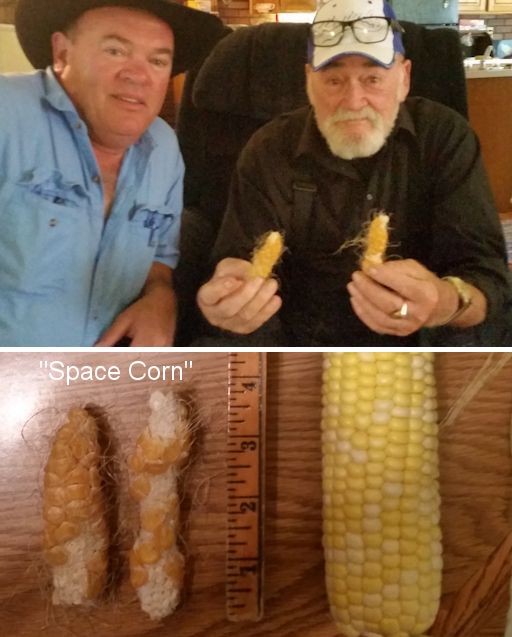
"I must say this experience has been quite fascinating," reports Binion. "Compared to regular corn, the 'space corn' stalks were quite short, tasseled out quite early, and the ears were stunted. As can be seen in the picture, above, Dad has a normal, good-eating ear from the same garden area shown for reference beside a couple of ears grown from your space seeds."
In summary, cosmic rays do not seem to agree with corn. Sorry, astronauts!
Many readers have purchased packets of space seeds as a fund raiser for the research of Earth to Sky Calculus. Later this week we'll report some findings from a batch of stratospheric chile peppers. Stay tuned.
Realtime Space Weather Photo Gallery
CME STRIKE SPARKS STRONG GEOMAGNETIC STORM: Arriving a full day earlier than expected, a CME hit Earth's magnetic field on Sept. 20th at approximately 0600 UT. The impact sparked a strong G3-class geomagnetic storm and bright auroras over high-latitude regions of North America and Asia. Darren White sends this picture from the shores of Jackson Lake in Wyoming's Grand Teton National Park:

"I reached the Park during the early morning hours of Sep 20th and immediately noticed a glow off to the north. It was the Aurora," says White. "This panoramic image shows Jackson Lake with the Milky Way, auroras and Mount Moran in the distance."
The storm is subsiding now, but it could flare up again as Earth passes through the wake of the CME. NOAA forecasters estimate a 50% chance of more geomagnetic storming on Sept. 21. Aurora alerts: text or voice