EQUINOX AURORA WATCH: For reasons researchers don't fully understand, auroras love equinoxes. At this time of year even a gentle gust of solar wind can spark a bright display. Tomorrow, Sept.23rd, is the northern autumnal equinox. Perfect timing: a CME is expected to deliver a glancing blow to Earth's magnetic field on Sept. 23rd. The impact will probably be weak, but on the first night of autumn, weak may be strong enough. High-latitude sky watchers should be alert for equinox auroras. Aurora alerts: text or voice
NOVAYA ZEMLYA EFFECT: January of 1597 was not a good time for the crew of Willem Barentsz's third expedition to the Arctic. While looking for the Northwest passage, their ship had became stuck in the thickening winter sea ice. They actually had to make camp on the ice and wait for the long polar night to end. On January 24, 1597, crew member Gerrit de Veer insisted he saw the sun above the horizon, two full weeks prior to its calculated return. The rest of the crew thought it was wishful thinking--but a few days later, they saw it too. This was the first recorded instance of the Novaya Zemlya Effect, a polar mirage which makes the sun appear to be "up" when it is technically "down."
Fast-forward to Sept. 20th, 2015. Two nights ago, spaceweather.com reader Mila Zinkova saw the Novaya Zemlya Effect from San Francisco:

"Long after Barentsz's voyages in the 16th century, Ernest Shackleton, Fridtjof Nansen and others described the same effect during their own polar expeditions," says Zinkova. "For example Ernest Shackleton described how the sun returned 9 days after its final setting on May 8 (Antarctic winter). In my situation, in California, the effect is never so strong. We're talking about minutes not days. Still it looked as if the sun just did not want to set. It set 5 minutes later than it was supposed to."
Zinkova sent her images to atmospheric optics expert Dr. Andy Young, and he explains: "This is basically the Novaya Zemlya effect -- although the refraction here isn't very large. The San Francisco images are similar to Nansen's drawing of a polar mirage of the sun."
More exotic pictures of the sun may be found in the realtime photo gallery:
Realtime Space Weather Photo Gallery
SPACE CORN FAILS TO APPETIZE: Regular readers of Spaceweather.com know that we have been flying simple life forms to the edge of space onboard helium balloons to test their response to space weather. Some fare better than others. Yeast, for instance, is incredibly tough. The microbes easily survive temperatures as low as -60 C and cosmic ray dose rates 100x Earth-normal. Corn, on the other hand, appears to be more fragile. In the spring of 2015, the students of Earth to Sky Calculus launched seed packets of corn and other vegetables to the stratosphere during geomagnetic storms. Bruce Binion bought some of these seeds as a gift for his father, a veteran farmer, who planted them alongside regular corn as an experiment. Here are the results:
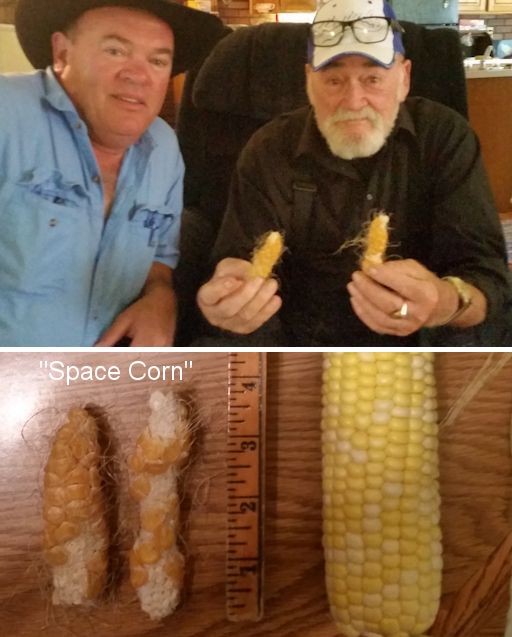
"I must say this experience has been quite fascinating," reports Binion. "Compared to regular corn, the 'space corn' stalks were quite short, tasseled out quite early, and the ears were stunted. As can be seen in the picture, above, Dad has a normal, good-eating ear from the same garden area shown for reference beside a couple of ears grown from your space seeds."
In summary, cosmic rays do not seem to agree with corn. Sorry, astronauts!
Many readers have purchased packets of space seeds as a fund raiser for the research of Earth to Sky Calculus. Later this week we'll report some findings from a batch of stratospheric chile peppers. Stay tuned.
Realtime Space Weather Photo Gallery