CHANCE OF STORMS: NOAA forecasters estimate a 40% chance of minor geomagnetic storms on Sept 25th when a solar wind stream is expected to reach Earth. High-latitude sky watchers should be alert for auroras mixed with the waxing light of this weekend's full moon. Aurora alerts: text or voice
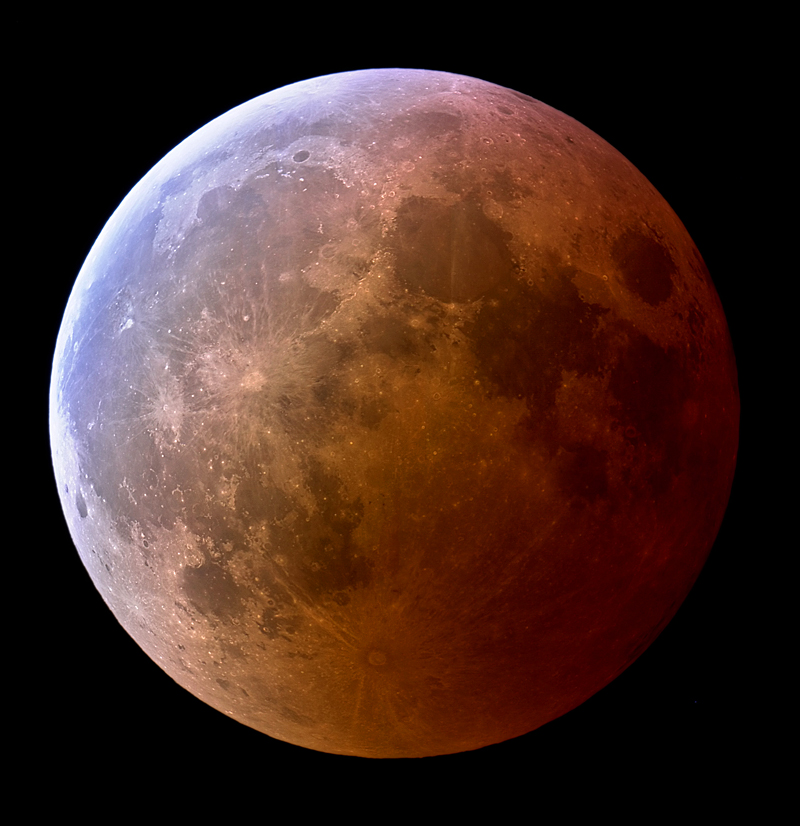
SUPERMOON ECLIPSE: This weekend's full Moon is a supermoon, the biggest and brightest full Moon of the year. And it is going to be eclipsed. On Sunday evening, Sept. 27th, the supermoon will pass through the shadow of Earth, turning the lunar disk a coppery shade of red. Click on the image, below, to view an animation of the eclipse and to find out when to look:

Sky watchers in the Americas, Europe, Africa, and eastern parts of Asia can see the event. The next total eclipse of the Moon won't come until January 31, 2018, so if you live in the eclipse zone, check it out.
What makes the eclipsed Moon turn red? A quick trip to the Moon provides the answer: Imagine yourself standing on a dusty lunar plain looking up at the sky. Overhead hangs Earth, nightside down, completely hiding the sun behind it. The eclipse is underway.
You might expect Earth seen in this way to be utterly dark, but it's not. The rim of the planet looks like it is on fire. As you scan your eye around Earth's circumference, you're seeing every sunrise and every sunset in the world, all of them, all at once. This incredible light beams into the heart of Earth's shadow, filling it with a coppery glow and transforming the Moon into a great red orb.
Red isn't the only color. There's also turquoise, shown here in a photo taken by Jens Hackman during an eclipse in March of 2007:
Its source is ozone. Atmospheric scientist Richard Keen of the University of Colorado explains: "During a lunar eclipse, most of the light illuminating the moon passes through the stratosphere where it is reddened by scattering. However, light passing through the upper stratosphere penetrates the ozone layer, which absorbs red light and actually makes the passing light ray bluer." This can be seen, he says, as a soft blue fringe around the red core of Earth's shadow.
To catch the turquoise on Sept. 27-28, he advises, "look during the first and last minutes of totality. The turquoise rim is best seen in binoculars or a small telescope."
Realtime Eclipse Photo Gallery
SPACE CORN FAILS TO APPETIZE: Regular readers of Spaceweather.com know that we have been flying simple life forms to the edge of space onboard helium balloons to test their response to space weather. Some fare better than others. Yeast, for instance, is incredibly tough. The microbes easily survive temperatures as low as -60 C and cosmic ray dose rates 100x Earth-normal. Corn, on the other hand, appears to be more fragile. In the spring of 2015, the students of Earth to Sky Calculus launched seed packets of corn and other vegetables to the stratosphere during geomagnetic storms. Bruce Binion bought some of these seeds as a gift for his father, a veteran farmer, who planted them alongside regular corn as an experiment. Here are the results:

"I must say this experience has been quite fascinating," reports Binion. "Compared to regular corn, the 'space corn' stalks were quite short, tasseled out quite early, and the ears were stunted. As can be seen in the picture, above, Dad has a normal, good-eating ear from the same garden area shown for reference beside a couple of ears grown from your space seeds."
In summary, cosmic rays do not seem to agree with corn. Sorry, astronauts!
Many readers have purchased packets of space seeds as a fund raiser for the research of Earth to Sky Calculus. Later this week we'll report some findings from a batch of stratospheric chile peppers. Stay tuned.
Realtime Space Weather Photo Gallery