SOLAR FLARE AND RADIO BLACKOUT: Today, Sept. 28th at 1458 UT, a strong M7-class solar flare erupted in the magnetic canopy of sunspot AR2422. Extreme UV radiation from the flare ionized the top of Earth's atmosphere and caused a brief low-frequency radio blackout over South America and the Atlantic ocean: blackout map. AR2422 has an unstable 'beta-gamma-delta' magnetic field that could erupt again at any moment. NOAA forecasters estimate a 40% chance of additional M-class solar flares and a 5% chance of X-flares during the next 24 hours. Solar flare alerts: text or voice

DARK LUNAR ECLIPSE (UPDATED): On Sunday night, Sept. 27th, the supermoon passed through the shadow of Earth, producing a total lunar eclipse visible from the Americas, Europe, Africa and parts of Asia. "It was one of the darkest lunar eclipses I have ever seen," reports Kevin R. Witman, who sends this picture from Cochranville, Pennsylvania:
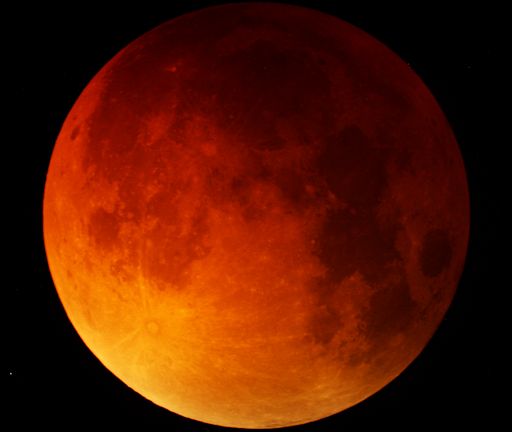
Other observers (see the gallery) also remarked on the darker hue of this lunar eclipse, compared to others in recent years. What caused the change? Atmospheric scientist Richard Keen of the University of Colorado offers one reason: "Supermoon eclipses should be a bit darker. Because of its closeness to Earth, a supermoon passes deeper into the shadow of our planet."
Working independently, Steve Albers of NOAA and Helio Vital of REA/Brazil have suggested another reason: aerosols in the atmosphere.
"Earth's stratosphere is no longer completely clean of volcanic ashes," says Vital. "In fact, lingering aerosols from the explosion of Calbuco, five months ago, may be to blame for that excessive darkening."
Calbuco is a volcano in Chile. After it erupted in April 2015, colorful sunsets were observed around the southern hemisphere for months. Recently, Albers has noted an increase in purple and yellow sunsets around his home town, Boulder CO, and elsewhere. These are telltale colors of volcanic exhaust.
"A thin veneer of aerosols from Calbuco may have now spread to the northern hemisphere," Albers says. "In addition, we could be seeing the effects of residual smoke from forest fires at high altitudes, or the general increase in sulfate pollution that has been documented on a global basis."
Richard Keen, who is a leading expert on volcanic aerosols and lunar eclipses, says "the Sept. 27th eclipse was about 0.5 magnitudes darker than expected for a clear stratosphere. A slight layer of aerosols in the upper troposphere/lower stratosphere might explain this. Also, the Moon passed through the southern part of Earth's shadow, so southern hemisphere aerosols (such as those produced by Calbuco) would have greater effect."
Keen says that he is still "crunching the numbers," and we may have more information soon...
Realtime Eclipse Photo Gallery
COSMIC RAYS IN THE ATMOSPHERE: Once a week, and sometimes more often, Spaceweather.com and the students of Earth to Sky Calculus fly "space weather balloons" to the stratosphere. These balloons are equipped with radiation sensors that detect cosmic rays, a form of space weather important to people on Earth. Cosmic rays can alter the chemistry of the upper atmosphere, seed clouds, spark exotic forms of lightning, and penetrate commercial airplanes. This last point is of special interest to the traveling public. Our measurements show that someone flying back and forth across the continental USA, just once, can absorb as much ionizing radiation as 2 to 5 dental X-rays. From now on we will be present the results of our regular weekly balloon flights in a new and dedicated section of our web site: Cosmic Rays in the Atmosphere. Scroll down to find it.
As an example of the kind of data you'll see, here is a radiation profile from our Sept. 23rd flight:

As the balloon ascends toward the stratosphere, radiation levels increase rapidly. By the time the payload reaches aviation altitudes (25,000 ft to 45,000 ft), dose rates are as much as 50 times higher than sea level. According to the Sept. 23rd measurements, a plane flying at 45,000 feet is exposed to 278 uRads/hr. At that rate, a passenger would absorb about one dental X-ray's worth of radiation in 5 hours.
Radiation levels peak at the entrance to the stratosphere in a broad region called the "Pfotzer Maximum." This peak is named after physicist George Pfotzer who discovered it using balloons and Geiger tubes in the 1930s. Radiation levels there are nearly 100x sea level.
The radiation sensors onboard our helium balloons detect X-rays and gamma-rays in the energy range 10 keV to 20 MeV. These energies span the range of medical X-ray machines and airport security scanners, so the data are of practical interest to humans.
Realtime Space Weather Photo Gallery
 |
|
| Cosmic Rays in the Atmosphere |
|
| Situation Report -- Sept. 28, 2015 | Stratospheric Radiation (+37o N) |
| Cosmic ray levels are elevated (+6% above the Space Age median). The trend is flat. Cosmic ray levels have increased +0% in the past month. | |
| Sept. 06: 414 uRad/hr | |
| Sept. 12: 409 uRad/hr | |
| Sept. 23: 412 uRad/hr | |
| Sept. 25: 416 uRad/hr |
Introduction: Once a week, and sometimes more often, Spaceweather.com and the students of Earth to Sky Calculus fly "space weather balloons" to the stratosphere. These balloons are equipped with radiation sensors that detect cosmic rays, a form of space weather important to people on Earth. Cosmic rays can alter the chemistry of the upper atmosphere, seed clouds, spark exotic forms of lightning, and penetrate commercial airplanes. This last point is of special interest to the traveling public. Our measurements show that someone flying back and forth across the continental USA, just once, can absorb as much ionizing radiation as 2 to 5 dental X-rays. From now on we will be present the results of our regular weekly balloon flights in this section of our web site. Here is the radiation profile from our Sept. 23rd flight:
The radiation sensors onboard our helium balloons detect X-rays and gamma-rays in the energy range 10 keV to 20 MeV. These energies span the range of medical X-ray machines and airport security scanners. In the plot, dose rates are given in microRads per hour (uRads/hr). According to the Sept. 23rd measurements, a plane flying at 45,000 feet is exposed to 278 uRads/hr. At that rate, a passenger would absorb about one dental X-ray's worth of radiation in 5 hours.
Stay tuned for improvements to this section in the days and weeks ahead as we develop a glossary and better plain language strategies for communicating this information. Suggestions are welcomed.