AFTER LAST WEEK'S "MASSIVE AURORAS," WHAT WILL THIS WEEK BRING? Arctic sky watchers are still buzzing about last week's 3-day outburst of Northern Lights. Many veteran observers ranked it as the brightest display they had seen in years. Photographer Ole Salomonsen was one of them. "On Friday, Oct. 9th, I was treated with perhaps the most massive aurora I have ever witnessed," he says. "They appeared right over my hometown, Tromsø, Norway."
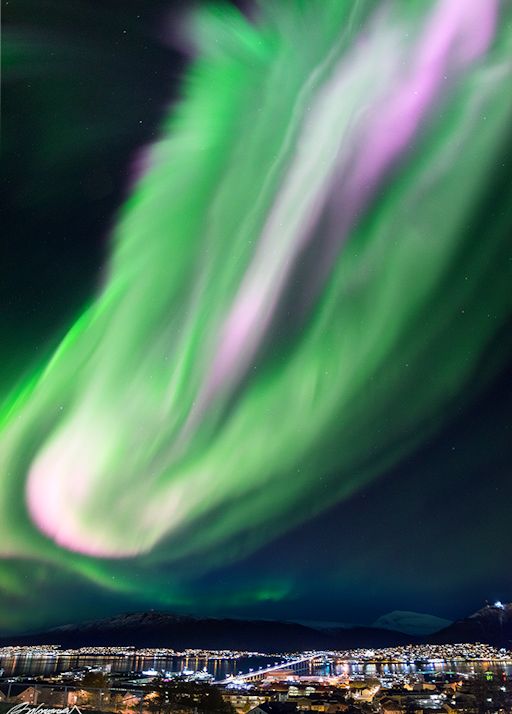
"The auroras were so strong that many of my shots were overexposed," he continues. "I had to continuously lower the exposure not to burn out the auroras. I have never in my life witnessed this amount of pink auroras, just MASSIVE!"
The display was caused by shock waves from a CIR (co-rotating interaction region), which hit Earth on Oct. 7th, followed by a stream of high-speed solar wind on Oct. 8th and 9th. Strong geomagnetic storms sparked Northern Lights as far south as Virginia, USA.
Another stream of solar wind is coming. ETA: Oct.12-13. Without another CIR to "pre-condition" Earth's magnetic field, however, this week's solar wind stream will probably have less effect. NOAA forecasters estimate a 60% chance of minor G1-class geomagnetic storms on Oct.12th. Aurora alerts: text or voice

MORNING SKY SHOW, IT'S ABOUT TO GET BETTER: All month long, "morning people" have been watching planets converge in the pre-dawn sky. Venus, Jupiter, and Mars are all visible in the east before sunrise. Pete Lawrence sends this picture from a beach in Selsey, West Sussex, UK

"This was the view at daybreak on Oct. 9th," says Lawrence. "Venus, Mars and Jupiter gathered together with the crescent Moon. What a great way to start the day!"
The view is about to get even better. For the rest of the month, the planets will draw closer and closer together until Oct. 24th - Oct. 29th when they fit within a circle only 5o wide (sky maps: #1, #2, #3, #4, #5, #6). Typical binoculars can see a patch of sky about 6o or 7o degrees wide. So when the triangle of planets shrinks to 5o, they will all fit inside a binoculars field of view. Imagine looking through the eyepiece and seeing three planets--all at once.


By the time October comes to an end, the planetary triangle will start breaking apart. But there are still two dates of special interest: Nov. 6th and 7th (sky maps: #1, #2). On those increasingly wintry mornings, the crescent Moon will swoop in among the dispersing planets for a loose but beautiful conjunction.


Look east before sunrise. There's a lot to see."
Realtime Space Weather Photo Gallery
Realtime Eclipse Photo Gallery
 |
|
| Cosmic Rays in the Atmosphere |
|
| Situation Report -- Oct. 8, 2015 | Stratospheric Radiation (+37o N) |
| Cosmic ray levels are elevated (+6.2% above the Space Age median). The trend is flat. Cosmic ray levels have increased +0% in the past month. | |
| Sept. 06: 414 uRad/hr | |
| Sept. 12: 409 uRad/hr | |
| Sept. 23: 412 uRad/hr | |
| Sept. 25: 416 uRad/hr | |
| Sept. 27: 413 uRad/hr |

Introduction: Once a week, and sometimes more often, Spaceweather.com and the students of Earth to Sky Calculus fly "space weather balloons" to the stratosphere. These balloons are equipped with radiation sensors that detect cosmic rays, a form of space weather important to people on Earth. Cosmic rays can alter the chemistry of the upper atmosphere, seed clouds, spark exotic forms of lightning, and penetrate commercial airplanes. This last point is of special interest to the traveling public. Our measurements show that someone flying back and forth across the continental USA, just once, can absorb as much ionizing radiation as 2 to 5 dental X-rays. From now on we will present the results of our regular weekly balloon flights in this section of our web site. Here is the radiation profile from our latest flight:

Radiation levels peak at the entrance to the stratosphere in a broad region called the "Pfotzer Maximum." This peak is named after physicist George Pfotzer who discovered it using balloons and Geiger tubes in the 1930s. Radiation levels there are nearly 100x sea level.
Note that the bottom of the Pfotzer Maximim is near 55,000 ft. This means that some high-flying aircraft are not far from the zone of maximum radiation. Indeed, according to the Sept. 27th measurements, a plane flying at 45,000 feet is exposed to 288 uRads/hr. At that rate, a passenger would absorb about one dental X-ray's worth of radiation in 5 hours.
The radiation sensors onboard our helium balloons detect X-rays and gamma-rays in the energy range 10 keV to 20 MeV. These energies span the range of medical X-ray machines and airport security scanners.
Stay tuned for improvements to this section in the days and weeks ahead as we develop a glossary and better plain language strategies for communicating this information. Suggestions are welcomed.