THE SOLAR FLARE THAT WOULDN'T END: Typical solar flares are finished in a matter of minutes. On Oct. 22nd, a solar flare in the magnetic canopy of sunspot AR2434 lasted for more than 3 hours. NASA's Solar Dynamics Observatory recorded the eruption:
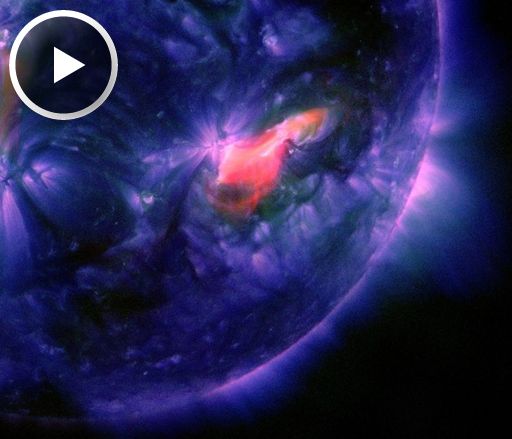
The peak X-ray intensity of the flare was relatively low. On the Richter Scale of Solar Flares it registered only C4.5. What the flare lacked in amplitude, however, it made up for in longevity. The hours-long blast was powerful and produced a bright CME, shown here billowing away from the sun's southwestern limb:

The CME is not heading directly for Earth. Nevertheless, it does have an Earth-directed component. NOAA forecast models suggest that the cloud will deliver a glancing blow to our planet's magnetic field on Oct. 25th. There is a 50% chance of G1-class geomagnetic storms when it arrives. Weekend auroras, anyone? Aurora alerts: text or voice
Realtime Space Weather Photo Gallery
SPACE WEATHER BALLOONING--LATEST RESULTS: Approximately once a week, Spaceweather.com and the students of Earth to Sky Calculus fly "space weather balloons" to the stratosphere over California. These balloons are equipped with radiation sensors that detect cosmic rays, a surprisingly "down to Earth" form of space weather. Cosmic rays can seed clouds, trigger lightning, and penetrate commercial airplanes. Our measurements show that someone flying back and forth across the continental USA, just once, can absorb as much ionizing radiation as 2 to 5 dental X-rays. Here is the data from our latest flight, Oct. 11th:

Radiation levels peak at the entrance to the stratosphere in a broad region called the "Pfotzer Maximum." This peak is named after physicist George Pfotzer who discovered it using balloons and Geiger tubes in the 1930s. Radiation levels there are more than 80x sea level.
Note that the bottom of the Pfotzer Maximim is near 55,000 ft. This means that some high-flying aircraft are not far from the zone of maximum radiation. Indeed, according to the Oct 11th measurements, a plane flying at 45,000 feet is exposed to 2.77 uSv/hr. At that rate, a passenger would absorb about one dental X-ray's worth of radiation in about 5 hours.
The radiation sensors onboard our helium balloons detect X-rays and gamma-rays in the energy range 10 keV to 20 MeV. These energies span the range of medical X-ray machines and airport security scanners.
Hey thanks! The cosmic ray research described above is 100% crowd-funded. Our Oct. 11th balloon flight was made possible by a generous donation of $500 from Spaceweather.com reader Vicki Brown. To say thanks, we flew Vicki's parents, Betty and Earl, to the edge of space:
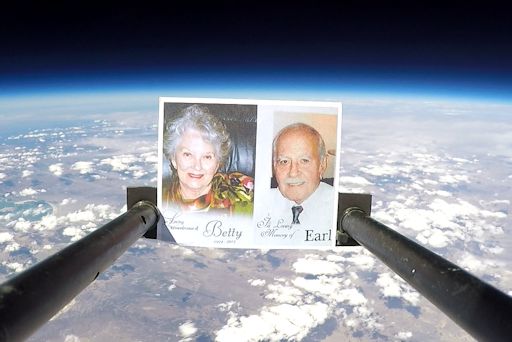
"I am so happy to help the young scientists, and it is cool to see my folks in the stratosphere!" says Vicki.
Readers, have you ever wanted to send a loved one to the stratosphere? You can make it happen by sponsoring a cosmic ray research flight. Contact Dr. Tony Phillips for details.