CME IMPACT: Arriving earlier than expected, a coronal mass ejection (CME) hit Earth's magnetic field on Oct. 24th at approximately 1900 UT. NASA's ACE spacecraft, located at the L1 point 1.5 million km upstream from Earth, detected the CME's leading edge about a half hour before it reached Earth:

As the plot shows, solar wind speeds abruptly jumped to more than 500 km/s as the CME passed by. G1-class geomagnetic storms are possible in the hours ahead as Earth moves into the CME's magnetized wake. Stay tuned for updates. Aurora alerts: text or voice

Update: The CME shockwave caused electrical currents to flow through the ground in the Lofoten islands of Norway. View the data.
MORNING PLANET SHOW: Set your alarm for dawn. Venus, Jupiter and Mars are gathering for a three-way close encounter in the early morning sky. Yesterday, Jeff Dai woke up early and photographed the convergence from Yading, China:
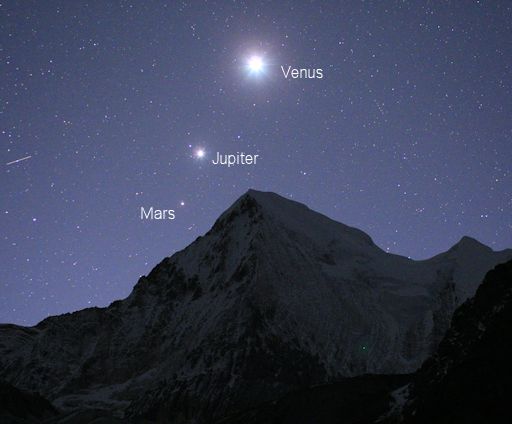
"At 6 am, Venus, Jupiter and Mars were rising just above the Xianuodukji peak at Yading national natural reserve in the province of Sichuan," says Dai. "The view was spectacular."
It's about to become even more spectacular. From Oct. 24th to Oct. 29th the converging planets will fit together inside a circle only 5o wide (sky maps: #1, #2, #3, #4, #5, #6). This means you can see all three planets at once using typical binoculars. Of course, you can also see the three planets with the naked eye. It is extra-cool, however, to frame the planets in a single binocular field of view. Wake up early and check it out.


Realtime Space Weather Photo Gallery
SPACE WEATHER BALLOONING--LATEST RESULTS: Approximately once a week, Spaceweather.com and the students of Earth to Sky Calculus fly "space weather balloons" to the stratosphere over California. These balloons are equipped with radiation sensors that detect cosmic rays, a surprisingly "down to Earth" form of space weather. Cosmic rays can seed clouds, trigger lightning, and penetrate commercial airplanes. Our measurements show that someone flying back and forth across the continental USA, just once, can absorb as much ionizing radiation as 2 to 5 dental X-rays. Here is the data from our latest flight, Oct. 11th:

Radiation levels peak at the entrance to the stratosphere in a broad region called the "Pfotzer Maximum." This peak is named after physicist George Pfotzer who discovered it using balloons and Geiger tubes in the 1930s. Radiation levels there are more than 80x sea level.
Note that the bottom of the Pfotzer Maximim is near 55,000 ft. This means that some high-flying aircraft are not far from the zone of maximum radiation. Indeed, according to the Oct 11th measurements, a plane flying at 45,000 feet is exposed to 2.77 uSv/hr. At that rate, a passenger would absorb about one dental X-ray's worth of radiation in about 5 hours.
The radiation sensors onboard our helium balloons detect X-rays and gamma-rays in the energy range 10 keV to 20 MeV. These energies span the range of medical X-ray machines and airport security scanners.
Hey thanks! The cosmic ray research described above is 100% crowd-funded. Our Oct. 11th balloon flight was made possible by a generous donation of $500 from Spaceweather.com reader Vicki Brown. To say thanks, we flew Vicki's parents, Betty and Earl, to the edge of space:
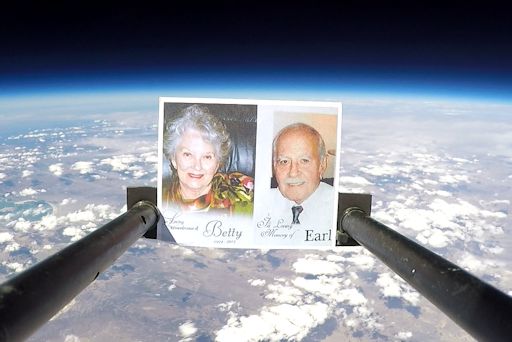
"I am so happy to help the young scientists, and it is cool to see my folks in the stratosphere!" says Vicki.
Readers, have you ever wanted to send a loved one to the stratosphere? You can make it happen by sponsoring a cosmic ray research flight. Contact Dr. Tony Phillips for details.